


Get a print-ready file that goes far beyond the web preview. Every digital image we sell comes from a high-resolution master in our stock database — usually 5,000 to 15,000 pixels wide — so you can print large, crop tightly, or reproduce fine detail with confidence.
No file leaves our studio untouched. A digital expert checks the colors against the original painting and corrects them if needed, then improves clarity and detail with professional retouching tools — always staying faithful to the artist's brushwork and style. The result is an image that looks like the painting, not like a filtered scan.
You approve before you're done: our expert sends the image by e-mail within 72 hours for your review. Not satisfied? Ask for improvements or corrections, or request a refund if the quality falls short.
This is the quality relied on by publishers, design studios, galleries and print shops.
Download a high-resolution file for personal display, printing, and creative projects. ( Switch to Print Buy Hand Made Painting)
When you choose WahooArt.com, you're not just getting an image - you're receiving a professionally enhanced digital artwork, crafted with precision and backed by a satisfaction guarantee. Here's everything that comes with your order, automatically:
Your high-resolution digital image file will be emailed to you within 72 hours of ordering - ready for immediate use.
Your artwork is professionally optimized using advanced AI tools and manual editing, ensuring maximum detail, clarity, and color accuracy.
Accidentally deleted or lost your file? No worries - we'll resend it to you anytime, free of charge.
Enjoy your artwork instantly with zero customs, duties, or delivery fees - digital downloads are always tax-free.
We ensure your digital image reflects the original colors as closely as possible using professional tools and color management.
If you're not satisfied with your digital image, we'll revise it or refund 100% within 100 days - no questions asked.
Not satisfied? Get a full refund within 100 days of receiving your digital file - no questions asked.
Buy 3 images, save 10% - Buy 5, save 15% - Buy 10+, save 20%. Great for creative projects, galleries, and agencies.
The painting Mrs. William Eppes by John Singleton Copley is a quintessential representation of the Neo-Classicism art movement. Created in 1769, this masterpiece measures 128 x 101 cm and is crafted in oil on canvas. As a professional expert in Art and salesman at WahooArt.com, I am thrilled to present an academic article about this stunning piece.
John Singleton Copley was an American artist who became famous for his historical and portrait paintings. His work Mrs. William Eppes is a testament to his skill in capturing the essence of his subjects. The painting features a woman in a pink dress with a blue ribbon around her neck, exuding elegance and refinement.
The Neo-Classicism style, characterized by its emphasis on simplicity, order, and reason, is evident in Mrs. William Eppes. The use of oil on canvas allows for a level of detail and texture that brings the subject to life. The background, featuring two trees, adds depth and context to the scene, suggesting that the portrait might have been painted outdoors or in an area with natural surroundings.
Beyond its aesthetic appeal, Mrs. William Eppes offers a window into the social values of colonial America. The subject's attire—the elegant pink dress and blue ribbon—signifies her status and refinement within Boston society. The carefully composed pose and serene expression convey an air of dignity and composure, reflecting the ideals of female virtue prevalent during that era. The landscape background subtly hints at the prosperity and stability enjoyed by families like the Eppeses, deeply rooted in colonial life. The painting evokes a sense of quiet grace and timeless beauty, inviting viewers to contemplate the lives and aspirations of those who shaped early American history.
As stated in the Discovering the Artworks of Kendal Museum, United Kingdom article, hand-made oil paintings reproductions of Mrs. William Eppes are a great way to experience the beauty of art in the comfort of your own home.
For more information on John Singleton Copley and his works, visit https://WahooArt.com or check out the Wikipedia page on John Singleton Copley.
In "Mrs.William Eppes" by John Singleton Copley, the Neo-Classicism movement meets the Early-Modern era.
Within John Singleton Copley's output, "Mrs.William Eppes" sits in the Neo-Classicism style, alongside the themes of classical art principles, european portraiture., early example of his portrait style, establishes colonial american subject matter., colonial society, status & elegance, femininity..
"Mrs.William Eppes" is executed in oil on canvas.

John Singleton Copley emerged from the commercial grit of colonial Boston, born in 1738. His upbringing was rooted in the maritime trade of Long Wharf, where his mother, Mary Singleton Copley, managed a shop. His father, Richard Copley, worked as a tobacco merchant. This environment provided more than just a social backdrop; it offered a direct view of the material textures and social hierarchies that would later define his visual language. He was not born into an artistic dynasty, but his proximity to the merchant class ensured he understood the value of the objects he would eventually paint.
His formal introduction to the craft came through his stepfather, Peter Pelham, an engraver and limner. While Pelham provided the initial technical foundation, Copley’s true development was a product of solitary, relentless labor. He was largely self-taught, bypassing the traditional European academy system in favor of a rigorous, self-imposed curriculum. He spent years meticulously copying engravings to master the mechanics of light and form. This disciplined, self-cultivated approach allowed him to bypass the limitations of his local surroundings and develop a technical precision that his predecessors in the colonies lacked.
By the 1760s, Copley had already secured his position as Boston’s premier portraitist. He did not merely paint faces; he manufactured the social identities of the colonial elite. His ability to translate material wealth into visual authority made him the preferred choice for the city's most influential figures. He understood that a portrait was a tool for projecting status, using textures and specific objects to signal a sitter's place in the social hierarchy.
His technical precision allowed him to move beyond simple likenesses. In his 1771 portrait of Mrs. Ezekiel Gondthwait (Elizabeth Lewis), the rendering of luxurious fabrics and refined posture communicates a specific sense of social standing. This was not accidental. Copley used every detail—from the gleam of silver to the drape of a sleeve—to calibrate the viewer's perception of his subjects. He turned the act of sitting for a portrait into a calculated performance of wealth and power.
The breadth of his clientele reflects the shifting landscape of colonial leadership. He captured the likeness of Paul Revere about 1768 and painted Samuel Adams in 1772. These were not just commissions; they were visual records of the men shaping the political future of the colonies. His work provided the visual vocabulary for a society in transition, documenting the very people who would soon define a new political order.
Copley’s aesthetic represents a calculated confluence of Rococo elegance and Enlightenment intellectualism. He did not merely replicate the decorative flourishes of his predecessors; he tempered them with a rigorous, Neo-Classical vision. This approach prioritized order, clarity, and moral virtue, qualities that resonated deeply within the colonial context. His work avoids the superficiality often found in purely decorative styles by grounding every composition in anatomical accuracy and psychological depth. He did not settle for a surface-level likeness. Instead, he used the sitter's posture and expression to reveal an underlying character, turning a simple portrait into a precise study of human identity.
The technical execution of his paintings relies on a sophisticated layering of translucent glazes. This method, combined with rapid brushwork, allowed him to achieve a high degree of realism in texture and light. He possessed a specific ability to render the material world—the heavy weight of fabric, the cold gleam of metal, and the subtle gradations of skin—with a precision that felt immediate. This technical proficiency ensured that his subjects appeared as physical presences rather than flat representations. By mastering the interplay of light and shadow, he sculpted figures that possessed a tangible volume and a sense of permanence.
Copley’s move to Europe was a calculated attempt to secure a foothold in the established artistic centers of the Old World. Long before his departure, his talent had already registered in London; he was elected a Fellow of the Society of Artists of Great Britain on September 3, 1766. This recognition provided the necessary momentum for his eventual relocation. In 1774, he left the Thirteen Colonies behind, traveling with his wife, Susanna Farnsworth Clarke, and their children. He settled in London that same year and never returned to America.
His time in Europe was marked by a deliberate pursuit of classical training. During the summer of 1774, he studied in Rome, a move intended to refine his command of composition and historical narrative. This period of study was not a mere excursion but a fundamental shift in his professional trajectory. By positioning himself in London, he sought to transition from a colonial portraitist to a painter of significant historical weight, testing his technical ability against the standards of the British art scene.
Copley’s output reveals a calculated shift from the social portraiture that secured his colonial standing toward the high-stakes arena of history painting. His early engagement with classical themes is evident in The Return of Neptune, painted about 1754. This work shows an early attempt to move beyond the mere likenesses of Boston's elite by utilizing the compositions of Old Masters. Even in his more personal depictions, such as The Copley Family in 1776, there is a clear intent to use the canvas to establish a specific social identity through carefully choreographed settings and objects.
The move to Europe prompted a more aggressive pursuit of historical narratives. He sought to tackle the most prestigious genre of the era, often choosing scenes of intense drama or political weight. Watson and the Shark, painted about 1778, demonstrates this drive toward dramatic tension. His most ambitious undertaking in this vein was The Death of Major Peirson, a work that attempted to capture the chaos of the Battle of Jersey. While some critics questioned the composition, the painting remains a significant attempt to translate modern conflict into the grand scale of historical art.
His later career in London saw him tackling complex political scenes, such as The Colapse of the Earl of Chatham in the House of Lords in 1779. This work moved away from the battlefield to the structured, high-tension environment of British governance. Through these varied subjects, Copley attempted to prove that a painter trained in the colonies could master the heavy, dramatic requirements of European historical tradition.
The final chapter of Copley’s life in London was marked by a decline in the professional momentum he had once enjoyed. His later years were less successful than his earlier period of prominence. Financial instability shadowed his final years, and he died heavily in debt. This fiscal struggle stands in sharp contrast to the social status his colonial portraits once helped define for the New England elite.
He died in London in 1815. His remains were interred at Croydon Minster in Croydon, Surrey. While his career ended under financial strain, his technical precision remains a fixed point in the study of 18th-century portraiture and historical composition.
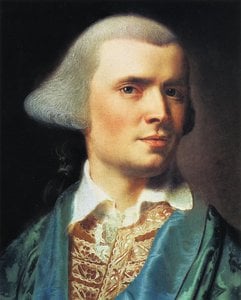
1738 - 1815 , United States
 Preview
 Send
Send Share
Share
 Details
 Guide
Guide

 Download
 Similars
 X-Ray
X-Ray Diaporama
 Q&A
Q&A
 Stats
Stats


 Read More


