

 Oil On CanvasWallArtNeo-Classical Style
 1764
1764 100.0 x 127.0 cm
 Art Institute of Chicago
Hand-painted oil on canvas in your size and frame, made to order by our artists. ( Switch to Print Switch to Digital Image)





























Pick from our preset sizes that match the artwork's original proportions.

You may enter your own dimensions to fit a specific frame or space. If your selected size does not match the original image's proportions, we will either crop the artwork or extend the painting with additional hand-painted elements. A digital mockup will be sent for your approval before production begins.
Please note that the on-screen preview does not reflect the actual cropping or extension. Only the mockup will accurately show the final composition.
While custom sizes are available, we recommend selecting a dimension from the predefined list to preserve the original proportions.
Worldwide Delivery () in 3/4 weeks instead of standard 5 weeks. (21 September). No compromise on quality.


Mrs.Daniel Hubbard (Mary Greene)
Reproduction Size
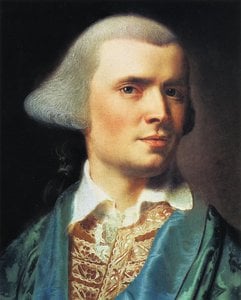
John Singleton Copley's "Mrs. Daniel Hubbard (Mary Greene)," painted in 1764, isn’t merely a likeness; it’s a carefully constructed tableau of wealth, status, and the burgeoning social consciousness of colonial America. This oil on canvas, currently residing within the hallowed halls of the Art Institute of Chicago, offers a rare glimpse into the domestic life of a prominent Boston family – specifically, Mary Greene Hubbard, a woman defined by her grace and quiet authority. Copley’s masterful handling of light and shadow, combined with his acute observation of human expression, elevates this portrait beyond simple representation, transforming it into a compelling study of character.
Copley's work firmly establishes itself within the Neo-Classical movement, a style deeply influenced by the ideals of ancient Greece and Rome. This is evident in the painting’s rigorously structured composition – the balanced arrangement of figures, the carefully considered use of space, and the emphasis on clear lines and forms. The palette is restrained yet sophisticated, dominated by muted tones of brown, grey, and cream, allowing Mary Greene's delicate complexion and the rich textures of her gown to take center stage. Copley’s technique showcases a remarkable ability to capture the subtle nuances of light reflecting off fabrics, creating an illusion of depth and volume that is characteristic of his best work. The use of loose brushstrokes, particularly in the rendering of drapery, adds a touch of dynamism and movement to what might otherwise have been a static portrait.
“Mrs. Daniel Hubbard” provides invaluable insight into the social fabric of 18th-century Boston. Mary Greene’s attire – a fashionable gown with a ruffled collar, indicative of her wealth and status – speaks volumes about the importance of appearances within this society. The inclusion of the book or sheet music suggests an educated and cultured woman, reflecting the growing emphasis on learning and refinement during the Enlightenment. The presence of the two figures in the background, partially obscured yet undeniably present, hints at a life beyond the domestic sphere, perhaps representing her husband’s business dealings or social connections. The very act of sitting, posed with such composure, embodies the ideals of female virtue and domesticity prevalent at the time – qualities highly valued within the upper echelons of colonial society.
Despite its formal presentation, “Mrs. Daniel Hubbard” possesses a remarkable emotional depth. Mary Greene’s gaze is direct and intelligent, conveying a sense of self-assuredness and quiet dignity. Her posture exudes composure, suggesting an inner strength that transcends mere social grace. Copley doesn't simply paint a face; he captures the essence of a woman – her intelligence, her poise, and perhaps even a hint of melancholy. This subtle emotionality is what elevates the portrait beyond a simple likeness, transforming it into a timeless representation of female character within a specific historical context. It’s a piece that invites contemplation, prompting us to consider not just *who* Mary Greene Hubbard was, but *what* she represented – a symbol of refinement, virtue, and the complexities of colonial life.
WahooArt offers exquisite, hand-painted reproductions of “Mrs. Daniel Hubbard (Mary Greene)” that faithfully capture Copley’s artistry and historical significance. Bring this captivating portrait into your home or office and experience the enduring beauty of a masterpiece from the Age of Enlightenment.

1738 - 1815 , United Kingdom

Discover the profound beauty of Academic Classicism. Explore the principles of order, anatomical precision, and the enduring legacy of Neoclassical masters through this expert guide to timeless elegance and technical perfection in fine art.

 Preview
 Send
Send Share
Share
 Details
 Guide
Guide

 Download
 Similars
 X-Ray
X-Ray Diaporama
 Stats
Stats Read More







 Glass option is only available in size under 110 CM


