


Museum-quality giclée or canvas print with fast production and flexible finish options. ( Buy Hand Made Painting Switch to Digital Image)





























Pick from our preset sizes that match the artwork's original proportions.

Type the width and the height you need, to fit your frame or your wall. A print can only be cut, never made bigger than the picture, so a size with a different shape loses a part of the image. We send you a digital mockup to approve before we print anything. The picture shown on this page does not show the real cut — only the mockup does.
Worldwide Delivery () in 2 weeks instead of standard 4/5 weeks. (11 November)
Atlantic Storm
Reproduction Size
The image of "Atlantic Storm" by John Singer Sargent can be downloaded from the artwork's Download page: a high-resolution digital image download.
"Atlantic Storm" is made in oil on canvas, in the Impressionism style.
Other names recorded for John Singer Sargent, creator of "Atlantic Storm", include John S. Sargent, Fitzwilliam Sargent.

Born in Florence, Italy, on January 12, 1856, John Singer Sargent entered a world shaped by the movement of his American expatriate parents, FitzWilliam and Mary Newbold Sargent. His father had previously served as an eye surgeon at the Wills Eye Hospital in Philadelphia between 1844 and 1854. This medical background provided a stable, if transient, foundation before the family’s life became defined by the cosmopolitan rhythms of Europe. The household was one of artistic inclination; his sister, Mary, was born in 1857, and his sister Emily would later establish herself as an accomplished painter. These early years were less about a fixed home and more about an immersion in the visual traditions of the continent.
His formal education followed a path through the major centers of European art, with training spanning Florence, Paris, and London. In Paris, he entered the studio of Carolus-Duran, a mentorship that would fundamentally shape his technical approach. This period of study was crucial in refining the observational skills that characterized his early development. Rather than following a rigid, academic path, his training was a sequence of direct engagement with the masters and the specific methods of the Parisian ateliers. He emerged from these studies with a technical facility that allowed him to move between the structured demands of portraiture and the more spontaneous requirements of his later studies.
In 1874, at the age of eighteen, Sargent entered the Paris studio of Carolus-Duran. This mentorship proved transformative, as the emphasis on direct painting helped hone his technical facility and ability to capture likenesses with speed. To further refine his skills, he enrolled at the École des Beaux-Arts, drawing from life models and casts to solidify his foundation. During these formative years, he began to establish himself among the city's elite, navigating the social and artistic hierarchies of the French capital.
His ascent toward becoming a premier society painter was interrupted by a sudden, sharp controversy. The unveiling of Madame X (Portrait of Madame Pierre Gautreau) at the 1884 Salon ignited a scandal that threatened his burgeoning career. The painting's daring depiction of the socialite—noted for her pale complexion and suggestive pose—was deemed provocative by Parisian society. Though he later repainted the strap of her gown, the social fallout was significant. This scandal eventually forced him to leave Paris and return to England, seeking a more receptive audience for his talents.
The scandal in Paris prompted a significant shift in his trajectory, leading him to relocate to London in 1886. This move proved to be a turning point, as he transitioned from a controversial figure to the leading portrait painter of his generation. He possessed a rare level of professional agency; he could choose which commissions to accept and set very high prices for his work. This autonomy allowed him to navigate the highest echelons of society with a sense of command that few of his contemporaries could match.
His subjects were the architects of their era, ranging from the social elite to prominent political figures. Among the numerous celebrities who sat for him was former president Theodore Roosevelt. He did not merely record a likeness; he captured the social dynamics and the opulence of the Edwardian era. His ability to document the character of his sitters made him a sought-after figure for those wishing to secure their place in the visual history of the age.
Sargent’s approach to the canvas was defined by a remarkable technical facility, particularly his ability to draw with a brush. Under the mentorship of Carolus-Duran, he embraced the principle of direct painting, a method that prioritized the immediate application of pigment over the safety of preliminary sketches. This training encouraged him to capture the essence of a subject through spontaneous, decisive movements. His method often involved blocking in tones in discreet, mosaic-like patches, which he would later blend together to achieve a sense of depth and form. Such a process allowed for a certain fluidity that became a hallmark of his hand.
His output reflected a dual nature in his artistic temperament. In his commissioned portraits, he adhered to the grand manner, meeting the expectations of his high-society sitters with elegance and poise. However, his informal studies and landscape paintings revealed a different inclination. In these works, he displayed a familiarity with Impressionism, utilizing loose brushwork to catch the shifting qualities of light. This versatility allowed him to move between the structured demands of formal portraiture and the more expressive, atmospheric requirements of plein-air painting.
Sargent’s output was vast, comprising roughly 900 oil paintings and more than 2,000 watercolors. His subject matter followed his movements across the globe, documenting landscapes and figures from Venice, the Tyrol, Corfu, and Capri to the Middle East, Spain, Montana, Maine, and Florida. This geographic breadth allowed him to move between the structured demands of high-society portraiture and the spontaneous requirements of plein-air studies. While his reputation was often tied to the elegance of his sitters, his sketches and charcoal drawings reveal a restless, observant eye that sought the essence of a moment rather than a mere likeness.
His ability to navigate different genres is evident in the contrast between his most famous subjects. Madame X remains a central piece of his early career, a work that defined his presence in the Parisian art scene. In contrast, his later interest in the natural world and more informal settings produced works like Carnation, Lily, Lily, Rose, a depiction of two young girls in an English garden. He also captured the energy of movement in El Jaleo, a portrayal of Spanish flamenco dancers. These works demonstrate a technical flexibility that allowed him to transition from the heavy, formal requirements of a commission to the light-filled atmosphere of a garden or a dance.
By the time of his death on April 15, 1925, the scope of Sargent's output had reached a vast scale, encompassing roughly 900 oil paintings and over 2,000 watercolors. His technical facility, particularly the ability to draw with a brush, left a mark on subsequent generations of artists. While much of his fame rested on the high-society commissions of the Edwardian era, his influence extended into the very mechanics of how light and atmosphere are rendered on canvas.
The understanding of his artistic range underwent a significant shift in the 1980s. The rediscovery of his previously overlooked male nudes provided a more complex view of his creative intentions, moving the conversation beyond the social circles of his portraiture. This expansion of his known oeuvre revealed a more nuanced artist, one whose interests were not confined to the glittering surfaces of the Gilded Age. His works continue to draw audiences across the globe, maintaining a presence in major institutions such as the Metropolitan Museum of Art and the Tate Gallery.

1856 - 1925 , Italy

Discover the breathtaking elegance of John Singer Sargent's masterpieces. From iconic Gilded Age portraits to impressionistic landscapes, explore the technical brilliance and timeless allure of this American master through our premium, hand-painted fine art reproductions.

Master the nuances of Impressionism vs. Post-Impressionism with our expert guide. Explore the revolutionary shift from Monet’s fleeting light to Van Gogh’s emotional depth. Discover how these iconic movements continue to inspire fine art collectors and modern interiors today.
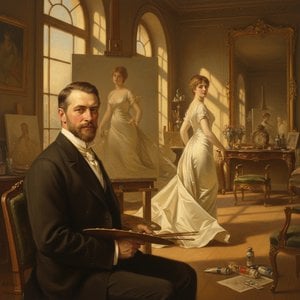
Discover the luminous mastery of John Singer Sargent. Explore an expert analysis of his legendary light, Gilded Age elegance, and technical brilliance, perfect for fine art enthusiasts seeking to bring timeless classical beauty into their modern collections.
 Preview
 Send
Send Share
Share
 Details
 Guide
Guide

 Download
 Similars
 X-Ray
X-Ray Diaporama
 Q&A
Q&A
 Stats
Stats

 Read More









 Glass option is only available in size under 110 CM


