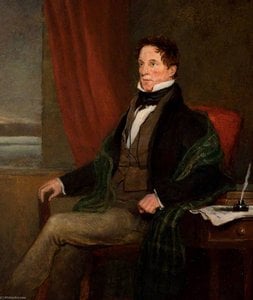
A Visionary of the Scottish Soul
Born in the historic heart of Edinburgh in 1805, John Irvine emerged as a profound voice within the Victorian era, capturing the quiet dignity of both the human spirit and the rugged Scottish landscape. His life and work unfolded during a period of immense transformation, as Scotland navigated the turbulent waters of the Industrial Revolution. Amidst this shifting social fabric, Irvine remained dedicated to an artistic pursuit rooted in emotional resonance and meticulous observation, creating a body of work that seamlessly blended the romanticism of his era with a burgeoning realist sensibility.
Irvine’s artistic foundation was deeply personal, forged in the studio of his father, William Irvine, a respected portrait painter. This early immersion in the craft provided him with more than just technical instruction; it instilled a lifelong reverence for the nuances of human character and the delicate complexities of texture and light. As he refined his talents at the Royal Scottish Academy in Edinburgh, he became part of a vibrant artistic dialogue, absorbing the prevailing currents of his time while developing a signature style that would eventually distinguish him as a master of his medium.
The Artistry of Light and Intimacy
To encounter an Irvine canvas is to step into a world defined by luminous color palettes and a gentle, atmospheric grace. His technique was characterized by soft, deliberate brushstrokes that lent a dreamlike quality to his subjects, particularly when he turned his gaze toward the domestic sphere. In his portraits and interior scenes, Irvine possessed a remarkable ability to render the tactile reality of fabrics—the sheen of silk, the weight of velvet—while simultaneously capturing the ephemeral essence of a subject's personality. His work often focused on the sanctity of the home, presenting idealized yet deeply human scenes of families engaged in the quiet rhythms of everyday life.
Beyond the intimate confines of the parlor, Irvine found immense inspiration in the expansive grandeur of the Highland Scotland landscapes. In these works, he moved away from the detailed textures of portraiture toward a more atmospheric approach, utilizing muted hues to evoke the mist-laden valleys and tranquil vistas of his homeland. His landscapes are not merely topographical records but emotional journeys, conveying a sense of peace and timelessness that resonated deeply with the Victorian appreciation for nature's sublime beauty.
Legacy and Historical Significance
The breadth of Irvine’s contribution to Scottish art lies in his ability to bridge the gap between different artistic movements. By weaving together the emotional depth of Romanticism with the precise, observational truth of Realism, he created a visual language that felt both timeless and contemporary to his era. His portraits of prominent Scottish lineages—including the Fergusons, Simpsons, and Gordons—serve as vital historical documents, preserving the likeness and social fabric of 19th-century Scotland.
Throughout his decades-long career, Irvine’s dedication to portraying the dignity of the human experience left an indelible mark on the Scottish art scene. His ability to find the extraordinary within the ordinary—whether in a flickering candle in a darkened room or the sweeping light across a mountain range—ensures his place as a significant figure in the history of British portraiture and landscape painting. His work remains a poignant testament to a period of profound change, captured through the eyes of an artist who found beauty in both the intimate and the infinite.


 Preview
 Send
Send Share
Share
 Details
 Guide
Guide

 Download
 Similars
 X-Ray
X-Ray Diaporama
 Q&A
Q&A
 Stats
Stats


 Read More
 Switch to Print





































 Glass option is only available in size under 110 CM