x


 1935
1935 51.0 x 64.0 cm
 Herbert Art Gallery - Museum
Hand-painted oil on canvas in your size and frame, made to order by our artists. ( Buy Print Buy Image)
Pick from our preset sizes that match the artwork's original proportions.

You may enter your own dimensions to fit a specific frame or space. If your selected size does not match the original image's proportions, we will either crop the artwork or extend the painting with additional hand-painted elements. A digital mockup will be sent for your approval before production begins.
Please note that the on-screen preview does not reflect the actual cropping or extension. Only the mockup will accurately show the final composition.
While custom sizes are available, we recommend selecting a dimension from the predefined list to preserve the original proportions.
Worldwide Delivery () in 3/4 weeks instead of standard 5 weeks. (28 August). No compromise on quality.


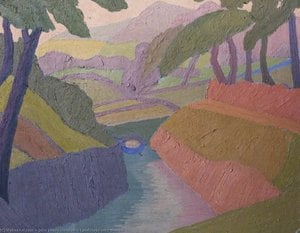
Farmstead and Trees
Reproduction Size

The work of John Henry Norman, a largely unsung figure of the early 20th-century American art scene, reveals a quiet mastery of capturing the essence of rural life and the subtle beauty of the natural world. Born in 1896 in what would later become part of Oklahoma, Norman’s artistic journey began amidst the vast landscapes of the American West, an environment that profoundly shaped his aesthetic sensibilities. While he never achieved widespread fame during his lifetime—a fact often obscured by the prominence of contemporaries like Rockwell—his paintings offer a poignant and enduring reflection on the changing face of America and its deep-rooted connection to the land.
Norman’s early life was marked by movement, reflecting the transient nature of frontier communities. He spent his formative years traveling with his family, absorbing diverse regional influences that would later inform his artistic style. This itinerant upbringing instilled in him a deep appreciation for the varied textures and colors of the American landscape, from the rolling hills of Oklahoma to the rugged mountains of Colorado. Largely self-taught, he developed a distinctive approach rooted in direct observation and an intimate engagement with his subjects. His early works demonstrate a clear debt to the traditions of tonal realism, reminiscent of masters like George Caleb Bingham, yet they quickly evolved into a style that was uniquely his own.
A pivotal moment in Norman’s artistic development occurred during his time in Montana in the 1920s. The stark beauty and dramatic light of the Big Sky Country ignited a passion for capturing winter scenes—snow-covered farms, frozen rivers, and solitary figures bundled against the cold. These paintings, characterized by their muted palette and atmospheric depth, became a hallmark of his oeuvre. He skillfully employed a limited range of colors—primarily blues, grays, whites, and browns—to evoke the biting chill and the profound stillness of a winter morning.
His technical prowess is perhaps most evident in works such as Landscape with Stream, created in 1930. In this piece, Norman utilizes soft brushstrokes and a delicate interplay of light and shadow to create a sense of tranquility. The composition, featuring a gentle stream winding through mountains and trees, draws the viewer into a peaceful, immersive experience. Through his ability to manipulate light, he transformed simple natural elements into profound studies of serenity and scale.
Throughout his career, Norman remained dedicated to the depiction of the pastoral and the seasonal. His repertoire included diverse subjects that celebrated the quiet dignity of the American landscape:
Though he passed away around 1980, Norman's historical significance lies in his ability to document a vanishing era of American life with sincerity and grace. His paintings serve as more than mere landscapes; they are emotional archives of a period defined by the intersection of rugged frontier spirit and the quietude of settled rural existence. For the modern observer, his work remains a window into a timeless, tranquil world, preserved through the careful application of oil and canvas.

1896 - 1980


Stay updated with the latest art news, exclusive offers, and decoration ideas.
Tell us about your project and our art experts will provide you with 3 personalized art suggestions.
Let Us Curate 3 Options Just for You - Free!

 Preview
 Send
Send Share
Share
 Details

 Download
 Similars
 X-Ray
X-Ray Diaporama
 Read More




































 Glass option is only available in size under 110 CM