Museum-quality giclée or canvas print with fast production and flexible finish options. ( Buy Hand Made Painting Switch to Digital Image)





























Pick from our preset sizes that match the artwork's original proportions.

You may enter your own dimensions to fit a specific frame or space. If your selected size does not match the original image's proportions, we will either crop the artwork or extend the image with a mirrored or solid-fill edge. A digital mockup will be sent for your approval before production begins.
Please note that the on-screen preview does not reflect the actual cropping or extension. Only the mockup will accurately show the final composition.
While custom sizes are available, we recommend selecting a dimension from the predefined list to preserve the original proportions.
Worldwide Delivery () in 2 weeks instead of standard 4/5 weeks. (14 October)
View on the Stour
Reproduction Size
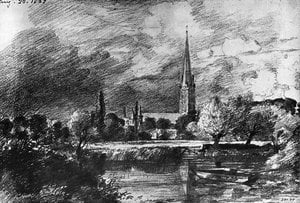
John Constable's “View on the Stour” is more than just a landscape; it’s an intimate portrait of a cherished place and a pivotal moment in the evolution of British painting. Executed around 1822, this work encapsulates the artist’s lifelong dedication to capturing the beauty and emotional resonance of the Suffolk countryside – specifically, the area surrounding his home known today as “Constable Country.” The scene unfolds with a gentle tranquility, inviting the viewer into a world where the river Stour meanders through lush meadows, framed by mature trees that stand as silent witnesses to the passage of time. It’s a composition built on observation and affection, a deliberate departure from the grand historical narratives favored by many of his contemporaries.
Constable emerged during a period of significant artistic transition, bridging the gap between the Neoclassical tradition and the burgeoning Romantic movement. While he received formal training at the Royal Academy, he found its emphasis on idealized forms and classical compositions restrictive. Instead, he sought inspiration in the works of 17th-century Dutch masters like Jacob van Ruisdael and Claude Lorrain, admiring their ability to convey atmosphere and light with remarkable sensitivity. However, Constable wasn’t simply imitating these artists; he was forging his own path, grounding his landscapes in direct observation and personal experience. “View on the Stour” exemplifies this approach – it's not a picturesque fantasy but a faithful rendering of a specific place, imbued with the artist’s deep emotional connection to the land. The subtle interplay of light and shadow across the water, the delicate rendering of foliage, and the inclusion of everyday figures engaged in simple activities all contribute to a sense of authenticity and immediacy.
Constable’s technique was revolutionary for its time. He rejected the highly finished, polished surfaces favored by many academic painters, opting instead for a more painterly approach characterized by loose brushwork and visible texture. In “View on the Stour,” this is evident in the way he renders the clouds – not as solid forms but as shifting masses of light and air. This technique wasn’t merely stylistic; it was integral to his goal of capturing the fleeting effects of weather and atmosphere. He often worked on paintings over extended periods, returning to them repeatedly to refine details and capture subtle changes in light. The result is a painting that feels alive, breathing with the same energy as the natural world it depicts. The composition itself is carefully balanced, drawing the eye through the scene along the winding river, while the strategically placed trees create depth and frame the view.
“View on the Stour” wasn’t an immediate success upon its exhibition at the Royal Academy in 1822. Critics were initially puzzled by Constable's focus on seemingly mundane subjects, accustomed as they were to more grandiose themes. However, his work gradually gained recognition, influencing a generation of artists both in England and abroad. The painting’s impact extended beyond the art world, contributing to a growing appreciation for the beauty of the English countryside and inspiring a sense of national identity. Today, “View on the Stour” is celebrated as a masterpiece of Romantic landscape painting, a testament to Constable's skill, vision, and unwavering commitment to capturing the essence of nature. A reproduction of this work brings not only a beautiful image into a space but also a piece of art history—a window into a world where tranquility reigns and the beauty of the natural world is celebrated with profound sincerity.
Artworks similar to "View on the Stour" by John Constable are gathered on the artwork's Similars page.
The copyright status of "View on the Stour" - in the public domain - its copyright has expired - follows from the artist's death in 1837.
In terms of perceived brightness, "View on the Stour" by John Constable is bright.
The color analysis of "View on the Stour" by John Constable records a bold contrast and a unified palette harmony.
"View on the Stour" by John Constable can be previewed on your own wall with the artwork's AR Preview page, using augmented reality on a compatible device.
The subjects of "View on the Stour" are landscape, river, nature, england, pastoral, trees, countryside, tranquility.
The diaporama of "View on the Stour" can be watched on the artwork's Diaporama page.
The color that stands out most in "View on the Stour" is phthalo green (#222418). The dominant color is useful when matching an artwork to an interior.


1776 - 1837 , United Kingdom

Explore the profound beauty of American Romanticism. Discover how the Hudson River School captured the wild frontier through masterful landscapes, exploring the legacy of legends like Thomas Cole and Asher Durand in this deep dive into art history.

Explore the profound beauty of American art history. From the Hudson River School to iconic landscapes, discover a curated journey through the masterpieces that defined a nation's spirit and the enduring legacy of American Romanticism.

Explore the profound legacy of John Constable. Discover how his mastery of light, atmosphere, and the English landscape redefined Romanticism through timeless, museum-quality oil reproductions for discerning collectors.

 Preview
 Send
Send Share
Share
 Details
 Guide
Guide

 Download
 Similars
 X-Ray
X-Ray Diaporama
 Stats
Stats
 Read More









 Glass option is only available in size under 110 CM