Museum-quality giclée or canvas print with fast production and flexible finish options. ( Buy Hand Made Painting Switch to Digital Image)





























Pick from our preset sizes that match the artwork's original proportions.

Type the width and the height you need, to fit your frame or your wall. A print can only be cut, never made bigger than the picture, so a size with a different shape loses a part of the image. We send you a digital mockup to approve before we print anything. The picture shown on this page does not show the real cut — only the mockup does.
Worldwide Delivery () in 2 weeks instead of standard 4/5 weeks. (21 November)
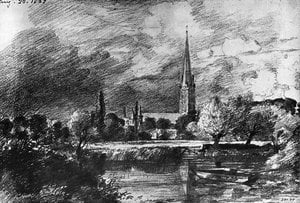
Dedham Lock and Mill1
Reproduction Size
"Dedham Lock and Mill1" is executed in acrylic on canvas.
"Dedham Lock and Mill1" by John Constable belongs to the Romanticism movement. This movement provides the stylistic context of the work.
"Dedham Lock and Mill1" was created by John Constable in the Romanticism style. Artist and movement identify the work's tradition.

John Constable was born in 1776 in the village of East Bergholt, Suffolk. He was the second son of Golding and Ann (Watts) Constable. His father was a prosperous corn and coal merchant who owned Flatford Mill. This connection to the river and the local trade meant that the rhythms of the water and the movement of goods were part of the household's daily life. About 1792, he began working in the family business, learning the practicalities of the corn trade before his path shifted toward the canvas.
His training began in earnest when he entered the Royal Academy Schools as a probationer in 1799. He spent his early years studying anatomy and copying the works of old masters to understand the structure of the world. This formal education provided a foundation for his later observations of the landscape. He moved between the quiet life of a merchant's son and the disciplined study of drawing and painting, eventually finding his way to London to pursue art as a vocation.
The landscape of his childhood remained a constant presence. Born in East Bergholt, United Kingdom, he grew up where the river shaped the daily rhythm. His father, a corn merchant, held the tenancy of mills along the River Stour and owned land within Dedham Vale. This connection to the water and the soil was not merely a matter of business; it was a lifelong attachment. He held a deep nostalgia for the Suffolk villages of East Bergholt, Dedham, Stratford St Mary, and Langham. Even when he moved away, the sight of a specific meadow or the way light hit a particular bank of the Stour stayed with him.
Life eventually pulled him toward the city. He lived in Bloomsbury, London, moving to Keppel Street in 1817 and later to Charlotte Street in 1822. These urban streets were a far cry from the riverbanks. He also spent time in Staffordshire, Derbyshire, the Lake District, and Brighton. Despite these travels, the familiar contours of the Stour Valley remained his primary reference. He looked at the world through the lens of the places he knew best, finding a sense of belonging in the damp earth and the shifting clouds of his home region.
The path toward a professional career often relies on the right introductions. For Constable, this came through George Beaumont, a collector who opened doors to a different way of seeing. Through Beaumont, he was introduced to the works of Claude Lorrain, whose influence helped shape his understanding of landscape. These early connections provided a foundation as he moved from the family corn business toward the formal study of art. In 1805, he took on a specific commission to paint an altarpiece for the church at Brantham.
His standing within the academic community grew steadily over the decades. He was elected an Associate of the Royal Academy in 1819, a step that marked his increasing recognition among his peers. By 1829, at the age of 52, he reached the rank of Royal Academician. This progression reflected a career built on a persistent, quiet observation of the world around him, moving from local commissions to a recognized place within the institutional structure of British art.
He did not rely on the theatricality of bravura to make a point. Instead, he sought a truthful representation of the natural world. This required a slow, methodical process of observation. He often worked outdoors, using plein air sketching to catch the way light interacts with the landscape. To build his larger compositions, he relied on a foundation of oil sketches, graphite drawings, and watercolour studies. These preliminary layers allowed him to work out the complexities of a scene before committing to a final canvas.
His brushwork carries a physical weight. He used thick impasto to build up texture, a method that gives the surface a sense of movement and life. This tactile approach helped him capture the specific way light and atmosphere shift across a field or a river. He referred to this study of light and shadow as the 'chiaroscuro of nature.' It was a way to record the actual, changing conditions of the sky and the water rather than an idealized version of them.
The river and the sky occupy much of his focus. In 1821, he produced The Hay Wain, a scene of the River Stour that has become his most recognized work. He often worked with large-scale formats to capture the movement of the air and water. This led to a series of six-foot canvases, such as The Leaping Horse (1825), where he used full-size preparatory oil sketches to coordinate the light and the composition. These large works allowed him to work out the details of the landscape before the final application of paint.
His interest in the local landscape extended to the estates and the structures within them. In 1816, he painted Wivenhoe Park, capturing the rural harmony of the Essex countryside. He also turned his attention to the interplay of light and architecture, as seen in Salisbury Cathedral from the Bishop's Grounds, painted in 1823. His ability to translate the atmosphere of a specific place was often reflected in the way he handled the weight of the clouds and the texture of the earth.
Some of his paintings achieved significant value long after they were finished. The Lock (1824) was sold at Christie's in 2012 for £22,441,250. His output included various other studies and finished works:
The brushwork of the Stour Valley was shaped by the quiet presence of several masters. The works of Claude Lorrain and Jacob van Ruisdael offered a way of seeing that moved away from the theatrical. He also looked toward the compositions of Thomas Gainsborough and the textures of Peter Paul Rubens. These influences helped him move past the rigid, academic rules of the Royal Academy. He sought a truth found in the dampness of the air and the way light hits a river, rather than in the grand, mythological scenes favored by his contemporaries.
His path often ran alongside JMW Turner. The two were contemporaries, and their rivalry flared during the exhibitions at the Royal Academy. While one looked toward the dramatic and the sublime, the other remained tethered to the familiar, local landscapes of his youth. This focus on the direct observation of nature eventually reached across the channel. His approach to light and atmosphere left a mark on the Barbizon School in France, where painters sought a similar connection to the natural world.
Personal connections also guided his movements. He was close with John Fisher, the nephew of the Bishop of Salisbury, who invited him to stay in the area. These friendships provided more than just social ties; they offered access to the specific landscapes that he would study and paint for years. Through these people and these places, his work became a record of a specific, lived reality.
The years following his marriage to Maria Bicknell in 1816 were marked by a shifting sense of place. While his work remained tied to the river and the fields of his youth, his life moved toward the city. By 1827, he had settled permanently in Hampstead, London. This period was shadowed by Maria’s declining health. She died of tuberculosis in 1828, an event that left a heavy mark on his life. He continued to paint, often finding solace in the changing light of the landscapes he had studied for decades.
His final years were spent in Bloomsbury, London. He remained dedicated to his practice, working through the complexities of his personal life and the physical demands of his medium. On March 31, 1837, he died in Bloomsbury. He was buried in the churchyard of St John's, Hampstead, a place that had become his home in his later years.
By turning his gaze toward the commonalities of the English countryside, he changed how the landscape was perceived. He moved away from the theatrical, idealized scenes favored by the academies, choosing instead to find weight in the ordinary. A hay wain or a simple farm building became subjects worthy of careful study. This shift helped move the focus of painting from grand mythological narratives toward a truthful representation of the natural world. He showed that a landscape could carry a deep sense of personal feeling, turning a view of a river or a meadow into a way to express internal moods.
His habit of working outdoors to capture the way light hits the clouds and the moisture in the air left a mark on those who followed. This commitment to direct observation and the study of atmospheric effects anticipated many of the concerns held by later Impressionist painters. His influence crossed the channel to France, where his approach resonated with the Barbizon School. These artists shared his interest in painting from life and observing the immediate, changing qualities of nature. His work remains a link to a way of seeing that prioritizes the actual texture of the earth and the shifting light of the sky.
Tracing his presence across different collections reveals how his views of the English countryside have been gathered over time. The Yale Center for British Art in New Haven holds 25 of his works, including a study of a landscape near Dedham from about 1802. In London, his presence is felt across several institutions. The Victoria and Albert Museum keeps 6 works, such as a scene of boat-building near Flatford Mill. The National Gallery holds 5 works, including the large canvas of The Hay Wain from 1821. The Tate Gallery maintains 4 works, including a detail of Flatford Mill from 1817.
His reach extends beyond the British Isles to the continent. The Louvre in Paris holds 2 works, including a depiction of Helmingham Dell. These pieces show the different ways he captured light and atmosphere, from the heavy clouds over the Stour to the quiet corners of a village. Seeing them in these various settings allows for a closer look at how he used thick layers of paint to build up texture on the canvas.

1776 - 1837 , United Kingdom
Journey through the sublime beauty of Romantic landscape paintings. Explore 10 iconic masterpieces, from Caspar David Friedrich to dramatic nature scenes, perfect for museum-quality decor. Discover the stories and techniques behind these timeless works on WahooArt.com.

Explore 25 iconic works from Turner to Hogarth at Yale Center for British Art. Discover every masterpiece on WahooArt.com.

Journey through the sublime beauty of Romantic landscape painting. Explore 10 iconic masterpieces by legends like Friedrich and Turner that capture nature's raw emotion. Find museum-quality art reproductions for your decor. Discover all masterpieces on WahooArt.com.

Explore the profound legacy of John Constable. Discover how his mastery of light, atmosphere, and the English landscape redefined Romanticism through timeless, museum-quality oil reproductions for discerning collectors.

Immerse yourself in the soulful landscapes of John Constable. Explore our curated list of 25 iconic masterpieces, from atmospheric skies to the beauty of Dedham Vale. Find inspiration for museum-quality art reproductions and decor. Discover all masterpieces on WahooArt.com.
 Preview
 Send
Send Share
Share
 Details
 Guide
Guide

 Download
 Similars
 X-Ray
X-Ray Diaporama
 Q&A
Q&A
 Stats
Stats

 Read More









 Glass option is only available in size under 110 CM