Hand-painted oil on canvas in your size and frame, made to order by our artists. ( Switch to Print Switch to Digital Image)





























Pick from our preset sizes that match the artwork's original proportions.

You may enter your own dimensions to fit a specific frame or space. If your selected size does not match the original image's proportions, we will either crop the artwork or extend the painting with additional hand-painted elements. A digital mockup will be sent for your approval before production begins.
Please note that the on-screen preview does not reflect the actual cropping or extension. Only the mockup will accurately show the final composition.
While custom sizes are available, we recommend selecting a dimension from the predefined list to preserve the original proportions.
Worldwide Delivery () in 3/4 weeks instead of standard 5 weeks. (13 October). No compromise on quality.
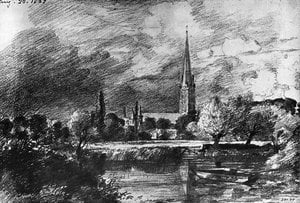
A Barge below Flatford Lock
Reproduction Size
The medium of "A Barge below Flatford Lock" by John Constable is oil on canvas. Reproductions aim to render the appearance of this technique.
Within John Constable's career, "A Barge below Flatford Lock" falls in the Early Maturity. The phase helps compare it with the artist's other works.
The Similars page of "A Barge below Flatford Lock" by John Constable presents related artworks.
"A Barge below Flatford Lock" belongs to the Romanticism movement, and its creator worked in the 19th-Century era.
"A Barge below Flatford Lock" by John Constable can be viewed as a slideshow on the artwork's Diaporama page.
"A Barge below Flatford Lock" by John Constable can be downloaded from the artwork's Download page, as a high-resolution digital image download.
"A Barge below Flatford Lock" was created by John Constable in the Romanticism style. Artist and movement identify the work's tradition.
"A Barge below Flatford Lock" by John Constable depicts: landscape, river, suffolk, rural, england, constable, tranquility, light.


1776 - 1837 , United Kingdom

Explore the profound beauty of American art history. From the Hudson River School to iconic landscapes, discover a curated journey through the masterpieces that defined a nation's spirit and the enduring legacy of American Romanticism.

Explore the profound legacy of John Constable. Discover how his mastery of light, atmosphere, and the English landscape redefined Romanticism through timeless, museum-quality oil reproductions for discerning collectors.

 Preview
 Send
Send Share
Share
 Details
 Guide
Guide

 Download
 Similars
 X-Ray
X-Ray Diaporama
 Stats
Stats
 Read More









 Glass option is only available in size under 110 CM