Museum-quality giclée or canvas print with fast production and flexible finish options. ( Buy Hand Made Painting Switch to Digital Image)
Pick from our preset sizes that match the artwork's original proportions.

Type the width and the height you need, to fit your frame or your wall. A print can only be cut, never made bigger than the picture, so a size with a different shape loses a part of the image. We send you a digital mockup to approve before we print anything. The picture shown on this page does not show the real cut — only the mockup does.
Worldwide Delivery () in 2 weeks instead of standard 4/5 weeks. (20 October)
Seascape
Reproduction Size

Born in London in 1822, John Callow emerged as a significant figure in 19th-century British watercolor painting. His work stands apart not merely for its technical skill – though undeniably impressive – but for its profound ability to capture the atmosphere and character of English landscapes, architecture, and, particularly, religious scenes. Unlike many of his contemporaries who favored grand vistas or historical subjects, Callow’s focus remained firmly rooted in the everyday beauty of his native land, offering viewers intimate glimpses into a rapidly changing world.
Callow's artistic journey began under the tutelage of his brother, William Callow, another accomplished watercolorist. This early influence undoubtedly shaped his approach to color and composition. He quickly gained recognition within the established art circles, becoming a member of both the New Watercolour Society and the Old Watercolour Society – prestigious organizations that served as vital platforms for showcasing emerging talent. His career took a notable turn when he was appointed junior professor of drawing at the Royal Military College, Addiscombe, from 1855 to 1861. This position provided him with valuable experience observing and documenting the natural world, skills which would later inform his artistic practice.
However, Callow’s life wasn't without its complexities. Accounts from the period paint a picture of an artist who was often described as “jaundiced” and “saturnine,” lacking in warmth or social grace. H.M. Vibart, writing in 1894, noted his unpopularity among the cadets at the Royal Military College, attributing it to his reserved personality. Despite this somewhat challenging demeanor, Callow continued to develop as an artist, eventually becoming master of landscape at the Royal Military Academy, Woolwich, and later professor at Queen’s College, London. His artistic output during these later years reflected a deepening understanding of light, shadow, and texture – elements that would become hallmarks of his distinctive style.
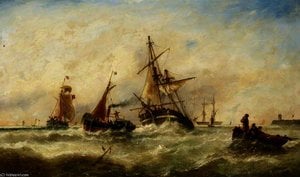
Callow's mastery lay in his skillful manipulation of watercolor techniques. He eschewed the heavy, blended washes favored by some of his contemporaries, instead employing a delicate, layered approach. His brushwork was often loose and expressive, creating a sense of immediacy and capturing the fleeting effects of light and atmosphere. This is particularly evident in works like “Coast Scene With Shipping,” where he uses impressionistic brushstrokes to convey the movement of the sea and the hazy quality of coastal landscapes. The warm tones – ochres, yellows, and browns – contribute to the painting’s overall sense of warmth and tranquility.
His use of color was equally nuanced. Callow rarely relied on bright, saturated hues; instead, he favored muted shades and subtle gradations, creating a harmonious and atmospheric effect. He expertly utilized dry brush techniques to build up texture and suggest the roughness of stone walls or the foliage of trees. Furthermore, his compositions were carefully constructed, often employing asymmetrical arrangements and leading lines to draw the viewer’s eye through the scene.
While Callow excelled at depicting landscapes – particularly those of rural England – he is perhaps best known for his watercolor paintings of religious scenes. These works are characterized by a quiet reverence and a deep understanding of biblical narratives. He avoided dramatic or overtly emotional depictions, instead focusing on capturing the serene beauty of the settings and the contemplative expressions of the figures within them.
His subjects often reflected the social and cultural context of Victorian England. He frequently depicted scenes of rural life – farmers working their fields, villagers gathering in the churchyard – offering a glimpse into the lives of ordinary people. His paintings also captured the architectural beauty of English churches and cathedrals, showcasing their intricate details and imposing grandeur. These works provide valuable insights into the religious beliefs and artistic sensibilities of the era.
John Callow’s work may not have achieved widespread fame during his lifetime, but it has since been recognized for its quiet beauty and understated elegance. His paintings offer a unique perspective on English landscapes and religious life, capturing the essence of a bygone era. His meticulous attention to detail, combined with his masterful use of watercolor techniques, ensures that his work continues to resonate with viewers today.
Further research into Callow’s life and work can be found through resources such as the WahooArt website (https://www.WahooArt.com/en/artists/john-callow-en/) and Wikipedia (https://en.wikipedia.org/wiki/John_Callow). The Wikipedia article provides a detailed biographical account, while the WahooArt website offers access to several of his paintings and related information.

1822 - 1878 , United Kingdom

 Preview
 Send
Send Share
Share
 Details
 Guide
Guide

 Download
 Similars
 X-Ray
X-Ray Diaporama
 Stats
Stats Read More






































 Glass option is only available in size under 110 CM