
x


Hand-painted oil on canvas in your size and frame, made to order by our artists. ( Buy Print Buy Image)
Pick from our preset sizes that match the artwork's original proportions.

You may enter your own dimensions to fit a specific frame or space. If your selected size does not match the original image's proportions, we will either crop the artwork or extend the painting with additional hand-painted elements. A digital mockup will be sent for your approval before production begins.
Please note that the on-screen preview does not reflect the actual cropping or extension. Only the mockup will accurately show the final composition.
While custom sizes are available, we recommend selecting a dimension from the predefined list to preserve the original proportions.
Worldwide Delivery () in 3/4 weeks instead of standard 5 weeks. (26 August). No compromise on quality.


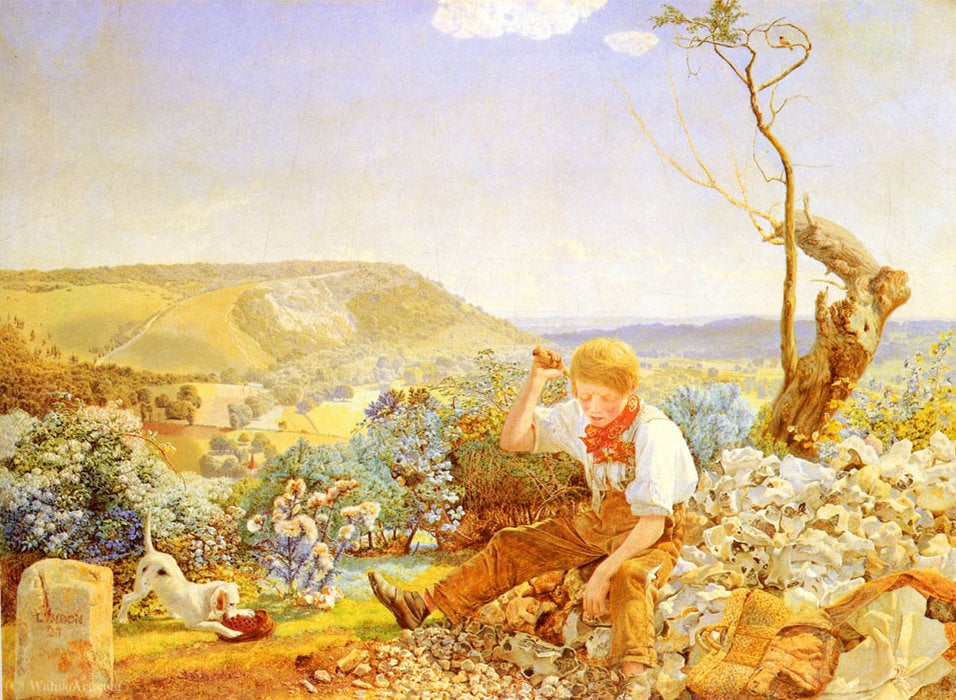
The stonebreaker
Reproduction Size

In the grand tapestry of nineteenth-century British art, few threads are as intricately woven with scientific precision and spiritual depth as those spun by John Brett. Born near Reigate on December 8th, 1831, Brett emerged from a military lineage that perhaps gifted him with the disciplined eye necessary for his life's work: the pursuit of absolute truth in nature. His early years were marked by a profound fascination with the natural world, a passion he shared deeply with his sister, Rosa Brett. Together, they established a collaborative studio in 1851, creating a sanctuary where artistic exploration and meticulous observation could flourish side by side.
Brett’s formal education was a journey through the very heart of British landscape tradition. His initial training under James Duffield Harding instilled in him a reverence for tonal harmony and accurate representation, while his subsequent studies with Richard Redgrave provided the technical foundation required to translate the complexities of the earth onto canvas. However, it was his entry into the Royal Academy Schools in 1853 that truly ignited his revolutionary spirit. It was here that he encountered the radical doctrines of John Ruskin and William Holman Hunt. These mentors championed a philosophy where scientific observation served as a direct conduit to spiritual understanding, a concept that would become the heartbeat of Brett’s entire oeuvre.
To gaze upon a John Brett landscape is to witness a masterclass in Pre-Raphaelite precision. Unlike many of his contemporaries who sought to idealize or soften the rugged edges of the world, Brett embraced the granular reality of geology and botany. His work often feels less like a mere painting and more like a window into a living, breathing ecosystem. This commitment to "truth to nature" reached its zenith in his 1858 masterpiece, The Stonebreaker. In this monumental work, the viewer is not merely presented with a scene of manual labor; they are invited into a meticulously rendered universe where every flint, every blade of grass, and every shift in light is captured with the rigor of a naturalist.
Beyond the technical brilliance, Brett’s paintings are layered with profound symbolism. He possessed a unique ability to weave subtle allegories into the very fabric of his landscapes. In The Stonebreaker, the presence of a bullfinch—a bird often associated with the human soul—serves as a silent, poetic meditation on existence amidst the toil of the physical world. His travels, including transformative journeys through the Swiss Alps, further expanded his visual vocabulary, allowing him to capture the sublime grandeur of mountain vistas and the delicate, luminous light of the Mediterranean coast. Through his brush, the rugged textures of the earth and the ephemeral qualities of atmosphere become a unified language of moral and spiritual contemplation.
The historical significance of John Brett lies in his ability to bridge the gap between the burgeoning scientific discoveries of the Victorian era and the emotive power of fine art. He did not see science and art as opposing forces, but as two halves of a single, divine truth. His legacy is defined by several key contributions to the art world:
Though the era of the great Pre-Raphaelite masters has passed, the works of John Brett continue to captivate the modern imagination. His paintings remain enduring testaments to a time when the act of looking closely at a leaf or a stone was considered an act of profound reverence, reminding us that beauty and truth are often found in the most minute and meticulously observed details of our world.

1831 - 1902


Stay updated with the latest art news, exclusive offers, and decoration ideas.
Tell us about your project and our art experts will provide you with 3 personalized art suggestions.
Let Us Curate 3 Options Just for You - Free!

 Preview
 Send
Send Share
Share
 Details

 Download
 Similars
 X-Ray
X-Ray Diaporama
 Read More




































 Glass option is only available in size under 110 CM


