

 Oil On CanvasWallArtUtrecht Caravaggism
 1630Early Modern
 84.0 x 73.0 cm
 Mauritshuis
Hand-painted oil on canvas in your size and frame, made to order by our artists. ( Switch to Print Switch to Digital Image)





























Pick from our preset sizes that match the artwork's original proportions.

You may enter your own dimensions to fit a specific frame or space. If your selected size does not match the original image's proportions, we will either crop the artwork or extend the painting with additional hand-painted elements. A digital mockup will be sent for your approval before production begins.
Please note that the on-screen preview does not reflect the actual cropping or extension. Only the mockup will accurately show the final composition.
While custom sizes are available, we recommend selecting a dimension from the predefined list to preserve the original proportions.
Worldwide Delivery () in 3/4 weeks instead of standard 5 weeks. (14 September). No compromise on quality.


Democritus, the Laughing Philosopher
Reproduction Size
In the quiet, tension-filled corridors of the Dutch Golden Age, few images capture the visceral pull of human emotion as masterfully as Johannes Pauwelszon Moreelse’s “Democritus, the Laughing Philosopher.” Created in 1630, this oil on canvas is not merely a portrait of an ancient thinker; it is a theatrical performance frozen in time. The painting invites the viewer into a world of profound intellectual conflict, where the starkness of light meets the deep, velvety mysteries of shadow. As one gazes upon the figure of Democritus, there is an immediate, magnetic pull toward his exuberant gesture—a finger pointing emphatically at a globe, accompanied by a laugh that seems to echo through the centuries. It is a moment of brilliant, almost defiant, joy set against a backdrop of existential contemplation.
Moreelse, a pivotal figure of the Utrecht Caravaggism movement, utilizes the revolutionary technique of tenebrism to sculpt his subjects from the darkness. By employing intense chiaroscuro—the dramatic interplay between brilliant highlights and impenetrable shadows—he grants the philosopher a palpable physicality. The light does not merely illuminate; it carves the folds of the man's attire and emphasizes the weathered texture of his skin, creating a sense of immediacy that feels startlingly modern. This mastery of light serves to heighten the painting's emotional stakes, transforming a scholarly subject into a gripping psychological drama that commands attention in any curated collection or sophisticated interior space.
Beyond its visual splendor, the artwork serves as a profound meditation on the human condition. The composition is built upon a deliberate juxtaposition of opposing philosophies. While Democritus—the "laughing philosopher"—is presented with an air of buoyant skepticism, his presence is often interpreted alongside the shadow of his counterpart, Heraclitus, the "weeping philosopher." Through the gesture toward the globe, Moreelse captures the essence of Democritus’s atomic theory and his view of the universe as a series of mechanical, predictable movements. The globe itself acts as a silent protagonist, representing the vast, complex world that the philosopher seeks to decode through reason and wit.
For the discerning collector or interior designer, this piece offers more than just aesthetic beauty; it provides a conversational centerpiece rich with symbolic weight. The tension between the laughter of the subject and the heavy, dark atmosphere suggests the inherent absurdity of worldly pursuits in the face of time's inevitable march. It is a work that speaks to the duality of life—the struggle between intellect and emotion, between the light of discovery and the darkness of the unknown. To hang such a reproduction is to invite a sense of historical gravity and intellectual curiosity into a room, making it an ideal choice for libraries, studies, or galleries designed to inspire deep thought and quiet reflection.

Johan Pauwelszon Moreelse (c. 1603 – October 1634), a Dutch Baroque painter hailing from Utrecht, stands as a pivotal figure within the Utrecht Caravaggist school—a movement that dramatically reshaped artistic sensibilities during the Dutch Golden Age.
Little is definitively known about Moreelse’s formative years. Born around 1603 in Utrecht, he descended from a family steeped in artistic tradition; his father, Paulus Moreelse, was already recognized as a respected portrait painter, establishing a powerful legacy of visual representation.
Moreelse’s formal education centered primarily around Utrecht, where he honed his skills under the tutelage of his father. However, recognizing the broader artistic landscape, he embarked on a journey to Rome in 1627—a pilgrimage that would profoundly impact his stylistic trajectory. The Roman environment exposed him to the burgeoning innovations of Baroque art, particularly those championed by Caravaggio himself.
Caravaggio’s revolutionary approach to lighting and dramatic composition served as an undeniable catalyst for Moreelse's artistic development. This influence is palpable in his paintings—characterized by intense chiaroscuro effects that heighten emotional impact and create a sense of theatrical grandeur. The artist skillfully employed color palettes reminiscent of Caravaggio, prioritizing vibrant hues alongside subdued tones to convey psychological depth.
Moreelse’s oeuvre remains relatively modest compared to contemporaries like Rembrandt or Vermeer, yet his paintings possess remarkable artistic merit. Among his most celebrated compositions is “The Triumph Arch with Bearers of the Spoils of War,” a monumental depiction capturing a pivotal moment in military history—a testament to Moreelse's mastery of perspective and emotive storytelling.
His style distinguishes itself through its dynamism and psychological realism. Unlike many artists of his time who favored idealized representations, Moreelse sought to portray human subjects with unflinching honesty, conveying their inner turmoil and vulnerability. This commitment to portraying emotion aligns seamlessly with the broader Caravaggist ethos—a rejection of academic conventions in favor of visceral immediacy.
Several canvases attributed to Moreelse grace prominent museum collections across Europe. The Mauritshuis in The Hague houses a significant selection, offering visitors an unparalleled opportunity to contemplate his artistic achievements firsthand. Furthermore, works by Moreelse can be found at the Stedelijk Museum Amsterdam and the Rijksmuseum Amsterdam.
Moreelse’s contribution to Utrecht Caravaggism solidified his place as one of the foremost painters of his era. His innovative techniques—particularly his masterful manipulation of light—influenced subsequent generations of artists, shaping the visual vocabulary of Baroque painting in Holland. Despite his untimely demise during a plague epidemic in 1634, Moreelse’s legacy persists—a beacon of artistic experimentation and emotional intensity within the annals of Dutch art history.

Netherlands

Explore the profound impact of Chiaroscuro and Tenebrism in Baroque masterpieces. Discover how dramatic light and shadow define emotion and volume, and learn to curate these powerful historical techniques for sophisticated, luxury interior design collections.

Explore the profound drama of chiaroscuro and tenebrism. Discover how masters like Caravaggio used light and shadow to sculpt emotion and volume, creating timeless masterpieces for the discerning collector.

Explore the profound mastery of Caravaggio's tenebrism. Discover how his dramatic use of chiaroscuro revolutionized Baroque art through intense emotion and realism. An expert guide for classic art enthusiasts seeking to understand the power of shadow in historical masterpieces.

Immerse yourself in the dramatic world of Jacopo Tintoretto. Explore 25 iconic Renaissance masterpieces defined by light, shadow, and emotion. Find inspiration for museum-quality art reproductions and curated decor. Discover all masterpieces on WahooArt.com.
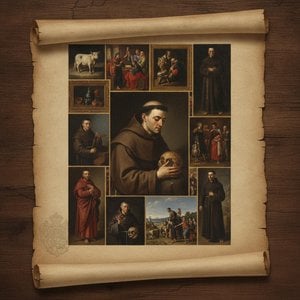
Immerse yourself in the dramatic world of Francisco de Zurbarán. Explore 25 iconic Spanish Baroque masterpieces defined by intense tenebrism and spiritual realism. Find inspiration for museum-quality art reproductions and decor. Discover all masterpieces on WahooArt.com.

 Preview
 Send
Send Share
Share
 Details

 Download
 Similars
 X-Ray
X-Ray Diaporama
 Stats
Stats Read More







 Glass option is only available in size under 110 CM


