
x


Museum-quality giclée or canvas print with fast production and flexible finish options. ( Buy Hand Made Painting Buy Image)





























Pick from our preset sizes that match the artwork's original proportions.

You may enter your own dimensions to fit a specific frame or space. If your selected size does not match the original image's proportions, we will either crop the artwork or extend the image with a mirrored or solid-fill edge. A digital mockup will be sent for your approval before production begins.
Please note that the on-screen preview does not reflect the actual cropping or extension. Only the mockup will accurately show the final composition.
While custom sizes are available, we recommend selecting a dimension from the predefined list to preserve the original proportions.
Worldwide Delivery () in 2 weeks instead of standard 4/5 weeks. (25 August)


Del libre Ruban de Michel Leiris
Reproduction Size
Joan Miró (1893–1983) stands as a monumental figure in the annals of 20th-century art, an artist whose singular vision irrevocably altered the landscape of modern expression. Born in Barcelona during a period of profound artistic ferment—marked by the burgeoning Surrealist movement and the echoes of Cubism—Miró embarked on a journey characterized not merely by stylistic evolution but by an unwavering pursuit of inner realms, translating dreams, memories, and Catalan identity onto canvas with a visual language imbued with poetic nuance.
The Surrealist impulse, championed by André Breton and fellow artists, sought to liberate creativity from the constraints of rational thought, tapping into the subconscious mind as a source of inspiration. Miró embraced this ethos wholeheartedly, employing techniques like automatism—chance operations designed to bypass conscious control—to generate imagery rooted in spontaneous association. This approach yielded works that defy easy categorization, blending organic forms with geometric abstractions and conveying emotions that transcend literal representation.
His distinctive style is instantly recognizable: bold colors juxtaposed against simplified shapes, reminiscent of Matisse’s Fauvist paintings, yet infused with a uniquely Miróesque spirit. Recurring motifs—birds, insects, fantastical creatures—appear throughout his oeuvre, symbolizing freedom, metamorphosis, and the primal forces of nature. These images are not merely decorative; they embody complex psychological states and convey profound philosophical ideas.
Miró’s artistic vocabulary is remarkably consistent across his prolific output. He favored a palette dominated by vibrant hues—yellows, reds, blues—creating canvases that pulsate with energy and luminosity. His brushstrokes are loose and expressive, conveying movement and texture without striving for photorealistic detail. This deliberate rejection of conventional realism reflects Miró’s belief in the primacy of feeling over observation.
Consider Tirador in the Arc—a captivating piece that exemplifies Miró’s signature style. The central horse figure dominates the composition, its mane rendered in swirling brushstrokes of brilliant yellow and orange, capturing a sense of restless dynamism. Around its neck encircles a ribbon of crimson, adding a touch of theatrical color and hinting at themes of confinement and liberation.
The overall effect is one of dreamlike beauty—a visual meditation on the interplay between order and chaos, rationality and imagination. Miró’s art invites contemplation, prompting viewers to confront their own subconscious desires and anxieties while simultaneously appreciating the sublime grandeur of nature.
Miró's work emerged during a period of intense artistic experimentation—the aftermath of World War I and the rise of Surrealism—a time when artists sought to challenge established conventions and explore new frontiers of creative expression. Influenced by Cubist fragmentation and Dada nihilism, Miró nevertheless forged his own path, developing a distinctive visual language that resonated with audiences worldwide.
His paintings are housed in prestigious institutions such as the Fundació Joan Miró in Barcelona—a testament to his enduring legacy and a beacon for contemporary art—and the Rugby Art Gallery and Museum in the United Kingdom. These venues offer visitors the opportunity to immerse themselves in Miró’s artistic universe and appreciate the profound impact of his work on subsequent generations of artists.
To delve deeper into Miró's life and oeuvre, visit WahooArt.com for comprehensive information and stunning reproductions of his celebrated paintings.


1893 - 1983 , Spain

Explore 25 iconic Joan Miró paintings! Discover the stories behind his Surrealist masterpieces, vibrant colors & unique style. Find museum-quality Miro reproductions and elevate your home decor with WahooArt.com. Explore the full collection online.

Explore 10 defining Abstract Expressionism masterpieces by Pollock, Rothko & de Kooning. Discover the stories behind these iconic paintings and find museum-quality art reproductions to elevate your home decor on .

Explore 10 defining masterpieces of Geometric Abstraction! Discover Kandinsky, Mondrian & Malevich’s iconic works. Find museum-quality art reproductions and curated decor ideas to elevate your home at WahooArt.com.
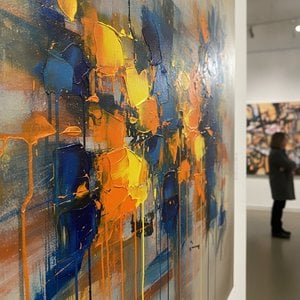
Master the high-impact world of contemporary abstraction. Discover how bold colors, textures, and modern movements like Abstract Expressionism can transform your space with premium, high-energy art curated for the design-conscious professional.

Embark on a cultural journey through Lyrical Abstraction. Explore how masters like Kandinsky used color and motion to translate emotion into visual poetry. Discover the profound beauty of abstract expressionism and learn to curate emotional resonance in your own art collection.


Stay updated with the latest art news, exclusive offers, and decoration ideas.
Tell us about your project and our art experts will provide you with 3 personalized art suggestions.
Let Us Curate 3 Options Just for You - Free!

 Preview
 Send
Send Share
Share
 Details

 Download
 Similars
 X-Ray
X-Ray Diaporama

 Read More







 Glass option is only available in size under 110 CM


