

The artwork displayed on this page is protected by copyright law, which means we cannot legally create or sell an identical reproduction. This protection is enforced under international agreements such as the Berne Convention and by national laws, including those outlined by the U.S. Copyright Law - Title 17.
This method fully complies with copyright regulations because it does not involve copying or duplicating the protected artwork. Instead, it is a creative reinterpretation - a new painting that is influenced by the original but not identical to it.
Museum-quality giclée or canvas print with fast production and flexible finish options. ( Buy Hand Made Painting Switch to Digital Image)





























Pick from our preset sizes that match the artwork's original proportions.

Type the width and the height you need, to fit your frame or your wall. A print can only be cut, never made bigger than the picture, so a size with a different shape loses a part of the image. We send you a digital mockup to approve before we print anything. The picture shown on this page does not show the real cut — only the mockup does.
Worldwide Delivery () in 2 weeks instead of standard 4/5 weeks. (26 October)
Cabeza de mujer
Reproduction Size
In the vast, labyrinthine landscape of 20th-century Surrealism, few works possess the raw, psychological magnetism of Joan Miró’s Cabeza de mujer. Painted during a transformative period between 1935 and 1940, this masterpiece serves as a profound window into the artist's subconscious. Rather than offering a traditional portrait, Miró presents us with a stylized, dreamlike visage that defies the boundaries of literal representation. The painting is an evocative exploration of identity and emotion, where the human form is deconstructed into a rhythmic dance of geometric shapes and organic flourishes. To gaze upon this work is to step into a realm where the distinction between reality and fantasy dissolves, leaving only the primal essence of the subject behind.
The visual language of Cabeza de mujer is defined by its striking, almost confrontational, palette. Miró utilizes a stark, dramatic tension through the interplay of deep blacks and a piercing, crimson red. This limited yet potent color scheme does more than just command attention; it mirrors the turbulent psychological landscape of an era marked by profound uncertainty. The technique itself—tempera on canvas applied with thick, expressive impasto strokes—lends a tactile physicality to the piece. These bold, textured marks create a sense of movement and spontaneity, as if the artist were capturing a fleeting thought or a sudden burst of emotion directly from the ether of his imagination.
Beyond its aesthetic brilliance, the artwork is deeply embedded in the historical currents of Catalonia. Created amidst the rise of Francisco Franco’s dictatorship following the Spanish Civil War, the painting breathes with the anxieties of a society under siege. For Miró, Surrealism was not merely an artistic choice but a tool for resistance—a way to articulate the suppressed truths and cultural identities that faced censorship. The composition, featuring eyes scattered across a face composed of circles, squares, and triangles, suggests a fragmented perception, perhaps reflecting the fractured state of a nation in turmoil. The inclusion of organic forms, reminiscent of roots or plant stems, intertwines the human experience with the very earth of Catalonia, grounding his abstract visions in a deep sense of place.
For the discerning collector or interior designer, Cabeza de mujer offers much more than visual intrigue; it provides an emotional anchor for a sophisticated space. The painting’s ability to evoke both unsettling tension and mesmerizing beauty makes it a versatile centerpiece for modern environments. Whether placed in a minimalist gallery setting or integrated into a richly textured living space, the work invites continuous contemplation. It is a piece that does not merely decorate a wall but transforms an atmosphere, offering a sophisticated dialogue between the viewer and the enduring legacy of one of art history's most visionary minds.
The color that stands out most in "Cabeza de mujer" is black (#0d0605). The dominant color is useful when matching an artwork to an interior.
The palette of "Cabeza de mujer" is subtle color in saturation.
"Cabeza de mujer" belongs to the Modern era.


1893 - 1983 , Spain

Explore 10 defining masterpieces of Geometric Abstraction! Discover Kandinsky, Mondrian & Malevich’s iconic works. Find museum-quality art reproductions and curated decor ideas to elevate your home at WahooArt.com.
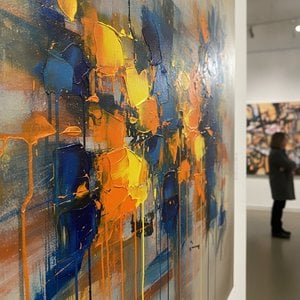
Master the high-impact world of contemporary abstraction. Discover how bold colors, textures, and modern movements like Abstract Expressionism can transform your space with premium, high-energy art curated for the design-conscious professional.

Journey into the dreamlike world of Surrealism! Explore 10 masterpieces by Dali, Magritte & Miró. Discover the stories behind these iconic paintings and find museum-quality art reproductions for your home at .

Explore 10 defining Abstract Expressionism masterpieces by Pollock, Rothko & de Kooning. Discover the stories behind these iconic paintings and find museum-quality art reproductions to elevate your home decor on .

Explore 25 iconic Joan Miró paintings! Discover the stories behind his Surrealist masterpieces, vibrant colors & unique style. Find museum-quality Miro reproductions and elevate your home decor with WahooArt.com. Explore the full collection online.

 Preview
 Send
Send Share
Share
 Details
 Guide
Guide

 Download
 Similars
 X-Ray
X-Ray Diaporama
 Stats
Stats

 Read More









 Glass option is only available in size under 110 CM


