

The artwork displayed on this page is protected by copyright law, which means we cannot legally create or sell an identical reproduction. This protection is enforced under international agreements such as the Berne Convention and by national laws, including those outlined by the U.S. Copyright Law - Title 17.
This method fully complies with copyright regulations because it does not involve copying or duplicating the protected artwork. Instead, it is a creative reinterpretation - a new painting that is influenced by the original but not identical to it.
Museum-quality giclée or canvas print with fast production and flexible finish options. ( Buy Hand Made Painting Switch to Digital Image)





























Pick from our preset sizes that match the artwork's original proportions.

Type the width and the height you need, to fit your frame or your wall. A print can only be cut, never made bigger than the picture, so a size with a different shape loses a part of the image. We send you a digital mockup to approve before we print anything. The picture shown on this page does not show the real cut — only the mockup does.
Worldwide Delivery () in 2 weeks instead of standard 4/5 weeks. (9 November)
Amanecer
Reproduction Size
"Amanecer" by Joan Miró shows a statement contrast between its light and dark areas.
"Amanecer" is a work of Surrealist Surrealist. The movement indicates the artistic tradition the work is part of.
A slideshow is available: the Diaporama page of "Amanecer" by Joan Miró.

Barcelona, April 20, 1893. Joan Miró i Ferrà enters a world of precision and gears, born into a family of watchmakers. This early environment provides a backdrop of meticulous craftsmanship that persists through his evolution as a painter, sculptor, and ceramicist. He moves through the decades not by following a set path, but by constantly shifting his focus, eventually becoming a central figure in the development of Surrealism and Abstract Art.
His creative output resists easy categorization. While many attempt to pin him to a single movement, Miró remains fiercely independent, often expressing a desire to overturn established aesthetic hierarchies. He works with a restless energy, experimenting across various media to capture the subconscious. His practice is a constant tension between the organic and the geometric, the dreamlike and the tangible. By the time he passes away on December 25, 1983, he has left behind a visual language that challenges the very definition of artistic expression.
Barcelona, 1893. The foundations of Joan Miró’s visual language begin in the Catalan capital. His early years are marked by a dual existence. At fourteen, he enters business school, a pragmatic path that runs parallel to his burgeoning creative impulses. He does not choose between commerce and art; he pursues both. While studying business, he concurrently enrolls in art classes at the Escuela Superior de Artes Industriales y Bellas Artes.
The momentum builds. By 1911, Miró is already stepping into the public eye, exhibiting his first painting at the sixth Exposición Internacional de Arte in Barcelona. This early exposure marks a departure from the classroom and into the professional sphere. His formal training deepens between 1912 and 1915, as he studies under Francesc Galí at the Escola d’Art. These years of rigorous instruction provide the technical scaffolding for the radical departures that follow.
Paris, 1920. The city pulls him in. Miró arrives in the French capital, a space where the tension between the currents of modernism and his own Catalan identity begins to pull at his creative core. He moves through these streets, encountering the presence of artists like Pablo Picasso. This is a period of intense friction and experimentation. He is not merely absorbing styles; he is navigating the space between the avant-garde and the roots of his own landscape.
The political climate shifts. The outbreak of the Spanish Civil War forces a change in his geography. He finds himself living in involuntary exile in France until mid-1940. This period of displacement marks a departure from his earlier, more settled explorations. Between 1937 and early 1938, the work undergoes a sudden, sharp transformation. He produces two paintings that are stylistically unique, breaking away from his established patterns to create something entirely different from his previous output.
Miró rejects the safety of established methods. He views conventional painting as a tool for bourgeois society, an approach he seeks to dismantle through a restless, iconoclastic practice. His work often defies easy classification, frequently interpreted as Surrealist but driven by a deeply personal style that resists any single "ism." He moves through media with a feverish energy, experimenting with painting, pastel, printmaking, sculpture, ceramics, collage, muralism, and tapestry. This versatility allows him to escape the constraints of traditional representation.
His biomorphic paintings emerge through rough shapes and objects that remain only marginally recognizable. There is a tension in these forms, a sense of the subconscious rendered through a unique pictorial idiom. He utilizes acrylic to build luminous, textured surfaces that give his compositions a physical presence. The shapes do not merely sit on the canvas; they exist in a state of flux, often appearing as glyphs or symbols that bridge the gap between the seen and the imagined.
The shift toward a personal, symbolic language finds its anchor in The Farm. This work marks a departure from his earlier training, acting as a cornerstone of his oeuvre by grounding his evolving abstraction in the reality of the Catalan landscape. By 1924, this connection to the earth intensified in The Tilled Field, where the boundaries between the physical world and the subconscious begin to blur. The imagery moves away from traditional representation toward a private, coded vocabulary.
In 1925, The Birth of the World emerges, signaling a move into a more fluid, primordial space. Here, the canvas becomes a site for spontaneous creation, where shapes seem to coalesce from nothingness. This experimentation with the origins of form continues through his later years. In 1967, The wing of the lark ... demonstrates a continued mastery of his unique visual language, maintaining a sense of movement and poetic suggestion even as his style matured.
His public presence also manifested in large-scale, monumental works. Dona i Ocell stands as a significant symbol of Catalan liberation, utilizing mosaic and irregular contours to claim space within the urban environment. This work bridges the gap between his intimate, dreamlike paintings and the public, architectural scale of his later vision.
The passing of Miró at age 90 marks the end of an era; he was widely regarded as the last of the modernist stars. His restless, iconoclastic approach to the canvas did more than just challenge aesthetic hierarchies. By stripping forms to their essence, his work paved the way for abstract expressionism. His unique personages—those idiosyncratic, symbolic figures—left a mark on the trajectory of modern art, influencing later artists such as Robert Motherwell and Louise Bourgeois.
His commitment to the future of art took physical form through the institutions he established to foster experimentation. In 1975, he founded the Fundació Joan Miró in Barcelona. This was followed by the establishment of the Fundació Pilar i Joan Miró in Palma de Mallorca in 1981. These spaces ensure his influence remains active, moving beyond the static display of objects to serve as centers for contemporary exploration.
The most concentrated encounter with his creative output occurs on the Montjuïc hill in Barcelona, Spain. Here, the Fundació Joan Miró preserves a massive collection of over 10,000 artworks. The museum environment, designed by Josep Lluís Sert, allows the viewer to move through terraces and courtyards that mirror the artist's own organic approach to space. It remains the primary site for studying the evolution of his visual language.
Beyond Spain, his presence is felt in the major institutional hubs of the art world. In New York City, the Museum of Modern Art holds several of his works, while the Metropolitan Museum of Art also maintains pieces in its permanent collection. These collections offer a window into how his specific brand of abstraction and symbolism integrated into the broader narrative of modernism. In Paris, the Centre Pompidou provides another essential location to observe his influence on the European avant-garde.

1893 - 1983 , Spain
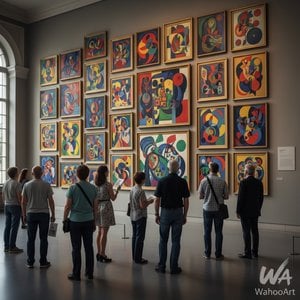
Explore 25 iconic Kandinsky masterpieces and the birth of abstraction. Discover the full collection online at WahooArt.com.

Journey into the dreamlike world of Surrealism! Explore 10 masterpieces by Dali, Magritte & Miró. Discover the stories behind these iconic paintings and find museum-quality art reproductions for your home at .

Explore 10 defining Abstract Expressionism masterpieces by Pollock, Rothko & de Kooning. Discover the stories behind these iconic paintings and find museum-quality art reproductions to elevate your home decor on .

Explore 10 defining masterpieces of Geometric Abstraction! Discover Kandinsky, Mondrian & Malevich’s iconic works. Find museum-quality art reproductions and curated decor ideas to elevate your home at WahooArt.com.

Explore 25 iconic Joan Miró masterpieces and his Surrealist vision. Discover the full collection online at WahooArt.com.
 Preview
 Send
Send Share
Share
 Details
 Guide
Guide

 Download
 Similars
 X-Ray
X-Ray Diaporama
 Q&A
Q&A
 Stats
Stats
 Read More









 Glass option is only available in size under 110 CM


