x


Hand-painted oil on canvas in your size and frame, made to order by our artists. ( Buy Print Buy Image)
Pick from our preset sizes that match the artwork's original proportions.

You may enter your own dimensions to fit a specific frame or space. If your selected size does not match the original image's proportions, we will either crop the artwork or extend the painting with additional hand-painted elements. A digital mockup will be sent for your approval before production begins.
Please note that the on-screen preview does not reflect the actual cropping or extension. Only the mockup will accurately show the final composition.
While custom sizes are available, we recommend selecting a dimension from the predefined list to preserve the original proportions.
Worldwide Delivery () in 3/4 weeks instead of standard 5 weeks. (28 August). No compromise on quality.


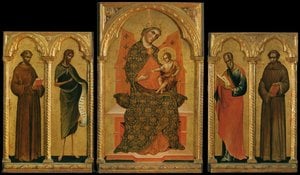
Annunciation And Resurrection
Reproduction Size

To step into the world of Joan Mates is to enter a period of profound spiritual intensity and burgeoning artistic curiosity. Born around 1370 in Vilafranca del Penedès, Spain, Mates emerged during a transformative era for Catalan art—a time when the rigid structures of the Gothic tradition began to breathe with the nascent naturalism of the early Renaissance. While much of his personal history remains shrouded in the mists of the fourteenth century, his artistic legacy is vividly preserved through works that pulse with a quiet, devotional power. His career was not merely a local phenomenon; it was part of an expanding European network, evidenced by his workshop's ability to produce altarpie and commissions that reached as far as Scotland and various regions across Aragon.
The foundations of Mates’s style were likely laid within the prestigious Catalan Gothic tradition. It is widely believed that he absorbed the techniques of masters such as Pere Serra, whose influential workshop set the standard for monumental altarpieces in the region. This early training instilled in him a reverence for clarity of form and theological precision, yet Mates possessed a unique ability to transcend mere imitation. He became an expressive painter, one who utilized sharp contrasts of line to achieve a striking intensity of effect. Rather than becoming lost in complex architectural settings, Mates focused his creative energy on the human figure, imbuing his subjects with a refined elegance that suggests the delicate influence of Franco-Flemish manuscript illumination.
The breadth of Mates’s achievements is best understood through his significant commissions for the great cathedrals and chapels of Catalonia. His ability to complete monumental tasks, such as finishing the retable of Saints Thomas and Anthony for the Barcelona Cathedral in 1409—a project left incomplete by Pere Serra—demonstrates both his technical skill and his standing within the professional guild system. His oeuvre is a tapestry of sacred narratives, ranging from the deeply personal to the grandly liturgical:
Ultimately, the historical significance of Joan Mates lies in his role as a transitional figure. He did not simply exist within the Gothic era; he helped navigate its evolution toward the Renaissance. By prioritizing the emotional resonance of the human figure and integrating international influences from the Flemish tradition, he helped craft a visual language that was both deeply rooted in Catalan identity and vibrantly connected to the broader currents of European art history. His works remain enduring testaments to a period when art served as the primary bridge between the mortal soul and the divine.

1370 - 1431 , Spain


Stay updated with the latest art news, exclusive offers, and decoration ideas.
Tell us about your project and our art experts will provide you with 3 personalized art suggestions.
Let Us Curate 3 Options Just for You - Free!

 Preview
 Send
Send Share
Share
 Details

 Download
 Similars
 X-Ray
X-Ray Diaporama
 Read More




































 Glass option is only available in size under 110 CM