

The artwork displayed on this page is protected by copyright law, which means we cannot legally create or sell an identical reproduction. This protection is enforced under international agreements such as the Berne Convention and by national laws, including those outlined by the U.S. Copyright Law - Title 17.
This method fully complies with copyright regulations because it does not involve copying or duplicating the protected artwork. Instead, it is a creative reinterpretation - a new painting that is influenced by the original but not identical to it.
Museum-quality giclée or canvas print with fast production and flexible finish options. ( Buy Hand Made Painting Switch to Digital Image)
Pick from our preset sizes that match the artwork's original proportions.

Type the width and the height you need, to fit your frame or your wall. A print can only be cut, never made bigger than the picture, so a size with a different shape loses a part of the image. We send you a digital mockup to approve before we print anything. The picture shown on this page does not show the real cut — only the mockup does.
Worldwide Delivery () in 2 weeks instead of standard 4/5 weeks. (27 October)
Untitled
Reproduction Size
Artworks similar to "Untitled" by Jiang Zhenghong are gathered on the artwork's Similars page.
"Untitled" can be examined layer by layer on the artwork's X-Ray page, a viewer inspired by a conservator's light bench with eleven optical readings of the image.
Regarding copyright, "Untitled" is still protected by copyright.
Born in 1936 amidst the scenic landscapes of Zhoushan, Zhejiang Province, Jiang Zhenghong has emerged as a profound voice in the realm of contemporary Chinese painting and printmaking. His life’s work is not merely a collection of images but a continuous dialogue with the natural world, rooted deeply in the heritage of his homeland. The foundations of his mastery were laid at the prestigious Central Academy of Fine Arts, where he graduated in 1960. It was within these hallowed halls that Zhenghong underwent a rigorous intellectual and technical transformation, absorbing the wisdom of legendary masters such as Li Hua, Li Keran, Ye Shaoyu, Li Kuchan, Guyuan, Huang Yongyu, and Zhang Ding. These mentors provided him with more than just technique; they bequeathed to him a lineage of aesthetic philosophy that balances the meticulous observation of reality with the spiritual essence of the landscape.
The evolution of Zhenghong’s style is a testament to his ability to bridge the gap between ancient tradition and modern sensibility. His academic pursuits took him through the halls of the Central University for Nationalities, Tsinghua University, and the Academy of Fine Arts, allowing him to weave a complex tapestry of art history into his creative practice. This deep scholarly grounding enabled him to master the nuances of Guo hua (ink wash painting), where every brushstroke serves as a vessel for emotion. His work often captures the ethereal beauty of the Zhejiang landscape—towering, mist-shrouded peaks that seem to touch the heavens and tranquil, flowing rivers that mirror the shifting light of day. Through his eyes, the mountains and valleys are not just geological formations but living entities imbued with the symbolic resonance of Confucian philosophy and Daoist cosmology.
Beyond the delicate strokes of his landscape paintings, Jiang Zhenghong has made significant contributions to the art of printmaking, demonstrating a versatility that is rare among his contemporaries. His early brilliance was recognized on the global stage when his work New City earned the Golden Medal at the 7th World Youth Festival in Vienna in 1959. This early triumph signaled the arrival of an artist capable of communicating universal themes through a uniquely Chinese lens. Throughout his prolific career, which includes four decades of dedicated teaching at institutions like the Central Academy of Arts and Crafts, he has remained a steadfast guardian of artistic excellence, influencing generations of students with his commitment to both precision and poetic expression.
The technical brilliance of his oeuvre lies in the seamless integration of varied textures and tonal depths. In his landscapes, one can observe:
Jiang Zhenghong’s historical significance is cemented by his numerous accolades, including the prestigious Lu Xun Literature and Art Award from the Chinese Print Artists Association. His ability to maintain the sanctity of traditional Shanshui aesthetics while embracing the evolving landscape of modern art ensures that his legacy remains as enduring as the mountains he paints. To encounter a work by Zhenghong is to experience a moment of profound serenity, an invitation to step into a world where the boundaries between the observer and the natural universe dissolve into a single, breathtaking vista.

1936 - , China
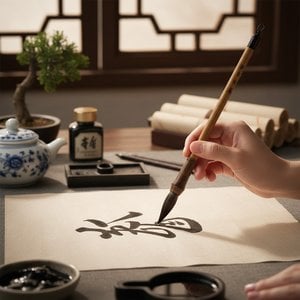
Embark on a profound journey through the soul of Chinese calligraphy. Explore the historical mastery of ink, brush, and script, from ancient Zhuanshu to elegant running script, and discover how this timeless art form reflects the enduring spirit of classical East Asian aesthetics.

Explore the profound elegance of ceramic art. From master glazes to sculptural forms, our expert guide offers discerning collectors deep insights into the mastery, texture, and timeless value of fine ceramics for sophisticated collections and luxury interiors.
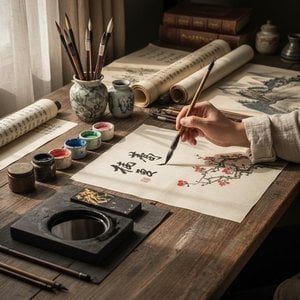
Embark on a sophisticated exploration of ink wash painting and Sumi-e. Uncover the profound historical lineages, Zen philosophies, and technical mastery behind this timeless medium in our authoritative guide for fine art enthusiasts.

Discover the profound serenity of timeless pastoral landscapes. From Impressionist masterpieces to bespoke oil commissions, explore how curated fine art brings the enduring beauty and tranquility of nature into your luxury home interior.

 Preview
 Send
Send Share
Share
 Details
 Guide
Guide

 Download
 Similars
 X-Ray
X-Ray Diaporama
 Stats
Stats

 Read More






































 Glass option is only available in size under 110 CM


