Museum-quality giclée or canvas print with fast production and flexible finish options. ( Buy Hand Made Painting Switch to Digital Image)
Pick from our preset sizes that match the artwork's original proportions.

Type the width and the height you need, to fit your frame or your wall. A print can only be cut, never made bigger than the picture, so a size with a different shape loses a part of the image. We send you a digital mockup to approve before we print anything. The picture shown on this page does not show the real cut — only the mockup does.
Worldwide Delivery () in 2 weeks instead of standard 4/5 weeks. (8 November)
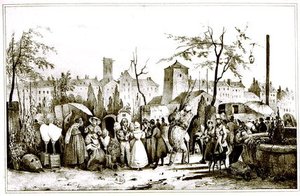
The Post-Chaise
Reproduction Size

Born into the vibrant artistic pulse of Paris in 1801, Jean Victor Adam emerged as a profound chronicler of a transformative era in French history. As the son of the esteemed engraver Jean Adam, his entry into the world of fine art was less a choice and more a destiny woven from the very ink and pigment of his upbringing. His early years were defined by rigorous discipline at the prestigious École des Beaux-Arts, where between 1814 and 1818, he immersed himself in the classical traditions of the masters. Under the watchful eyes of Charles Meynier and Jean-Baptiste Regnault, Adam absorbed the foundational principles of composition and form, yet his spirit possessed a restless energy that would eventually lead him beyond the rigid confines of Neoclassicism toward a more dynamic, narrative-driven style.
Adam’s artistic evolution is a fascinating study in versatility, moving seamlessly between the grand scale of historical oil painting and the intimate, widespread reach of lithography. In his early career, he gained significant acclaim for his ability to capture the fervor of military life and historical turning points. His works were often commissioned for prestigious institutions, such as the Museum at Versailles, where he depicted monumental events like The Entry of the French into Mainz and The Battle of Montebello. These paintings were not merely records of conflict but were imbued with a sense of movement and drama that resonated with the Romantic sensibilities of his time. He possessed a rare talent for rendering the chaos of battle alongside the quiet, dignified presence of the soldier, creating a tapestry of 19th-century French identity.
While his historical canvases commanded the halls of museums, it was Adam’s mastery of lithography that allowed his vision to permeate the broader public consciousness. After a period of relative withdrawal from the public eye, he returned in 1846 with a renewed dedication to the lithographic medium, producing works that celebrated the beauty of the natural world and the charm of the French landscape. This phase of his career revealed a more observational, almost lyrical side of his talent. His lithographic albums, such as Views in the Environs of Paris and his detailed studies of animals for the works of Buffon, showcased an exquisite command over line and tonal gradation, proving that he could evoke profound emotion through the subtle interplay of black ink on paper.
The breadth of his subject matter remains one of his most enduring legacies. His oeuvre is characterized by a remarkable range, encompassing:
Ultimately, Jean Victor Adam stands as a bridge between the structured academicism of the early century and the expressive freedom of the later Romantic movement. His ability to navigate the complexities of both the monumental and the minute allowed him to leave an indelible mark on French art. Whether through the sweeping brushstrokes of an oil painting or the delicate precision of a lithograph, Adam’s work continues to invite viewers into a world where history, nature, and human emotion converge in a timeless, visual symphony.

1801 - 1866 , France
 Preview
 Send
Send Share
Share
 Details
 Guide
Guide

 Download
 Similars
 X-Ray
X-Ray Diaporama
 Q&A
Q&A
 Stats
Stats Read More






































 Glass option is only available in size under 110 CM