
x


 Acrylic On CanvasWallArtNeo-Expressionist
 1982
1982 172.0 x 259.0 cm
 The Broad
Museum-quality giclée or canvas print with fast production and flexible finish options. ( Buy Hand Made Painting Buy Image)





























Pick from our preset sizes that match the artwork's original proportions.

You may enter your own dimensions to fit a specific frame or space. If your selected size does not match the original image's proportions, we will either crop the artwork or extend the image with a mirrored or solid-fill edge. A digital mockup will be sent for your approval before production begins.
Please note that the on-screen preview does not reflect the actual cropping or extension. Only the mockup will accurately show the final composition.
While custom sizes are available, we recommend selecting a dimension from the predefined list to preserve the original proportions.
Worldwide Delivery () in 2 weeks instead of standard 4/5 weeks. (5 September)


Obnoxious Liberals
Reproduction Size
To stand before Jean-Michel Basquiat’s "Obnoxious Liberals" is to be enveloped in an immediate, visceral confrontation with modern cultural critique. This monumental piece, executed in 1982, does not whisper its message; it bellows it across the canvas. The work pulses with the raw, untamed energy characteristic of neo-expressionism, a style that allowed Basquiat to channel the chaotic vibrancy of urban life and intellectual ferment into something undeniably powerful. Viewing the composition—the central figure dramatically outstretched against a stark red wall, surrounded by figures adorned with chains or restrictive ties—one cannot help but feel the weight of historical commentary pressing down from the canvas itself.
Basquiat’s vocabulary was always one of potent symbols drawn from street art, academic texts, and socio-political unrest. In "Obnoxious Liberals," the symbolism is dense and immediate. The vibrant red background acts less as a mere backdrop and more as an emotional field—a charged space reflecting passion, warning, or perhaps even revolutionary fervor. The figures themselves seem caught in a tableau of societal constraint; the chains suggest bondage to outdated ideologies or systemic limitations. Meanwhile, the central figure’s open posture contrasts sharply with this perceived confinement, embodying a struggle for authentic self-expression against prevailing dogma. It is a visual argument rendered in acrylic on canvas.
The sheer scale of this work, measuring 172 x 259 cm, contributes significantly to its overwhelming presence. Basquiat’s technique here is masterful in its apparent spontaneity. The application of acrylic paint is vigorous, layered, and immediate, giving the surface a palpable texture that invites close inspection. One can almost hear the scraping sound of the paint being applied, the urgency behind every mark. This rawness is not accidental; it is integral to the piece’s narrative power, mirroring the urgent dialogue Basquiat was having with the art world and its prevailing structures.
Created in 1982, "Obnoxious Liberals" captures a moment of intense cultural reckoning. The painting speaks to the anxieties and ideological battles brewing beneath the polished surface of late 20th-century society. It is an artifact steeped in the intellectual ferment of its time—a visual scream against complacency. For the collector or designer seeking art that does not merely decorate but actively participates in a conversation, this piece offers profound depth. Reproducing this work allows one to bring that same electrifying, thought-provoking dialogue into a contemporary space.

Jean-Michel Basquiat erupted onto the 1980s art scene as a force of raw energy and intellectual depth, an impact that continues to resonate profoundly today. Born on December 22, 1960, in Brooklyn, New York, to a Haitian father and Puerto Rican mother, his upbringing was a vibrant tapestry woven with diverse cultures and languages—Spanish, English, and French filled his childhood home. This multilingual environment, coupled with his mother’s dedication to artistic pursuits—she enrolled him as a Junior Member of the Brooklyn Museum at age six—laid an early foundation for his creative journey. However, Basquiat's life wasn’t without hardship; a car accident at eight years old resulted in a splenectomy and a period of convalescence during which he became captivated by a copy of *Gray’s Anatomy* gifted by his mother. The book’s detailed illustrations would later profoundly influence the anatomical imagery that frequently appears in his work, becoming a haunting motif throughout his career. Before achieving recognition as a painter, Basquiat made his mark under the pseudonym SAMO, alongside friend Al Diaz. Together they covered Lower Manhattan with cryptic, poetic graffiti—epigrams challenging societal norms and questioning established power structures. These weren’t mere tags; they were thought-provoking statements that captured the spirit of the burgeoning hip-hop culture and the gritty energy of 1970s New York City. SAMO was more than just street art; it was a philosophical intervention, a visual disruption designed to provoke dialogue and challenge perceptions.
By the early 1980s, Basquiat transitioned from graffiti to canvas, rapidly gaining recognition within the New York art world. His paintings weren’t easily categorized; they were a unique synthesis of influences ranging from Abstract Expressionism to tribal art, comic books, and historical painting. He became a central figure in the Neo-Expressionist movement, though he resisted easy labeling. His canvases are characterized by a frenetic energy—a chaotic layering of text, symbols, figures, and colors. Basquiat’s technique was deliberately raw and improvisational, often incorporating collage, scratching, and dripping paint. He wasn't interested in technical perfection; instead, he sought to convey emotion, ideas, and social commentary with visceral immediacy. Recurring motifs—crowns, skulls, anatomical diagrams, words crossed out or repeated—became his signature visual language. The crown, perhaps his most iconic symbol, has been interpreted as a representation of aspiration, self-mythologization, and the complexities of Black identity in America. His work frequently grappled with themes of wealth versus poverty, integration versus segregation, and the internal struggles of the individual within society. Paintings like *Piscine versus the Best Hotels (or various loin)* exemplify his ability to juxtapose seemingly disparate elements—luxury and deprivation, beauty and decay—creating a powerful commentary on social inequalities. Basquiat’s art was not merely about what he depicted but how he depicted it, creating a visual language that was both deeply personal and universally resonant.
Basquiat’s ascent was meteoric. In 1982, at just twenty-one years old, he participated in Documenta in Kassel, Germany, becoming the youngest artist ever to exhibit there. The following year, he showcased his work at the Whitney Biennial, further solidifying his position within the art establishment. A pivotal moment came with his friendship and artistic collaboration with Andy Warhol. The two artists pushed each other creatively, exploring themes of consumerism, celebrity, and mass media in a series of collaborative paintings. While their partnership was complex and sometimes fraught with tension, it undoubtedly elevated both artists’ profiles. Despite achieving international acclaim and financial success, Basquiat struggled with the pressures of fame and his ongoing battle with drug addiction. His work became increasingly introspective and darker as he grappled with personal demons and societal injustices. Tragically, Jean-Michel Basquiat died on August 12, 1988, at the age of twenty-seven from a heroin overdose. His untimely death cemented his status as a tragic figure—a brilliant artist whose life was cut short by addiction and the complexities of navigating the art world.
In the years since his death, Basquiat’s reputation has only grown. His work continues to captivate audiences with its raw energy, intellectual depth, and unflinching social commentary. In 2017, *Untitled* (1982), a powerful depiction of a skull, sold for $110.5 million at Sotheby's, setting a new record for any U.S. artist at auction—a testament to the enduring value and cultural significance of his work. Basquiat’s influence can be seen in the work of countless contemporary artists, particularly those who explore themes of identity, race, and social justice. He paved the way for a more diverse and inclusive art world, challenging traditional notions of artistic expression and representation. His ability to seamlessly blend high and low culture—graffiti, fine art, music, poetry—continues to inspire artists today. He remains a potent symbol of creative rebellion, intellectual curiosity, and the power of art to challenge the status quo. His paintings are not merely aesthetic objects; they are windows into a complex mind grappling with profound questions about humanity, society, and the search for meaning in a chaotic world.
Here are some defining works that encapsulate Basquiat’s artistic vision:
Basquiat’s art consistently addressed issues of racial inequality, the legacy of colonialism, and the complexities of Black identity. He used his platform to challenge dominant narratives and give voice to marginalized communities. His work remains profoundly relevant today, prompting viewers to confront uncomfortable truths about society and their own biases. He wasn't simply an artist; he was a cultural commentator, a poet, and a visionary who left an indelible mark on the art world and beyond.

1960 - 1988 , United States of America
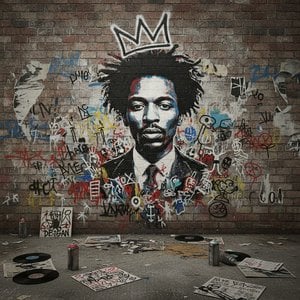
Explore the raw energy of Jean-Michel Basquiat and Neo-Expressionism. Discover how urban rebellion redefined modern art through a lens of luxury, identity, and profound emotional intensity for the discerning collector.

Unlock your creative potential with this expert guide for art students. Master acrylic painting techniques, from fluid washes to textured impasto. Learn about essential brushes, surfaces, and advanced color theory to elevate your fine arts practice with professional precision.

Discover the vibrant world of acrylic on canvas. Our expert guide explores the technical versatility, rich textures, and enduring beauty of modern acrylic masterpieces, offering essential insights for discerning art collectors seeking quality and longevity.


Stay updated with the latest art news, exclusive offers, and decoration ideas.
Tell us about your project and our art experts will provide you with 3 personalized art suggestions.
Let Us Curate 3 Options Just for You - Free!

 Preview
 Send
Send Share
Share
 Details

 Download
 Similars
 X-Ray
X-Ray Diaporama
 Read More







 Glass option is only available in size under 110 CM


