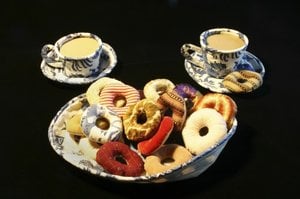
The artwork displayed on this page is protected by copyright law, which means we cannot legally create or sell an identical reproduction. This protection is enforced under international agreements such as the Berne Convention and by national laws, including those outlined by the U.S. Copyright Law - Title 17.
As a respectful and legal alternative, we offer custom, hand-painted artworks inspired by the original. Our skilled and professional artists carefully study the original's style, mood, and artistic essence to create a new, unique piece that evokes the same feeling - while remaining an original creation in its own right.
This method fully complies with copyright regulations because it does not involve copying or duplicating the protected artwork. Instead, it is a creative reinterpretation - a new painting that is influenced by the original but not identical to it.
Hand-painted oil on canvas in your size and frame, made to order by our artists. ( Switch to Print Switch to Digital Image)
Pick from our preset sizes that match the artwork's original proportions.

Type the width and the height you need, to fit your frame or your wall. This is hand-painted, so for a size with a different shape the artist can paint a bit more around the picture, or cut a bit — you choose. We send you a digital mockup to approve before the painting starts. The picture shown on this page does not show the real result — only the mockup does.
Worldwide Delivery () in 3/4 weeks instead of standard 5 weeks. (27 October). No compromise on quality.
Fields
Reproduction Size

To understand the vibrant, often subversive essence of Jann Haworth’s work, one must first look to the sun-drenched, creatively charged atmosphere of her Hollywood upbringing. Born in 1942, Haworth was immersed in a world where art was not merely an academic pursuit but a way of life. Her lineage provided a unique dual foundation: from her mother, Miriam Haworat, a distinguished ceramist and painter, she inherited the tactile intimacy of craft and the precision of needlework; from her father, Ted Haworth, an Academy Award-winning art director, she gained a cinematic eye for scale, set design, and the theatricality of space. This early exposure to both the delicate stitch and the grand production set would later coalesce into her signature style, where the domestic and the monumental meet in unexpected, often unsettling ways.
Her academic path took her from the University of California, Los Angeles, to the heart of the London art scene in 1961. Enrolling at the Courtauld Institute of Art and the Slade School of Fine Art, Haworth found herself navigating a landscape that was as intellectually stimulating as it was socially restrictive. In an era where female artists were often relegated to the periphery of male-dominated institutions, Haworth embraced a spirit of defiance. She did not merely participate in the art scene; she sought to disrupt its very fabric. This rebellious energy became the heartbeat of her practice, driving her to utilize materials traditionally dismissed as "feminine" or "decorative"—such as textiles, quilts, and soft fabrics—to challenge the rigid hierarchies of the fine art world.
Haworth’s most enduring contribution to cultural history arrived in 1967, through a collaborative masterpiece that would redefine visual language for a generation. As a co-creator of The Beatles’ Sgt. Pepper's Lonely Hearts Club Band album cover, she helped construct a kaleidoscopic collage of historical figures and pop culture icons. This achievement was more than a feat of graphic design; it was an exercise in assemblage that mirrored the psychedelic, boundary-pushing spirit of the decade. Through this work, Haworth’s ability to blend high art with mass media became etched into the global consciousness, positioning her at the very vanguard of the Pop Art movement.
Beyond the iconic imagery of Sgt. Pepper, Haworth pioneered the medium of soft sculpture, a technique that allowed her to explore themes of identity and the subconscious through pliable, organic forms. Her work often functions as a surrealist dialogue between the real and the simulated. In pieces like Pop, she utilizes intricate quilting and textile elements to create figures that feel both whimsical and hauntingly aged. By employing the language of folk art and domestic craft, she elevates the "soft" to something profound, using texture and volume to evoke a sense of memory, loss, and the layered complexities of the human experience.
The significance of Jann Haworth’s career lies not only in her aesthetic innovations but in her steadfast commitment to feminist advocacy. Throughout her life, she has remained a vocal proponent for the representation of women within the art historical canon. Her work serves as a continuous critique of gender roles, using the very tools of domesticity—sewing, fabric, and pattern—to dismantle the stereotypes associated with them. She transformed the "feminine" medium into a powerful instrument of political and social commentary.
Today, Haworth’s legacy is viewed through a lens of immense historical importance. Her ability to weave together the following elements defines her enduring impact:
As her work continues to be celebrated in galleries and museums worldwide, Jann Haworth remains a vital figure whose textured, layered, and unapologetically bold vision continues to inspire new generations of artists to push against the boundaries of what is considered "art."

1942 -

 Preview
 Send
Send Share
Share
 Details
 Guide
Guide

 Download
 Similars
 X-Ray
X-Ray Diaporama
 Stats
Stats
 Read More






































 Glass option is only available in size under 110 CM