The artwork displayed on this page is protected by copyright law, which means we cannot legally create or sell an identical reproduction. This protection is enforced under international agreements such as the Berne Convention and by national laws, including those outlined by the U.S. Copyright Law - Title 17.
This method fully complies with copyright regulations because it does not involve copying or duplicating the protected artwork. Instead, it is a creative reinterpretation - a new painting that is influenced by the original but not identical to it.
Museum-quality giclée or canvas print with fast production and flexible finish options. ( Buy Hand Made Painting Switch to Digital Image)





























Pick from our preset sizes that match the artwork's original proportions.

Type the width and the height you need, to fit your frame or your wall. A print can only be cut, never made bigger than the picture, so a size with a different shape loses a part of the image. We send you a digital mockup to approve before we print anything. The picture shown on this page does not show the real cut — only the mockup does.
Worldwide Delivery () in 2 weeks instead of standard 4/5 weeks. (22 October)
Grace profile
Reproduction Size
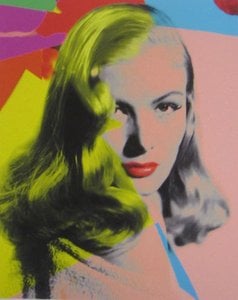
The painting presents a profile view of a woman's face set against a background of varied shapes and patterns. Her hair is rendered in distinct segments of blue, green, yellow, red, and orange. These colors follow the contours of her locks, creating a multi-colored texture that contrasts with the skin tones of her face. The application of paint includes visible layers that suggest the use of makeup on the subject. The background contains geometric and organic forms in bright hues, which intersect with the edges of the figure. This arrangement creates a sharp boundary between the subject and the surrounding space.
The technique utilizes the Pop Art style, characterized by bold outlines and a saturated palette. Each color is applied with enough density to maintain its individual identity within the larger composition. The use of different pigments in the hair provides a sense of movement through color shifts rather than through traditional shading. The facial features are defined by precise lines that separate the skin from the colorful elements of the hair and background.
James Gill, an American artist born in Truth or Consequences, United States of America, developed a visual language rooted in the Pop Art movement. This specific work utilizes the high-contrast approach common to mid-century pop aesthetics. The subject's features are framed by a chaotic arrangement of color, which directs the eye toward the central profile. The interaction between the woman's face and the patterned background creates a sense of energy through chromatic tension.
The emotional weight of the piece resides in its intensity. By using primary and secondary colors in close proximity, the artist produces a visual frequency that is loud and direct. There is no soft transition between the subject and her environment; instead, the painting relies on the strength of the color blocks to hold the viewer's attention. The result is a portrait that emphasizes the physical presence of the figure through the sheer density of pigment.
The color composition of "Grace profile" by James Gill combines a statement contrast with a discordant palette harmony.
"Grace profile" is executed in painting.
"Grace profile" was created by James Gill. The information on this page describes James Gill's original work.

Born in 1934 in Truth or Consequences, New Mexico, though formative years were spent in the Texan landscapes of Tahoka and San Angelo, James Francis Gill emerged as a pivotal figure within the burgeoning Pop Art movement. His story is one of early artistic inclination nurtured by his mother, an interior decorator with an entrepreneurial spirit, alongside youthful dreams of a different kind – those of a rodeo cowboy. This blend of practicality and imagination would later inform his unique approach to artmaking. Even during his military service in the United States Marines (1953-1956), Gill’s creative drive found expression as a draftsman designing posters, honing technical skills that would prove invaluable. His formal education at San Angelo College and later the University of Texas at Austin, initially focused on architecture before shifting decisively towards art, laid the groundwork for his distinctive visual language. It was a foundation built not just on artistic principles but also on an understanding of structure and design.
The year 1962 marked a turning point. Gill’s relocation to Los Angeles, armed with a portfolio including the striking “Women in Cars,” led him directly to Felix Landau Gallery, initiating a relationship that would propel his career forward. However, it was the acquisition of his *Marilyn Triptych* by the Museum of Modern Art in November of the same year – a gift from John and Dominique de Menil – that catapulted Gill into international recognition. This work wasn’t merely a portrait; it was a complex commentary on celebrity culture, capturing the multifaceted persona of Marilyn Monroe with a boldness and emotional depth rarely seen in early Pop Art. The triptych's impact resonated deeply within the art world, solidifying his position alongside contemporaries like Warhol and Lichtenstein. Early recognition continued with exhibitions featuring “Laughing Women in Car and Close-Up” alongside works by masters such as Picasso and Odilon Redon. Yet, Gill’s artistic trajectory wouldn’t remain confined to glamorous portraits. By 1965, a shift began, influenced by the escalating turmoil of the Vietnam War and broader social unrest. His teaching position at the University of Idaho became a crucible for darker themes, manifesting in a series of anti-war paintings depicting civil and military leaders caught in moments of moral ambiguity – figures, as playwright William Inge described them, “caught in some nefarious act.” This culminated in *The Machines*, a powerful work that fused media coverage of the war with visceral depictions of combat, exposing the dehumanizing aspects of conflict. Gill distinguished himself through his unique blend of expressionistic techniques and the meticulous use of graphite pencil, imbuing his works with an emotional resonance often absent in the more detached aesthetic of other Pop artists.
Gill’s artistic voice continued to gain international traction. Participation in “São Paulo 9 - Environment United States” in 1967, alongside Warhol and Hopper, underscored his growing prominence on the global stage. A commission from Time Magazine to create a quadriptych portrait of Alexander Solzhenitsyn – charting the author's transformation from political prisoner to celebrated dissident – further demonstrated his ability to tackle complex socio-political themes with nuance and power. Despite this peak in recognition during the 1970s, Gill made a surprising decision: he retreated from the art scene for approximately three decades. This wasn’t an abandonment of creativity but rather a period of quiet reflection and exploration. Around 30 years later, he re-emerged with innovative techniques involving inkjet printing and gel mediums, creating vibrant and textured works that built upon his earlier explorations while embracing new possibilities. These weren't simply a return to form; they were a reinvention, demonstrating an artist unwilling to rest on past laurels.
James Gill’s rediscovery reaffirmed his importance as a significant American artist. His later work continued to grapple with themes of political imprisonment, social commentary, and the human condition, solidifying his legacy as an artist who consistently challenged conventions. He is recognized not just as a Pop Art pioneer but as an artist whose emotionally charged style set him apart from many of his contemporaries. Gill’s willingness to address controversial topics like the Vietnam War elevated his work beyond superficial critiques of consumer culture, adding layers of socio-political depth and intellectual rigor. The combination of expressionistic techniques with graphite pencil – and later, innovative printing methods – created a distinctive visual language that continues to resonate with audiences today. His art is a testament to the power of individual vision and the enduring relevance of social commentary. Gill’s influence extends beyond his own creations; he inspires artists to engage critically with the world around them, using their work as a platform for dialogue and change.

1934 - , United States of America

Explore the profound impact of the Pop Art Revolution on modern aesthetics. From Lichtenstein’s dots to Warhol’s icons, gain expert insights into how this vibrant movement redefined culture through consumerism and mass media. A definitive guide for art lovers and collectors.

Explore the profound impact of Pop Art on modern aesthetics. From Warhol’s icons to Lichtenstein's bold dots, discover how mass media redefined the masterpiece and continues to inspire sophisticated art collectors and contemporary interior design.

Dive into the vibrant world of Pop Art. Explore iconic masterpieces from Warhol to Haring, discover how bold colors and mass media redefined art history, and learn to curate high-impact, colorful pieces for your modern home collection.

Explore the visceral power of Aggressive Confrontational Pop. From the rebellion of NO!art to Neo-Pop icons, discover how bold aesthetics and social critique redefined modern art for today's discerning collectors.

 Preview
 Send
Send Share
Share
 Details
 Guide
Guide

 Download
 Similars
 X-Ray
X-Ray Diaporama
 Stats
Stats

 Read More









 Glass option is only available in size under 110 CM