

Hand-painted oil on canvas in your size and frame, made to order by our artists. ( Switch to Print Switch to Digital Image)





























Pick from our preset sizes that match the artwork's original proportions.

Type the width and the height you need, to fit your frame or your wall. This is hand-painted, so for a size with a different shape the artist can paint a bit more around the picture, or cut a bit — you choose. We send you a digital mockup to approve before the painting starts. The picture shown on this page does not show the real result — only the mockup does.
Worldwide Delivery () in 3/4 weeks instead of standard 5 weeks. (22 October). No compromise on quality.
Fleurs et legumes
Reproduction Size
"Fleurs et legumes" belongs to the 19th-Century era.
The subjects of "Fleurs et legumes" are fruit composition, vegetable display, table setting, floral arrangement, color palette, texture contrast, belgium art.
The copyright answer for "Fleurs et legumes" by James Ensor: the work is in the public domain - its copyright has expired. This determines whether reproductions of the image may be freely made.

Born in Ostend, Belgium, in 1860, James Sidney Edouard Ensor emerged from a fascinating confluence of cultures—his father English, his mother Belgian. This duality perhaps foreshadowed the artist’s lifelong fascination with masks and disguise, themes that would come to dominate his unsettling yet captivating oeuvre. Growing up amidst the bustling energy of a seaside resort town, young James was deeply affected by the atmosphere of carnivals and curiosities. His parents operated a souvenir shop brimming with shells, carnival masks, and peculiar objects—a veritable cabinet of wonders that ignited his imagination and provided a rich visual vocabulary for his future art. Though initially hesitant to embrace traditional academic pursuits, Ensor eventually enrolled at the Académie Royale des Beaux-Arts in Brussels, but found its rigid structure stifling to his burgeoning artistic vision. He quickly realized he needed to forge his own path, one that would lead him far beyond conventional boundaries.
Ensor’s early paintings reflected a more traditional approach, depicting scenes of everyday life rendered in somber tones. Works like *Russian Music* (1881) and *The Drunkards* (1883) reveal a nascent talent grappling with realism, but even within these early pieces, hints of the unsettling imagery to come are present. A pivotal shift occurred as Ensor’s palette brightened and his subject matter grew increasingly bizarre. He began to populate his canvases with carnivals, skeletons, puppets, and allegorical figures—a world steeped in fantasy and often bordering on the grotesque. This wasn't merely a stylistic change; it was a deliberate exploration of the darker aspects of human existence, a rejection of societal norms, and an embrace of the irrational. His style became instantly recognizable for its bold brushwork, vibrant colors, and theatrical quality—a visual language uniquely his own. The influence of his childhood surroundings is undeniable: those carnival masks weren’t simply decorative elements; they were symbols of hidden identities, social critique, and the fragility of appearances.
Throughout his career, Ensor produced a series of works that continue to shock and fascinate audiences today. *The Scandalized Masks* (1883) stands as an early testament to his fascination with the power of disguise and its ability to reveal hidden emotions. Perhaps his most controversial work, *Christ's Entry into Brussels* (1888-1889), remains a powerful satire of religious hypocrisy and societal indifference—a painting initially met with harsh criticism but now celebrated as a masterpiece. The unsettling image of Christ entering a city teeming with grotesque masked figures is a potent commentary on the disconnect between spiritual ideals and human behavior. *Skeletons Fighting over a Hanged Man* (1891) offers a stark meditation on mortality, decay, and the absurdity of life, while *Tribulations of Saint Anthony* (1887) delves into complex allegorical themes of temptation, sin, and spiritual struggle. Recurring throughout his work are explorations of death, social critique, religious satire, and the boundless power of imagination—themes that resonate with a timeless relevance.
While Ensor resisted easy categorization, his artistic lineage is complex and fascinating. He acknowledged influences from masters like Pieter Bruegel the Elder, whose crowded scenes and moralizing narratives resonated with his own vision, as well as Francisco Goya, whose dark humor and unflinching depictions of human suffering left a lasting impression. James Abbott McNeill Whistler’s emphasis on aestheticism also played a role in shaping Ensor's artistic sensibilities. However, Ensor was not merely an imitator; he synthesized these influences into something entirely new and original. He is now widely recognized as a pivotal figure in the transition from 19th-century Symbolism to early 20th-century Expressionism and Surrealism—a true pioneer of modern art. His fearless exploration of the subconscious, his embrace of grotesque imagery, and his rejection of academic conventions paved the way for future generations of artists who dared to challenge artistic norms. Despite facing initial resistance, Ensor eventually gained recognition in his later years, being named a Baron by King Albert I in 1929 and awarded the Légion d'honneur in 1933. He died in Ostend in 1949, leaving behind a body of work that continues to captivate, disturb, and inspire. His legacy endures as a testament to the power of art to confront uncomfortable truths and explore the depths of the human condition.

1860 - 1949 , Belgium

Explore the profound world of Clyfford Still's Abstract Expressionism with WahooArt. Discover his unique style, existential themes & investment potential. Expert analysis for discerning collectors.
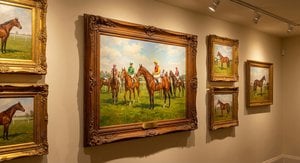
Explore 25 iconic Sir Alfred Munnings paintings! Discover the beauty of British Impressionism, equine art & rural England. Find museum-quality reproductions and elevate your home decor with WahooArt. Explore the full collection online.

Explore the unsettling yet captivating world of James Ensor, a pioneer of Expressionism. Discover his satirical masterpieces, symbolic imagery & lasting influence on modern art. High-quality reproductions available at WahooArt.

Journey through 25 iconic James Abbott McNeill Whistler paintings! Explore his masterpieces of Aestheticism, from 'Nocturne in Black and Gold' to captivating portraits. Find museum-quality art reproductions & elevate your home decor with WahooArt.com. Discover the full collection online.

Explore the rich history of still life painting with WahooArt. Discover Dutch Masters, decode vanitas symbolism & learn about collecting timeless art. Expert insights and museum-quality reproductions.

 Preview
 Send
Send Share
Share
 Details
 Guide
Guide

 Download
 Similars
 X-Ray
X-Ray Diaporama
 Stats
Stats

 Read More









 Glass option is only available in size under 110 CM


