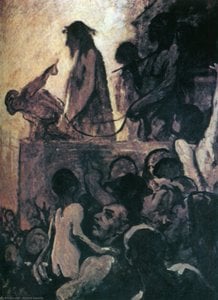
Au conservatoire by James Ensor, hand-painted oil painting reproduction by a master artist
Preview AR preview Switch to Print Switch to Digital Image Send
Details Guide Add to favorites Download Similars X-Ray Diaporama Q&A Presentation Stats

Au conservatoire Hand-painted oil painting reproduction

James Ensor's 'Au Conservatoire' is an Expressionist masterpiece brimming with unsettling figures and satirical humor. Explore the painting’s layered symbolism, masks, and critique of Belgian society through a unique, captivating visual experience.

A pioneer of Expressionism known for Christ's Entry into Brussels. Explore his haunting world of masks and shadows today.

Hand Made Oil Reproduction

Hand-painted oil on canvas in your size and frame, made to order by our artists. ( Switch to Print Switch to Digital Image)


Corner sample of the P118B picture frame: moulded polystyrene, 5 cm wide and 3 cm thick
P118B $10
Corner sample of the P118H picture frame: moulded polystyrene, 5 cm wide and 3 cm thick
P118H $10
Corner sample of the P118W picture frame: moulded polystyrene, 5 cm wide and 3 cm thick
P118W $10
Corner sample of the P438Z picture frame: moulded polystyrene, 5.5 cm wide and 3.5 cm thick
P438Z $10
Corner sample of the P508JH picture frame: moulded polystyrene, 7 cm wide and 3.5 cm thick
P508JH $12
Corner sample of the P508YH picture frame: moulded polystyrene, 7 cm wide and 3.5 cm thick
P508YH $12
Corner sample of the P805H picture frame: moulded polystyrene, 5 cm wide and 3.5 cm thick
P805H $10
Corner sample of the P805Z picture frame: moulded polystyrene, 5 cm wide and 3.5 cm thick
P805Z $10
Corner sample of the P919BZ picture frame: moulded polystyrene, 7 cm wide and 3.5 cm thick
P919BZ $10
Corner sample of the P919G picture frame: moulded polystyrene, 7 cm wide and 3.5 cm thick
P919G $10
Corner sample of the P919XJ picture frame: moulded polystyrene, 7 cm wide and 3.5 cm thick
P919XJ $10
Corner sample of the P959ZH picture frame: moulded polystyrene, 5 cm wide and 3 cm thick
P959ZH $10
Corner sample of the P968JZ picture frame: moulded polystyrene, 6 cm wide and 4 cm thick
P968JZ $12
Corner sample of the W106C picture frame: solid wood, 5 cm wide and 3 cm thick
W106C $8
Corner sample of the W218G picture frame: solid wood, 5 cm wide and 3 cm thick
W218G $10
Corner sample of the W218JH picture frame: solid wood, 5 cm wide and 3 cm thick
W218JH $8
Corner sample of the W218Y picture frame: solid wood, 5 cm wide and 3 cm thick
W218Y $10
Corner sample of the W307PJ picture frame: solid wood, 6 cm wide and 3 cm thick
W307PJ $10
Corner sample of the W316G picture frame: solid wood, 6 cm wide and 3 cm thick
W316G $10
Corner sample of the W316PJ picture frame: solid wood, 6 cm wide and 3 cm thick
W316PJ $8
Corner sample of the W316Y picture frame: solid wood, 6 cm wide and 3 cm thick
W316Y $10
Corner sample of the W398PJ picture frame: solid wood, 5 cm wide and 3 cm thick
W398PJ $8
Corner sample of the W4111J picture frame: solid wood, 6.5 cm wide and 3.5 cm thick
W4111J $10
Corner sample of the W500HY picture frame: solid wood, 7 cm wide and 5 cm thick
W500HY $15
Corner sample of the W500JH picture frame: solid wood, 7 cm wide and 5 cm thick
W500JH $15
Corner sample of the W692G picture frame: solid wood, 8 cm wide and 4 cm thick
W692G $12
Corner sample of the W849H picture frame: solid wood, 5 cm wide and 3 cm thick
W849H $8
Corner sample of the W940BG picture frame: solid wood, 7.5 cm wide and 4.5 cm thick
W940BG $15
Corner sample of the W953PJ picture frame: solid wood, 6 cm wide and 3.5 cm thick
W953PJ $8

Standard
custom
CM
INCH

Pick from our preset sizes that match the artwork's original proportions.

width
height

Type the width and the height you need, to fit your frame or your wall. This is hand-painted, so for a size with a different shape the artist can paint a bit more around the picture, or cut a bit — you choose. We send you a digital mockup to approve before the painting starts. The picture shown on this page does not show the real result — only the mockup does.

Examples of what can be changed: Replace face with customer photo; Add pet (e.g., replace cat with dog); Include hidden message in background; Change background landscape or elements.
After order, WahooArt.com team will email client for instructions and provide a mockup preview

Worldwide Delivery () in 3/4 weeks instead of standard 5 weeks. (15 November). No compromise on quality.

Free Worldwide Express Shipping
High-Quality Linen Canvas
Full Shipping Insurance
Customs Tax Refund Guarantee
True Color Matching Guarantee
100-Day Return Policy (Defects Only)
100% Money-Back Guarantee
Bulk Discount Offer

Total Price

$ 272

Au conservatoire

Reproduction Medium

Reproduction Size

-

Total Price

$ 272

Quick Facts

  • Year: 1902
  • Notable elements: Masks, satire, hareng-saur
  • Title: Au Conservatoire
  • Influences:
    • Wagnerism
    • Carnival
  • Dimensions: 56 x 71.5 cm
  • Artist: James Ensor

Art Quiz

There is only one correct answer for each question.

Question 1:
What artistic movement is most closely associated with James Ensor’s ‘Au Conservatoire’?
Question 2:
The painting 'Au Conservatoire' primarily utilizes what color palette?
Question 3:
What is the significance of the numerous objects depicted in ‘Au Conservatoire’?
Question 4:
Which of the following best describes James Ensor’s style as evident in ‘Au Conservatoire’?
Question 5:
The inclusion of a ‘hareng-saur’ (a type of herring) in the painting is most likely intended to convey:

A Window into the Psyche: Unpacking James Ensor’s *Au Conservatoire*

James Ensor's 1902 painting, *Au Conservatoire*, isn’t merely a depiction of a scene; it’s an unsettling plunge into the artist’s uniquely warped perception of reality. This work, housed within the Musée d'Orsay in Paris, stands as a cornerstone of Expressionism – a movement that prioritized raw emotion and subjective experience over objective representation. More than just a portrait or still life, *Au Conservatoire* is a meticulously constructed tableau designed to provoke, to challenge, and ultimately, to reveal the anxieties simmering beneath the surface of Belgian society at the turn of the 20th century.

The painting immediately commands attention with its deliberate lack of harmony. A central figure, seemingly directing our gaze with a pointed stick, dominates the composition, yet his purpose remains ambiguous. Surrounding him is a chaotic collection of individuals – men in ties, a woman holding sheet music, and a scattering of objects: a bowl overflowing with what appears to be a disconcerting assortment of items, a knife and fork resting on a table, a bottle, two cell phones—each element contributing to the painting’s overall sense of unease. The use of sepia tones lends an air of timelessness, reminiscent of old photographs, yet this formality is immediately undermined by the distorted figures and jarring juxtapositions.

The Language of Distortion: Style and Technique

Ensor's masterful manipulation of form and color is central to *Au Conservatoire’s* impact. The figures are rendered with a deliberate lack of detail, their faces often obscured by masks or distorted expressions. This technique isn’t simply stylistic; it serves to strip away any semblance of conventional beauty or social decorum, exposing the underlying anxieties and tensions within the scene. Notice how the perspective is subtly skewed, creating a sense of disorientation and pulling the viewer into the painting's unsettling atmosphere. The artist employs a bold, almost frantic brushstroke, adding to the feeling of agitation and instability.

Furthermore, the inclusion of seemingly random objects – the hareng-saur (a type of herring), a canard (duck), and even a cat—functions as a deliberate disruption. These elements, presented with an almost absurd intensity, suggest a critique of bourgeois values and societal pretensions. The inscription on the back of the painting, “He.Y.HOTO.yo / Ho y Ho Ho / HAUT Y HAUT / TROP HAUT / TROP D’EAU / CONSERVATOIRE / ROYAL,” adds another layer of complexity, hinting at a satirical commentary on the rigid hierarchy and self-importance within the musical establishment.

Contextualizing the Discomfort: Expressionism and Beyond

*Au Conservatoire* is deeply rooted in the context of early 20th-century Expressionism. Artists like Egon Schiele, known for his emotionally charged portraits and unsettling imagery, and Pablo Picasso, whose exploration of form and psychology profoundly influenced the movement, were grappling with similar themes of alienation, anxiety, and the fragmentation of modern life. Ensor’s work shares a kinship with these artists, yet possesses a uniquely Belgian sensibility – a darkly humorous critique of national identity and social conventions.

The painting's influence extends beyond its immediate historical context. The use of masks, grotesque figures, and symbolic objects anticipates later developments in Surrealism and continues to resonate within contemporary art. Reproductions of *Au Conservatoire*, particularly those crafted by WahooArt.com, offer a remarkable opportunity to experience the power and complexity of this seminal work, allowing viewers to engage with Ensor’s vision on a deeper level.

To explore further, consider visiting the Musée d'Orsay in Paris or delving into James Ensor’s extensive body of work. And for a truly immersive experience, we invite you to commission a hand-painted reproduction of *Au Conservatoire* – a timeless piece that will undoubtedly become a captivating centerpiece in your collection.

Questions & Answers

How do the colors of "Au conservatoire" by James Ensor relate to its emotion?

The neutrals palette of "Au conservatoire" by James Ensor goes together with its melancholic emotional tone. Color is one of the ways a work conveys feeling.

Toward which tone does "Au conservatoire" lean?

The dominant hue of "Au conservatoire" by James Ensor is green to violet spectrum. The hue is the underlying tone of the palette.

What use and space are recommended for "Au conservatoire" by James Ensor?

"Au conservatoire" is suggested for statement, and the recommended space is a living room.


Artist Biography

Early Life, Family and Artistic Training

James Ensor was born on April 13, 1860, in Ostend, Belgium. His identity was shaped by a specific cultural intersection: his father, James Frederic Ensor, was born in Brussels to English parents, while his mother, Maria Catherina Haegheman, was Belgian. This dual heritage provided a foundation for a perspective that often sat outside the narrow confines of local tradition. Growing up, the artist lived within the walls of a souvenir shop operated by his parents in Ostend. This environment was not merely a place of residence but a repository of the strange and the ornamental. The shop was filled with shells, carnival masks, and peculiar objects that provided a visual vocabulary for his later work.

His formal education in art was a process of trial and error. Before entering the structured environment of the academy, he began his artistic training under two local painters. This early instruction provided the technical groundwork that he would later manipulate and distort. From 1877 to 1880, he attended the Académie Royale des Beaux-Arts in Brussels. Even within these academic walls, his interests remained distinct from the rigid expectations of the institution. He was not a student of the status quo; he was a student of the objects that surrounded him in Ostend.

The Evolution of His Artistic Style

Ensor’s early output lacked the psychological friction that defines his mature work. In pieces like Russian Music (1881) and The Drunkards (1883), he worked within a somber, realistic framework. These compositions relied on muted tones and traditional depictions of everyday life. They show an artist still tethered to the gravity of realism before his visual language underwent a radical shift. He eventually abandoned this restraint, opting instead for a palette that brightened significantly as his subject matter grew increasingly bizarre.

The shift toward the grotesque was driven by a specific fascination with the mask. He was drawn to the plastic forms and the intense colors of the carnival masks found in his family's souvenir shop. These objects were not mere props; they became central to his aesthetic. He integrated them into his still lifes to introduce a theatrical quality, using them to disrupt the domesticity of the scene. This move toward the irrational allowed him to move beyond simple representation into a space of psychological tension.

Key Works and Major Themes

Ensor’s preoccupation with the mask and the grotesque provides a direct link to the psychological tensions of the modern era. In The Scandalized Masks (1883), he established an early interest in the power of disguise, using the carnival motif to strip away social pretenses. This fascination with the theatrical and the unsettling was not a mere stylistic choice but a method of exploring identity. His 1882 work The Oyster Eater demonstrates a different facet of his ability to handle light and color, depicting his sister Mitche in a scene that challenged the conservative sensibilities of the Antwerp Salon. The painting’s rejection by the establishment highlights the friction between his vision and the rigid norms of the time.

The artist’s shift toward more aggressive, expressive forms is most evident in his monumental compositions. Christ's Entry Into Brussels (1888-1889) functions as a forerunner of twentieth-century Expressionism, utilizing a chaotic, brightly-colored procession of grotesque figures to parody modern society. This sense of existential struggle is furthered in The Man of Sorrows (1891), an oil painting that combines the suffering of Christ with the jarring imagery of a Japanese Noh theatre mask. Such works reveal a man using religious and allegorical themes to express a profound frustration with human behavior and societal indifference.

Mortality and the absurdity of existence remain central to his output. Skeletons Fighting over a Hanged Man (1891) uses skeletal figures to confront the viewer with the reality of decay and death. These recurring themes of sin, temptation, and the fragility of appearances ensure his work remains a potent subject for study. His ability to synthesize these dark, often uncomfortable truths into a coherent visual language is what defines his contribution to the transition toward modernism.

Where to See His Works Today

Ensor’s presence in major international collections confirms his lasting impact on the development of modernism. In Antwerp, the Royal Museum of Fine Arts holds two significant works: The Man of Sorrows and The Oyster Eater. These pieces demonstrate the technical range of an artist who could move from religious tension to domestic scenes. His influence extends across the Atlantic, where the Museum of Modern Art in New York City preserves Tribulations of Saint Anthony. This work remains a primary example of his shift toward the bizarre and the psychological.

The reach of his imagery is global. The Getty Center in Los Angeles houses Entry of Christ into Brussels, a massive composition that captures his most aggressive social critiques. Meanwhile, the Kimbell Art Museum in Fort Worth maintains Skeletons Warming Themselves. These scattered locations ensure that his visual language, defined by its refusal to adhere to academic norms, remains accessible to a diverse audience of scholars and observers.

  • The Man of Sorrows
  • The Oyster Eater
  • Tribulations of Saint Anthony
  • Entry of Christ into Brussels
  • Skeletons Warming Themselves
James Ensor

James Ensor

1860 - 1949 , Belgium

Quick Facts

  • Artistic Movement Or Style:
    • Symbolism
    • Expressionism
  • Artists Or Movements Influenced By This Artist:
    • Expressionism
    • Surrealism
  • Artists Who Influenced This Artist:
    • Pieter Bruegel the Elder
    • Francisco Goya
    • James Abbott McNeill Whistler
  • Full Name: James Sidney Edouard Ensor
  • Nationality: Belgian
  • Notable Artworks:
    • Christ's Entry into Brussels
    • The Man of Sorrows
    • The Oyster Eater
    • Tribulations of Saint Anthony
    • Skeletons Fighting over a Hanged Man
  • Place Of Birth: Ostend, Belgium
  • Date Of Birth: 1860
  • Date Of Death: 1949
Explore artworks organized by themes, styles, and characteristics.