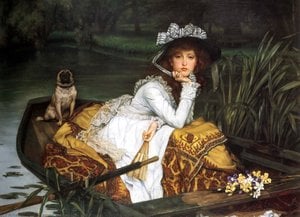
Hand-painted oil on canvas in your size and frame, made to order by our artists. ( Switch to Print Switch to Digital Image)





























Pick from our preset sizes that match the artwork's original proportions.

You may enter your own dimensions to fit a specific frame or space. If your selected size does not match the original image's proportions, we will either crop the artwork or extend the painting with additional hand-painted elements. A digital mockup will be sent for your approval before production begins.
Please note that the on-screen preview does not reflect the actual cropping or extension. Only the mockup will accurately show the final composition.
While custom sizes are available, we recommend selecting a dimension from the predefined list to preserve the original proportions.
Worldwide Delivery () in 3/4 weeks instead of standard 5 weeks. (22 September). No compromise on quality.


The Last Evening
Reproduction Size
In the soft, amber glow of a fading day, James Jacques Joseph Tissot’s 1873 masterpiece, “The Last Evening,” invites us to step aboard a vessel suspended between the elegance of the Belle Éponque and the quiet melancholy of an approaching night. This exquisite oil on canvas is far more than a mere maritime scene; it is a meticulously choreographed tableau of Victorian social grace. As the sun dips below the horizon, Tissot captures a group of well-dressed individuals gathered upon a yacht, their figures bathed in a warm, atmospheric light that seems to vibrate with the very essence of a departing era. The painting presents a window into the Victorian soul, where the opulence of high society meets a profound, quiet contemplation of mortality.
The scene unfolds with an intimate, almost voyeuristic quality, drawing the viewer into a social gathering that feels both grand and deeply personal. Men are gathered around a table, engaged in conversation that carries the weight of unspoken significance, while a woman sits nearby, her presence adding a layer of grace and perhaps a touch of wistful observation to the group. There is a palpable sense of psychological realism here; Tissot eschews the grand, heroic narratives common to his time to focus instead on the quiet, flickering moments of human connection. The setting—a boat adrift in the twilight—serves as a powerful metaphor for the fleeting nature of life and the transient beauty of social splendor.
Tissot’s technical prowess is on full display through his masterful use of muted tones and atmospheric luminescence. Eschewing the vibrant, clashing palettes favored by many of his contemporaries, he employs a sophisticated range of browns, blues, and golds to create a sense of depth and solemnity. His technique involves a painstaking glazing method, applying thin, translucent layers of paint to achieve a remarkable textural richness. This allows light to penetrate the surface of the canvas, giving the fabrics of the figures' clothing—intricate patterns that hint at the influence of Japonisme—a luminous, lifelike quality.
While firmly rooted in the traditions of Victorian narrative painting, there are unmistakable echoes of Impressionism within his brushwork. The way the light interacts with the sea and the surrounding atmosphere suggests a preoccupation with the ephemeral. For the collector or interior designer, this duality makes the piece incredibly versatile; it possesses the formal dignity required for classical settings, yet its soft, atmospheric qualities allow it to integrate seamlessly into more modern, contemporary spaces. It is a work that does not merely decorate a wall but transforms the very mood of a room, offering a sense of calm, historical depth, and sophisticated elegance.
To possess a reproduction of “The Last Evening” is to hold a piece of history that bridges the gap between French brilliance and British Victorian tradition. Tissot, born in Nantes but deeply connected to the London art scene, had a unique ability to capture the fashion and social nuances of his time with unparalleled precision. Every fold of fabric and every shadow cast by the setting sun tells a story of a world on the brink of massive industrial and societal change.
The emotional impact of the painting lies in its ability to evoke nostalgia—not just for a specific historical period, but for the universal human experience of witnessing beauty fade. It is an ideal selection for those seeking art that inspires conversation and provides a focal point of quiet reflection. Whether placed in a grand library, a sophisticated dining room, or a serene study, this painting serves as a timeless reminder of the grace found in life's most fleeting moments.


1836 - 1902 , France
Explore 25 iconic Sir Alfred Munnings paintings! Discover the beauty of British Impressionism, equine art & rural England. Find museum-quality reproductions and elevate your home decor with WahooArt. Explore the full collection online.

Discover the art of museum-quality oil painting reproduction. Explore our expert process, skilled artists & authentic replicas. Elevate your home with timeless beauty – handcrafted and customized to your vision.
Explore the captivating world of Jacques Joseph Tissot, a master painter of Belle Époque society. Discover his realism, Impressionistic style, and lasting influence on art history. Learn more at WahooArt.

Journey through 25 iconic James Abbott McNeill Whistler paintings! Explore his masterpieces of Aestheticism, from 'Nocturne in Black and Gold' to captivating portraits. Find museum-quality art reproductions & elevate your home decor with WahooArt.com. Discover the full collection online.

Explore the art & culture of the Belle Époque! Discover Impressionism, Realism, and iconic Parisian paintings from Degas, Béraud & more. High-quality reproductions at WahooArt.

 Preview
 Send
Send Share
Share
 Details
 Guide
Guide

 Download
 Similars
 X-Ray
X-Ray Diaporama
 Stats
Stats


 Read More







 Glass option is only available in size under 110 CM