Hand-painted oil on canvas in your size and frame, made to order by our artists. ( Switch to Print Switch to Digital Image)





























Pick from our preset sizes that match the artwork's original proportions.

You may enter your own dimensions to fit a specific frame or space. If your selected size does not match the original image's proportions, we will either crop the artwork or extend the painting with additional hand-painted elements. A digital mockup will be sent for your approval before production begins.
Please note that the on-screen preview does not reflect the actual cropping or extension. Only the mockup will accurately show the final composition.
While custom sizes are available, we recommend selecting a dimension from the predefined list to preserve the original proportions.
Worldwide Delivery () in 3/4 weeks instead of standard 5 weeks. (22 September). No compromise on quality.


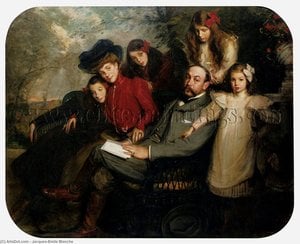
Miss Winny MacEwan
Reproduction Size
In the quiet, luminous depths of Jacques-Émile Blanche’s 1887 masterpiece, Miss Winny MacEwan, we find more than a mere portrait; we encounter a window into the soul of late 19th-century Parisian high society. The painting captures a moment of profound stillness, presenting a woman seated with an air of contemplative grace that transcends the canvas. As one gazes upon her, there is an immediate sense of intimacy, as if the viewer has stumbled upon a private moment of reflection in a sun-drenched salon. Blanche, a master of capturing the spirit of the Belle Époque, does not simply record a likeness; he orchestrates an atmosphere of refined dignity and subtle melancholy that lingers long after the first encounter.
The subject herself serves as the emotional anchor of the work. Positioned prominently within the frame, her face becomes the focal point where light and shadow perform a delicate dance. Her gaze, directed outward toward the spectator, is hauntingly introspective, hinting at unspoken emotions and a rich inner life. This psychological depth is what elevates the piece from a standard social portrait to a profound study of character, making it an irresistible centerpiece for those who appreciate art that speaks to the human condition.
Technically, Miss Winny MacEwan is a triumph of Impressionistic sensibility blended with a refined realism. Blanche employs a restrained and sophisticated palette, dominated by muted tones of cream, deep brown, and velvety black. This deliberate choice of color creates a luminous surface that mimics the soft, diffused light filtering through Parisian windows, casting gentle shadows that lend a sculptural three-dimensionality to the subject's features. The artist’s brushwork is characteristically loose yet purposeful, allowing for a textured surface that breathes with life.
For the discerning collector or interior designer, the tactile quality of this painting offers immense visual richness. Blanche demonstrates an acute sensitivity to materiality, meticulously rendering the intricate textures of the era's fashion. One can almost feel the delicate weight of the lace collars and the smooth, luxurious sheen of silk gowns. These fine details are not merely decorative; they contribute to the overall sense of luxury and historical authenticity. The interplay between the organic lines of the subject’s silhouette and the soft, blended backgrounds creates a sense of depth that makes the artwork feel as though it occupies its own physical space within a room.
To possess a reproduction of this caliber is to invite a piece of art history into one's personal sanctuary. Influenced by the legendary techniques of Manet and Whistler, Blanche’s work bridges the gap between the rigid academic traditions of the past and the emotive freedom of modernism. The painting embodies a sense of "quiet luxury"—a concept that remains as relevant in contemporary interior design as it was in 1887.
Whether placed in a formal study, a sophisticated living area, or a curated gallery wall, Miss Winny MacEwan provides a focal point of unparalleled elegance. It offers an aesthetic anchor that complements both classical and modern decor, bringing with it a sense of historical weight and emotional resonance. For those seeking to surround themselves with art that inspires contemplation and celebrates the enduring beauty of the human spirit, this portrait stands as an exquisite choice.


1861 - 1942 , France

Explore the captivating portraits of Jacques-Émile Blanche, a master Impressionist who captured the essence of Belle Époque society in Paris and London. Discover his unique style & lasting legacy.

Journey through 19th century art with WahooArt! Explore 10 iconic paintings – from Monet & Renoir to Courbet – and discover the stories behind Romanticism, Realism & Impressionism. Find museum-quality reproductions for your home decor. Explore the full collection online!

Discover Émile Munier's tender depictions of 19th-century French life. Explore his Realist style, charming paintings of children & pets, and lasting artistic legacy. Expert insights at WahooArt.

Explore the rich history of French art, from the Salon to Impressionism & beyond. Discover iconic masters, key movements, and expert guidance for collecting timeless masterpieces. WahooArt.

Explore the life & art of Émile Jean Horace Vernet, a master of Romantic Realism. Discover his captivating battle scenes, portraits, and Orientalist works – a window into 19th-century France. Learn about his techniques & enduring legacy.

 Preview
 Send
Send Share
Share
 Details
 Guide
Guide

 Download
 Similars
 X-Ray
X-Ray Diaporama
 Stats
Stats


 Read More







 Glass option is only available in size under 110 CM