x


Museum-quality giclée or canvas print with fast production and flexible finish options. ( Buy Hand Made Painting Buy Image)





























Pick from our preset sizes that match the artwork's original proportions.

You may enter your own dimensions to fit a specific frame or space. If your selected size does not match the original image's proportions, we will either crop the artwork or extend the image with a mirrored or solid-fill edge. A digital mockup will be sent for your approval before production begins.
Please note that the on-screen preview does not reflect the actual cropping or extension. Only the mockup will accurately show the final composition.
While custom sizes are available, we recommend selecting a dimension from the predefined list to preserve the original proportions.
Worldwide Delivery () in 2 weeks instead of standard 4/5 weeks. (5 September)


Rea Silvia
Reproduction Size
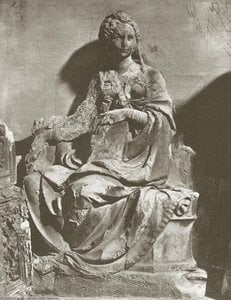
Jacopo della Quercia’s “Rea Silvia,” a captivating stone sculpture housed within the Santa Maria della Scalla in Siena, Italy, transcends mere representation; it embodies a potent narrative of myth, motherhood, and divine intervention. This remarkable piece, part of the Fonte Gaia fountain complex commissioned around 1420, offers a poignant glimpse into the heart of Roman legend – the story of Rhea Silvia’s conception by Mars and the birth of Romulus and Remus, the founders of Rome itself. The sculpture isn't simply a depiction of a woman holding infants; it’s an invitation to contemplate themes of destiny, sacrifice, and the very origins of civilization.
The work immediately draws the viewer in with its serene composure. Della Quercia masterfully captures a moment of profound tenderness – Rhea Silvia cradles two infants, their faces turned towards her in quiet trust. The pose is remarkably naturalistic for its time, eschewing the rigid formality often associated with early Renaissance sculpture. Her posture suggests not just maternal care but also a subtle vulnerability, hinting at the extraordinary circumstances surrounding her birth. The slight tilt of her head and the gentle curve of her arms convey an intimate connection that transcends the purely symbolic.
Della Quercia’s skill as a sculptor is evident in every meticulously carved detail. The work is executed in marble, likely sourced from Carrara, renowned for its purity and luminosity. The artist demonstrates an exceptional understanding of the material's capabilities, skillfully manipulating the stone to achieve a remarkable sense of volume and texture. Notice the subtle gradations in tone – the cool grey of the skin contrasting with the warmer hues of the drapery—creating a convincing illusion of depth and form. The smooth, polished surfaces reflect light beautifully, enhancing the sculpture’s overall presence.
The technique employed is characteristic of Florentine Renaissance sculpture: a combination of subtractive carving (removing excess material) and additive modeling (building up forms with small tools). Della Quercia's attention to anatomical detail is particularly noteworthy, reflecting his deep engagement with classical ideals of beauty. However, he departs from strict realism, imbuing the figures with an emotional resonance that elevates the sculpture beyond a mere imitation of life.
The story of Rhea Silvia is rich in symbolism. As the mother of Romulus and Remus, she represents not only motherhood but also the foundation of Rome – a city built on myth and destined for greatness. The act of cradling the infants can be interpreted as a symbol of protection, nurture, and sacrifice. Her vulnerability underscores the extraordinary circumstances of her birth, highlighting the role of divine intervention in shaping the destiny of an entire civilization.
The sculpture’s placement within the Fonte Gaia fountain further enriches its symbolic meaning. The fountain itself was designed to evoke Roman mythology and civic pride. Rhea Silvia's image, therefore, serves as a powerful reminder of Rome’s legendary origins and its connection to the gods. The presence of the two infants reinforces this theme, suggesting that the future of Rome is inextricably linked to its maternal roots.
Jacopo della Quercia stands as a pivotal figure bridging the Gothic and Renaissance artistic traditions. While influenced by the stylistic conventions of his predecessors, he embraced the humanist ideals and classical references that characterized the burgeoning Renaissance movement. His work demonstrates a remarkable ability to synthesize diverse influences, creating sculptures that are both emotionally resonant and technically sophisticated. “Rea Silvia” exemplifies this talent, offering a compelling synthesis of Roman mythology, Renaissance aesthetics, and masterful sculptural technique. It’s a testament to Della Quercia's foresight—a glimpse into the artistic revolution that would reshape European art for centuries to come.

Jacopo della Quercia, a name synonymous with artistic transition in 15th-century Italy, stands as a pivotal figure bridging the lingering shadows of the Gothic era with the burgeoning brilliance of the Italian Renaissance. Born in Monteroni di Lecce around 1374 and tragically dying in Bologna in 1438, his life was a tapestry woven with commissions, rivalries, and a profound engagement with both classical antiquity and the evolving sensibilities of his time. He wasn’t merely a sculptor; he was an architect of style, a translator between traditions, and ultimately, a harbinger of the revolutionary artistic shifts that would define the Renaissance.
His early training, meticulously honed under his father, Piero d'Angelo – a skilled woodcarver and goldsmith – laid the foundation for his burgeoning talent. This formative period instilled in him not just technical proficiency but also an appreciation for craftsmanship and the enduring power of traditional techniques. Crucially, however, young Jacopo’s artistic journey was profoundly shaped by his exposure to the monumental works of Nicola Pisano and Arnolfo di Cambio adorning the pulpit of Siena Cathedral. These encounters ignited a fascination with narrative sculpture, dynamic composition, and the expressive potential of human form – elements that would become hallmarks of his distinctive style.
Jacopo’s career truly blossomed in Lucca, a city strategically positioned at the crossroads of artistic influence. His relocation to Lucca with his father in 1386, driven by political instability, proved to be a catalyst for significant artistic development. It was here that he began to establish himself as a sculptor of considerable promise, undertaking projects such as the poignant “Man of Sorrows” for the altar of the Sacrament and a relief depicting St. Aniello on a tomb. These early works already demonstrated a nascent ability to imbue stone with emotional depth – a characteristic that would become increasingly pronounced in his later career.
A pivotal moment arrived in 1401 when Jacopo entered the prestigious competition to design the bronze doors for Florence’s Baptistery, a contest ultimately won by Ghiberti. Though he didn't secure the commission itself, this experience exposed him to the highest standards of Florentine artistry and fueled his ambition. The whereabouts of the designs themselves remain a tantalizing mystery, adding an element of intrigue to his already fascinating story.
Jacopo’s journey continued eastward to Ferrara in 1403, where he was commissioned to sculpt the marble Virgin and Child for the city's cathedral. This work marked a significant shift towards greater naturalism and classical influence – a reflection of his growing engagement with the artistic legacy of ancient Rome. He also undertook the creation of a statuette of St. Maurice during this period, now housed in the Museo del Duomo, showcasing his ability to seamlessly blend Gothic sensibilities with emerging Renaissance ideals.
The city of Ferrara provided him with access to an extraordinary collection of Roman sculptures and sarcophagi, sparking a deep appreciation for the elegance, proportion, and narrative power of classical antiquity. These encounters profoundly shaped his artistic vision, leading him to incorporate elements of classical drapery, anatomy, and composition into his own work – subtly yet decisively transforming the Gothic style he had inherited.
Perhaps Jacopo della Quercia’s most enduring legacy is undoubtedly Fonte Gaia, a monumental fountain commissioned in 1406 by Paolo Guinigi, the ruler of Lucca. This ambitious project represented not only a significant civic investment but also a bold artistic statement – a deliberate rejection of the pagan Venus statue that had previously adorned the square and been blamed for outbreaks of plague. The fountain itself is a marvel of engineering and artistry, constructed from gleaming white marble and adorned with numerous statues and spouts, creating a vibrant spectacle of water and light.
Fonte Gaia stands as a testament to Jacopo’s ability to synthesize diverse influences – Gothic elegance, classical proportion, and the burgeoning spirit of the Renaissance. The inclusion of nude putti flanking the fountain's base—a daring departure from traditional sculptural conventions—clearly signaled his embrace of classical ideals while retaining a distinctly humanistic sensibility. The project, however, was a protracted undertaking, spanning over a decade and reflecting the challenges inherent in managing multiple commissions simultaneously.
Throughout the remainder of his career, Jacopo della Quercia continued to work on a diverse range of projects, including the Trenta Chapel in San Frediano, Lucca, and tomb slabs for Lorenzo Trenta and his wife. His involvement in the design of a hexagonal basin with bronze panels for Siena’s Baptistery, alongside his rival Ghiberti, resulted in the completion of only one relief – “The Annunciation to Zacharias” – due to his simultaneous commitments to other projects. This episode highlights his cautious approach to working with bronze and his preference for the more manageable medium of marble.
Jacopo della Quercia’s life was tragically cut short in 1438, but his artistic legacy endures as a bridge between the Gothic and Renaissance worlds. He wasn't simply a skilled craftsman; he was an innovator, a visionary, and a key figure in shaping the trajectory of Italian art. His work foreshadowed the revolutionary developments championed by Michelangelo, solidifying his place as one of the most important sculptors of the Early Renaissance.

1374 - 1438 , Italy

Master the nuances of three-dimensional art with our expert guide. Explore sculptural history, from Phidias to Neoclassicism, and learn to evaluate materiality, form, and technique like a true connoisseur. Elevate your collection with profound insights into the world of sculpture.

Explore the profound legacy of marble sculpture, from Classical antiquity to Neoclassical mastery. A definitive guide for elite collectors and designers seeking to integrate the luminous, eternal beauty of stone into sophisticated, high-end architectural spaces.


Stay updated with the latest art news, exclusive offers, and decoration ideas.
Tell us about your project and our art experts will provide you with 3 personalized art suggestions.
Let Us Curate 3 Options Just for You - Free!

 Preview
 Send
Send Share
Share
 Details

 Download
 Similars
 X-Ray
X-Ray Diaporama

 Read More







 Glass option is only available in size under 110 CM