

 Oil On CanvasWallArtBaroque
 1740Early Modern
 45.0 x 75.0 cm
 Gallerie dell'Accademia
Hand-painted oil on canvas in your size and frame, made to order by our artists. ( Switch to Print Switch to Digital Image)





























Pick from our preset sizes that match the artwork's original proportions.

You may enter your own dimensions to fit a specific frame or space. If your selected size does not match the original image's proportions, we will either crop the artwork or extend the painting with additional hand-painted elements. A digital mockup will be sent for your approval before production begins.
Please note that the on-screen preview does not reflect the actual cropping or extension. Only the mockup will accurately show the final composition.
While custom sizes are available, we recommend selecting a dimension from the predefined list to preserve the original proportions.
Worldwide Delivery () in 3/4 weeks instead of standard 5 weeks. (27 September). No compromise on quality.


Venus and Adonis
Reproduction Size
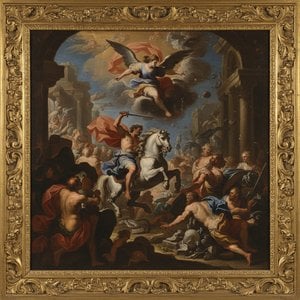
In the grand tapestry of eighteenth-century art, few works capture the delicate tension between divine grace and mortal longing as poignantly as Jacopo Amigoni’s Venus and Adonis. Painted around 1740, this masterpiece serves as a quintessential window into the Rococo aesthetic—an era defined by an unapologetic obsession with beauty, sensuality, and aristocratic refinement. While the subject matter draws from the deep wells of classical mythology, Amigoni breathes a contemporary vitality into the scene, transforming a legendary tale into a luminous meditation on desire and fate. The painting does not merely depict a moment in time; it invites the viewer into an ethereal realm where the boundaries between the heavens and the earth seem to dissolve in a soft, golden haze.
The composition is a masterclass in Baroque elegance refined. Amigoni utilizes the dramatic lighting and dynamic movement characteristic of the Baroque period but tempers it with the delicate, ornamental touch of the Rococo. At the heart of the canvas, the figures move with a choreographed grace that feels both energetic and serene. The goddess Diana, often associated with the hunt and protection, anchors the central axis, her form rendered with a meticulous anatomical precision that speaks to Amost impressive command of classical realism. Surrounding her, a celestial ballet of angels and playful cupids swirls through the landscape, creating an atmosphere of vibrant, youthful energy that is both captivating and dreamlike.
Amigoni’s technical prowess is most evident in his sophisticated use of color and light, a skill deeply rooted in his Venetian training. He employs a remarkable layering of translucent glazes, a technique that imbues the oil on canvas with an almost supernatural luminosity. This allows light to appear as if it is emanating from within the figures themselves, particularly in the soft, pearlescent skin tones of the deities. To provide a necessary counterpoint to this ethereal glow, Amigoni utilizes impasto—the thick, textured application of paint—especially within the flowing draperies and the lush foliage of the background. This interplay between smooth, glazed surfaces and tactile, raised textures creates a profound sense of depth and physical presence.
Every element of the natural world within the painting is treated with painterly devotion. The dappled sunlight filtering through the trees, the mirror-like surface of the water reflecting an azure sky, and the intricate details of the forest floor all contribute to a cohesive, immersive environment. For the discerning collector or interior designer, this level of detail ensures that the artwork remains visually engaging from every angle, offering new discoveries upon every viewing. The painting functions not just as a focal point, but as a window into a lush, idealized landscape that brings a sense of classical grandeur to any sophisticated space.
Beyond its visual splendor, Venus and Adonis is steeped in profound symbolic meaning. The artwork captures the eternal struggle between the permanence of the gods and the fragility of human life. The presence of the bow and arrow serves as a poignant reminder of Diana’s role as a huntress, while the cupids represent the untamable nature of love and joy. There is an inherent emotional duality at play: a sense of tranquil beauty juxtaposed with the underlying drama of mythological destiny. This tension creates an emotional resonance that transcends the era in which it was painted, making it a timeless piece for those who appreciate art that speaks to the complexities of the human heart.
For those seeking to adorn a home or gallery with a high-quality reproduction, this work offers more than mere decoration. It provides an infusion of history, culture, and emotion. Whether placed in a sunlit salon or a more intimate study, Amigoni’s vision of mythological splendor acts as a conversation piece that evokes reverence for the natural world and the enduring power of classical myth. It is an investment in an atmosphere of elegance, grace, and eternal beauty.

Born in Naples around 1682 and passing away in Madrid in 1752, Jacopo Amigoni stands as a pivotal figure in the late Baroque and early Rococo art world. Initially trained in Venice, his career blossomed across Europe, establishing him as one of the most sought-after portraitists and scene painters of his era. Amigoni’s journey was marked by constant movement – from the Venetian ateliers to the opulent courts of Bavaria, England, Spain, and beyond – each location leaving its distinctive imprint on his evolving style and subject matter.
Early in his career, Amigoni produced works encompassing both mythological narratives and religious scenes. These early pieces demonstrate a burgeoning technical skill and an appreciation for dramatic composition. However, as the 18th century progressed and he gained recognition amongst aristocratic patrons, his focus shifted towards more intimate, salon-style paintings – depictions of gods in languid poses, allegorical subjects, and portraits that captured the essence of European nobility. His ability to render luxurious fabrics, shimmering jewels, and expressive faces became hallmarks of his distinctive style.
Amigoni’s career is inextricably linked with his travels. He began working in Bavaria around 1717, initially for the court at Nymphenburg Castle, later finding a prestigious position at Schleissheim Castle from 1725 to 1729. His time in these Germanic locales solidified his reputation for creating richly detailed and technically proficient works. From 1726 onward, he journeyed to Venice, continuing to serve prominent Venetian families like the Streit and Savoia, producing a significant body of work for their residences.
The mid-18th century witnessed Amigoni’s extensive travels through England. He spent several years in London, working for various patrons including Lord Tankerville, and even contributing to the theatrical scene at Covent Garden. His presence in England was notable; he engaged in a lively exchange with contemporary critics like James Ralph, whose scathing reviews highlighted both the beauty and perceived excesses of Amigoni’s work. This period also saw him play a crucial role in encouraging Canaletto to relocate to England, leveraging his connections within the English art world.
His journey continued to Paris in 1736, where he encountered the celebrated castrato Farinelli, producing two remarkable portraits of the singer and his entourage. Later, he spent time in Madrid, becoming court painter to Ferdinand VI of Spain and director of the Royal Academy of Saint Fernando – a position that afforded him considerable influence within the Spanish art establishment. He also encountered the work of François Lemoyne and Boucher, absorbing elements of their distinctive styles.
Amigoni’s style is characterized by its sumptuousness, technical brilliance, and a masterful command of color and light. His paintings are often imbued with a sense of theatricality, employing dramatic chiaroscuro to create depth and highlight key figures within the composition. He was particularly adept at rendering textures – from the folds of velvet robes to the shimmer of jewels – contributing significantly to the opulent feel of his works.
While influenced by the Baroque traditions of artists like Giuseppe Nogari, Amigoni developed a distinctly Rococo sensibility, characterized by its elegance, grace, and emphasis on decorative detail. His portraits are not merely representations of likeness; they capture the personalities and social standing of their subjects with remarkable sensitivity. His work demonstrates a keen eye for fashion and an understanding of the prevailing aesthetic trends of his time.
Jacopo Amigoni’s legacy extends beyond his prolific output. He mentored several promising young artists, including Charles Joseph Flipart, Michelangelo Morlaiter, and Pietro Antonio Novelli, ensuring the continuation of his artistic lineage. His influence can be seen in the work of later generations of painters.
Among his most celebrated works are “Juno Receiving the Head of Argos” (1730), a dramatic depiction of the Roman goddess, and “Abraham and the Three Angels,” a powerful portrayal of divine intervention. His “Allegory of Charity” exemplifies his ability to convey complex allegorical themes with elegance and grace. His portrait of Farinelli remains a particularly noteworthy example of his skill in capturing the personality and charisma of his subjects.
Amigoni’s life culminated in Madrid, where he died in 1752. His daughter, Caterina Amigoni Castellini, continued the family artistic tradition as a pastelist, further cementing the Amigoni name within the art world. His works continue to be admired for their beauty, technical skill, and evocative portrayal of European aristocratic life during the Rococo era.

1682 - 1752 , Italy
Explore the breathtaking power of Baroque art. Delve into the dramatic interplay of light, shadow, and motion through the works of masters like Caravaggio. Discover how the era's intense emotional realism continues to inspire collectors and connoisseurs of classical grandeur.

Explore the breathtaking drama of the Baroque era. From the mastery of chiaroscuro to epic mythological narratives, discover a definitive guide to art's most powerful period of light, shadow, and emotion for the true classical art enthusiast.

Embark on a sophisticated visual journey through art history's most iconic Venus masterpieces. Explore the divine beauty of Botticelli and the evolution of classical mythology through expert curation for the discerning art enthusiast.

Embark on a sophisticated journey through the eternal allure of mythological art. Discover how master painters breathe life into ancient legends, from Greek deities to Baroque masterpieces, and learn to curate these timeless narratives within your own exquisite art collection.

 Preview
 Send
Send Share
Share
 Details
 Guide
Guide

 Download
 Similars
 X-Ray
X-Ray Diaporama
 Stats
Stats Read More







 Glass option is only available in size under 110 CM


