Oil On CanvasWallArtBaroque
 1670Early Modern
 42.0 x 49.0 cm
 Rijksmuseum
Hand-painted oil on canvas in your size and frame, made to order by our artists. ( Switch to Print Switch to Digital Image)





























Pick from our preset sizes that match the artwork's original proportions.

You may enter your own dimensions to fit a specific frame or space. If your selected size does not match the original image's proportions, we will either crop the artwork or extend the painting with additional hand-painted elements. A digital mockup will be sent for your approval before production begins.
Please note that the on-screen preview does not reflect the actual cropping or extension. Only the mockup will accurately show the final composition.
While custom sizes are available, we recommend selecting a dimension from the predefined list to preserve the original proportions.
Worldwide Delivery () in 3/4 weeks instead of standard 5 weeks. (22 September). No compromise on quality.


Winter Landscape
Reproduction Size
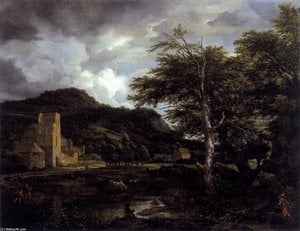
In the quiet, biting chill of the seventeenth century, Jacob Isaackszoon van Ruisdael captured a moment that transcends mere seasonal change, offering instead a profound meditation on the soul. His Winter Landscape Near Haarlem is far more than a topographical record of the Dutch countryside; it is a masterclass in atmospheric drama. As the eye wanders across the frozen expanse, one is immediately struck by the heavy, brooding sky—a vast canopy of slate gresem and charcoal clouds that seems to press down upon the earth. This interplay of light and shadow creates a palpable sense of stillness, as if the world itself has held its breath under the weight of a recent snowfall. The composition is anchored by the distant, skeletal silhouette of a church spire, a singular vertical element that pierces the horizon and serves as a beacon of spiritual permanence amidst the shifting, ephemeral textures of the winter frost.
Ruisdael’s technical prowess is nothing short of extraordinary, particularly in his ability to manipulate atmospheric perspective to evoke depth. Through a sophisticated layering of muted blues, silvery greys, and bone-whites, he guides the viewer from the textured, tactile foreground—where one can almost feel the crunch of ice beneath a boot—into the hazy, receding distance. The artist employs a meticulous brushwork that breathes life into the inanimate; the delicate, fractured branches of winter-stripped trees and the subtle undulations of the snow-covered ground are rendered with such precision that the cold becomes a physical presence. This mastery of light, often referred to as the "heroic" style in his later works, allows him to transform a bleak landscape into a stage for dramatic tension, where every glint of light on a frozen patch of ice tells a story of survival and solitude.
Beyond its breathtaking aesthetic appeal, the painting serves as a profound visual metaphor, deeply rooted in the cultural and spiritual anxieties of the Dutch Golden Age. To the contemporary viewer, the desolate winter scene may evoke themes of mortality and decay—the seasonal death of nature reflecting the fleeting nature of human life. The scattered figures, small and seemingly fragile against the immense landscape, emphasize a sense of human insignificance when confronted with the overwhelming grandeur of the natural world. Yet, there is no pure despair in this vista. The presence of the church spire, rising steadfastly through the gloom, introduces a layer of divine majesty and hope. It suggests that even in the most desolate winters of the spirit, there remains an architectural and spiritual anchor to guide the weary traveler.
For the discerning collector or interior designer, this reproduction offers more than just a beautiful image; it provides a focal point of contemplative depth. The painting’s somber palette and commanding presence make it an ideal centerpiece for spaces designed for reflection, such as a private library, a study, or a sophisticated gallery-style living room. It possesses the rare ability to anchor a room with its gravity while simultaneously inviting the eye to wander through its intricate, frozen details. Owning a piece of this caliber is an invitation to engage with the legacy of the Dutch masters, bringing a sense of historical weight, quiet elegance, and timeless emotional resonance into the modern home.

jacob isaackszoon van ruisdael, a prominent dutch painter, draughtsman, and etcher, was born in 1628 in the netherlands. he is widely regarded as the pre-eminent landscape painter of the dutch golden age, a period marked by great wealth and cultural achievement.
van ruisdael's work is characterized by its versatility and prolific nature, depicting a wide variety of landscape subjects. from 1646, he painted remarkable dutch countryside scenes, which later took on a more heroic character after his trip to germany in 1650. his late work, produced while living and working in amsterdam, featured city panoramas and seascapes, often with the sky occupying two-thirds of the canvas.
van ruisdael's work is spread across private and institutional collections worldwide, with notable holdings at:
van ruisdael's influence on landscape painting traditions is profound, shaping the english romantics, the barbizon school in france, and the hudson river school in the us. he also inspired generations of dutch landscape artists. notable works:
artist's profile on WahooArt: jacob isaackszoon van ruisdael

1628 - 1682 , Netherlands

Explore the breathtaking mastery of Dutch Golden Age landscapes. From Italianate light to atmospheric realism, discover the techniques of 17th-century masters and learn how to bring these timeless, museum-quality masterpieces into your home through expert oil reproductions.

 Preview
 Send
Send Share
Share
 Details
 Guide
Guide

 Download
 Similars
 X-Ray
X-Ray Diaporama
 Stats
Stats Read More







 Glass option is only available in size under 110 CM