x


 WatercolorWallArtOther
 13.0 x 19.0 cm
 Tate Britain
Hand-painted oil on canvas in your size and frame, made to order by our artists. ( Buy Print Buy Image)





























Pick from our preset sizes that match the artwork's original proportions.

You may enter your own dimensions to fit a specific frame or space. If your selected size does not match the original image's proportions, we will either crop the artwork or extend the painting with additional hand-painted elements. A digital mockup will be sent for your approval before production begins.
Please note that the on-screen preview does not reflect the actual cropping or extension. Only the mockup will accurately show the final composition.
While custom sizes are available, we recommend selecting a dimension from the predefined list to preserve the original proportions.
Worldwide Delivery () in 3/4 weeks instead of standard 5 weeks. (25 August). No compromise on quality.


Two Figures
Reproduction Size
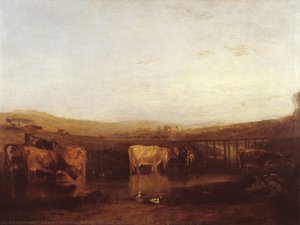
J.M.W. Turner's "Two Figures," painted circa 1827, isn’t a grand spectacle of color or dramatic landscape; rather, it’s a quietly profound meditation on human connection and the subtle poetry of everyday existence. This small watercolor, measuring just 13 x 19 cm, resides within the Tate Images collection, offering a glimpse into Turner's evolving artistic sensibilities during a period marked by intense introspection and experimentation. It immediately draws the eye with its muted palette – predominantly cool blues and grays—a deliberate choice that evokes a sense of melancholy and contemplative stillness. The figures themselves are rendered with remarkable economy; they’re not sharply defined, but rather suggested through loose, gestural brushstrokes, creating an impression of two individuals engaged in some form of hushed conversation or shared observation.
Turner's technique here is exquisitely delicate. He masterfully employs wet-on-wet blending—a hallmark of his style—to create a remarkably soft and atmospheric surface. The watercolor washes flow seamlessly into one another, dissolving the edges of the figures and blurring the boundaries between them and their surroundings. This deliberate lack of precision isn’t a sign of carelessness; it's integral to the painting’s emotional impact. It mirrors the ephemeral nature of human interaction—fleeting moments captured in time before dissolving back into the vastness of experience. The composition, with the figures positioned on opposite sides of the frame, subtly reinforces this sense of distance and isolation, yet simultaneously suggests a shared awareness or unspoken connection.
“Two Figures” firmly anchors itself within the broader context of the Romantic movement. Turner, like his contemporaries, rejected the rigid academic traditions of art, prioritizing emotional expression and subjective experience over meticulous representation. He sought to capture not just what he *saw*, but how he *felt* – a deeply personal response to the world around him. This is evident in the painting’s atmospheric quality; it's less concerned with accurate depiction than with conveying a specific mood or feeling. The diffused lighting, the hazy background, and the muted colors all contribute to this sense of dreamlike ambiguity.
The historical backdrop is equally important. Turner was grappling with profound personal losses during this period – the death of his beloved wife Mary in 1817 profoundly impacted his artistic vision. This emotional turmoil undoubtedly informed his work, leading him to explore themes of solitude, memory, and the transient nature of life. “Two Figures” can be interpreted as a reflection on these experiences—a poignant reminder of the beauty and fragility of human relationships.
While seemingly simple in its subject matter, "Two Figures" is rich with symbolic potential. The figures themselves are deliberately ambiguous; their identities remain unknown, allowing viewers to project their own experiences and emotions onto the scene. Their posture—slightly turned towards each other but not actively engaged in conversation—suggests a quiet contemplation or perhaps a shared sadness. The setting, undefined and atmospheric, further enhances this sense of mystery.
The painting’s overall effect is one of poignant loneliness, yet also of subtle connection. It speaks to the universal human need for companionship and understanding, even in moments of isolation. Turner masterfully captures the delicate balance between solitude and intimacy—the recognition that true connection often arises from shared silence and unspoken awareness. The work invites us to consider our own relationships with others and the quiet moments of resonance that define our lives.
Reproductions of “Two Figures” offer a remarkable opportunity to bring this evocative artwork into any space. WahooArt’s high-quality reproductions faithfully capture Turner's delicate brushwork and atmospheric effects, allowing viewers to appreciate the painting’s subtle nuances. Whether displayed in a gallery, a study, or a living room, "Two Figures" serves as a constant reminder of the power of art to evoke emotion, stimulate reflection, and connect us to the shared human experience. The piece's understated beauty makes it an ideal addition to collections seeking both artistic merit and contemplative depth.


1775 - 1851 , United Kingdom
Journey through 10 legendary watercolor masterpieces by Sargent, Turner & Homer! Explore iconic landscapes, portraits & floral art that redefined history. Find museum-quality reproductions and curated decor ideas at WahooArt.com.

Immerse yourself in the captivating world of slate blue! Explore 10 iconic paintings by Monet, Van Gogh & Renoir. Discover their stories, techniques & find museum-quality art reproductions for your home at .

Transform your home with soulful blue art. From serene Monet impressions to modern textured sculptures, discover curated masterpieces designed to inspire calm. Explore expert art consultations and bespoke hand-painted reproductions to create your personal sanctuary.

Explore the captivating world of watercolor painting! Discover its rich history, essential techniques, influential artists & collecting tips. A comprehensive guide for art enthusiasts from WahooArt.
Explore the captivating history of watercolor painting, from ancient techniques to modern masters like Kandinsky & Blake. Discover essential artists, collecting tips & the emotional power of this luminous medium. Expert insights for art enthusiasts.


Stay updated with the latest art news, exclusive offers, and decoration ideas.
Tell us about your project and our art experts will provide you with 3 personalized art suggestions.
Let Us Curate 3 Options Just for You - Free!

 Preview
 Send
Send Share
Share
 Details

 Download
 Similars
 X-Ray
X-Ray Diaporama
 Read More







 Glass option is only available in size under 110 CM


![Abstract Composition [triptych] — Vaclav Vytlacil, Abstract Expressionism](/media/artworks/images-thumb/08/3c/083c0675045645fd42d4e6c6d63f1ced.jpg)