x


 1800
1800 28.0 x 22.0 cm
 Museu Nacional da Música
Hand-painted oil on canvas in your size and frame, made to order by our artists. ( Buy Print Buy Image)
Pick from our preset sizes that match the artwork's original proportions.

You may enter your own dimensions to fit a specific frame or space. If your selected size does not match the original image's proportions, we will either crop the artwork or extend the painting with additional hand-painted elements. A digital mockup will be sent for your approval before production begins.
Please note that the on-screen preview does not reflect the actual cropping or extension. Only the mockup will accurately show the final composition.
While custom sizes are available, we recommend selecting a dimension from the predefined list to preserve the original proportions.
Worldwide Delivery () in 3/4 weeks instead of standard 5 weeks. (29 August). No compromise on quality.


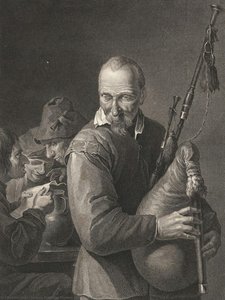
Bagpipe player
Reproduction Size

In the golden twilight of the eighteenth century, a period defined by both exquisite refinement and profound social transformation, there emerged an artist capable of capturing the very essence of visual narrative through the delicate medium of printmaking. Isidore Stanislas Henri Helman, often referred to as Helman le cadet, was not merely a technician of the copperplate; he was a translator of dreams, a man who possessed the rare ability to transmute the fluid brushstrokes of great masters into the permanent, rhythmic language of engraving. Born in Lille in 1743 into a lineage of skilled craftsmen—his father Jean Henri and grandfather Adolphus were both esteemed master engravers—Helman was destined to inherit a legacy of precision and artistic devotion.
His early years were shaped by the rigorous intellectual and artistic atmosphere of France. After receiving foundational training at the free drawing school in Lille, Helman’s talent led him toward the prestigious tutelage of Louis-Jean Guèret. This formative period instilled in him a profound respect for composition and light, but it was his move to Paris that would truly ignite his professional ascent. In the bustling heart of the French art world, he entered the studio of the celebrated printseller Jacques-Philippe Lebas. Under Lebas’s direction, Helman became one of the most accomplished disciples of the era, honing a style that balanced technical exactitude with an emotive depth that allowed his prints to breathe with the vitality of the original paintings they sought to replicate.
Helman’s artistry was characterized by a remarkable versatility, allowing him to navigate various thematic landscapes with ease. While he is celebrated for his ability to reproduce the ethereal, delicate compositions of artists like Watteau and Boucher, his work often ventured into more structured and historical territories. He possessed an uncanny ability to translate the soft, atmospheric qualities of Rococo painting into the starker medium of etching and engraving, ensuring that the nuance of shadow and the grace of a silhouette were never lost in translation.
His repertoire was vast and intellectually stimulating, encompassing:
The significance of Isidore Stanislas Helman lies in his role as a vital conduit of culture. In an age before the widespread availability of photography, engravers like Helman were the primary means by which artistic movements traveled across borders and through generations. His work helped solidify the visual vocabulary of French art, ensuring that the aesthetic triumphs of the eighteenth century could be studied, collected, and admired far beyond the walls of royal galleries.
His professional achievements were marked by high honors, including a prestigious appointment as the engraver to the Duc de Chartres, a testament to the trust placed in his ability to handle the most delicate and important commissions. As he navigated the turbulent transition from the Ancien Régime into the new century, Helman remained a steadfast figure of technical excellence. Though he passed away in Paris around 1806-1809, his contribution to the art of printmaking remains etched in history—a permanent record of a master who could look upon a masterpiece and find within it a new way to tell its story through the humble yet powerful medium of ink and paper.

1743 - 1806 , France


Stay updated with the latest art news, exclusive offers, and decoration ideas.
Tell us about your project and our art experts will provide you with 3 personalized art suggestions.
Let Us Curate 3 Options Just for You - Free!

 Preview
 Send
Send Share
Share
 Details

 Download
 Similars
 X-Ray
X-Ray Diaporama
 Read More




































 Glass option is only available in size under 110 CM