The artwork displayed on this page is protected by copyright law, which means we cannot legally create or sell an identical reproduction. This protection is enforced under international agreements such as the Berne Convention and by national laws, including those outlined by the U.S. Copyright Law - Title 17.
This method fully complies with copyright regulations because it does not involve copying or duplicating the protected artwork. Instead, it is a creative reinterpretation - a new painting that is influenced by the original but not identical to it.
Museum-quality giclée or canvas print with fast production and flexible finish options. ( Buy Hand Made Painting Switch to Digital Image)





























Pick from our preset sizes that match the artwork's original proportions.

Type the width and the height you need, to fit your frame or your wall. A print can only be cut, never made bigger than the picture, so a size with a different shape loses a part of the image. We send you a digital mockup to approve before we print anything. The picture shown on this page does not show the real cut — only the mockup does.
Worldwide Delivery () in 2 weeks instead of standard 4/5 weeks. (12 November)
Spring Breeze
Reproduction Size
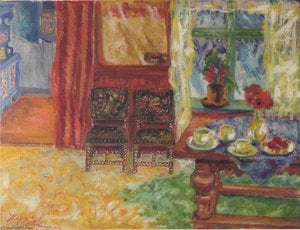
“Spring Breeze,” painted in 1905 by the Russian Post-Impressionist artist Igor Emmanuilovich Grabar, is more than just a depiction of a bedroom; it's an immersive experience of light, color, and quiet contemplation. Created during a pivotal period in Grabar’s career – his peak artistic output between 1903 and 1907 – the painting exemplifies his distinctive approach to divisionist technique, a method that sought to capture fleeting moments through meticulously placed dots of pure color, creating an almost shimmering effect. Measuring 79 x 79 cm on canvas, this intimate scene invites viewers into a world of warmth and tranquility, reflecting Grabar’s profound interest in capturing the subtle nuances of domestic life.
Grabar's mastery lies in his skillful deployment of the divisionist technique. Rather than blending colors on the canvas, he applied small, distinct brushstrokes—often described as bordering on pointillism—to build up the image. This approach isn’t simply a stylistic choice; it’s a deliberate attempt to mimic the way light itself is perceived – fragmented and shimmering. Observe how the sunlight streaming through the two windows is rendered not with smooth gradations, but with a mosaic of yellows, oranges, and whites, creating an ethereal glow that bathes the room in warmth. The careful arrangement of these color fragments generates a remarkable sense of depth and texture, drawing the eye across the canvas.
‘Spring Breeze’ emerged from the broader context of Post-Impressionism, a movement that arose as a reaction against the Impressionists' focus on objective observation of light. While Impressionists sought to capture fleeting moments, Post-Impressionists aimed for something more – a deeper emotional and symbolic resonance within their work. Grabar, influenced by artists like Ilya Repin and Anton Azbe, pushed this movement further with his unique divisionist style. His work aligns with the broader Russian avant-garde of the early 20th century, exploring themes of domesticity and spirituality through a highly personal artistic lens.
Beyond its technical brilliance, ‘Spring Breeze’ is rich in subtle symbolism. The piano, positioned prominently in the corner, suggests both musical contemplation and perhaps a yearning for creative expression. The carefully arranged vases, each placed with intention, contribute to the overall sense of order and serenity. The potted plant adds a touch of nature, connecting the interior space with the outside world. The composition as a whole evokes a feeling of peaceful solitude – a sanctuary from the bustle of daily life. It’s a scene designed not just to be observed, but to be felt.
This exceptional reproduction captures the essence of Grabar’s ‘Spring Breeze,’ offering a stunning addition to any art collection or interior design scheme. Its evocative beauty and masterful technique make it a timeless piece, reflecting the enduring appeal of Post-Impressionist artistry.
"Spring Breeze" shows bedroom scene, piano interior, divisionist style, russian painter, light & color, post-impressionism, vase arrangement, and its recorded mood is serene.
"Spring Breeze" by Igor Grabar uses an earthy color palette. The palette summarizes the work's overall color character.
Format (square) and recommended space (bedroom) are the two placement facts recorded for "Spring Breeze" by Igor Grabar.

Igor Emmanuilovich Grabar was born on March 25, 1871, in Budapest, Hungary. His father, Emmanuil Hrabar, was an ethnic Rusyn lawyer and politician. The family's ties to Russian culture remained a constant presence. After attending high school in Yegoryevsk, Igor moved to Moscow to enroll in Mikhail Katkov's boarding school. It was during these years that his interest in drawing began to take shape.
His formal training followed a path through several major European art centers. In 1894, he entered the Academy of Arts in Saint Petersburg, where he studied under Ilya Repin. This period of study was followed by a move to Munich. There, he worked in the studio of Anton Ažbe. His education was not limited to painting alone; he also completed an architecture course at the Munich Polytechnic School under F. von Thiersch.
His life moved between the studio and the administrative halls of Russia's most important institutions. In 1913, he was appointed executive director of the Tretyakov Gallery in Moscow. This role evolved as the political landscape shifted, and he eventually served as the Head of the State Tretyakov Gallery from 1918 to 1925. His work was not limited to the canvas; he was a publisher, a restorer, and a historian of art who sought to organize and preserve the visual history of his country.
The academic world provided another significant setting for his work. In 1921, he held a position as a professor of art restoration at Moscow State University. His influence in the university continued as a professor of art history. Beyond the classroom, he took on the responsibility of directing the Scientific Research Institute of Art History at the Academy of Sciences. His administrative reach extended to the highest levels of the state when he was named the Director of the All-Russian Academy of Arts in 1943.
Between 1903 and 1907, his brushwork took on a specific, rhythmic quality. He often worked with a divisionist technique that moved toward pointillism, applying color in small, distinct strokes to build up a surface. This approach allowed him to capture the way light shifts across a landscape. He was known to paint directly from nature, often bypassing the habit of making preparatory sketches or drawings before touching the canvas. This immediacy gives his work a sense of direct observation.
His palette relied on bold colors to define form and atmosphere. This was particularly evident in his renditions of snow, where he managed to capture its changing textures and light through careful application of pigment. While his work shows an affiliation with the Jugendstil movement, his focus remained on the physical properties of his subjects. He looked closely at how light interacts with the environment, whether in a garden or a quiet interior.
His brush often turned toward the quiet rhythms of the landscape and the subtle shifts of light. In September Snow, painted about 1903, there is a specific focus on how the season settles over the land. This interest in the natural world is seen again in Spring Flow, from about 1904, and in Landscape with a Haystack. He had a particular way of rendering snow, capturing its texture and the way it sits upon the earth. His 1904 work, Pavilion in Kuzminki, shows a similar attention to the environment and the way structures sit within a setting.
Beyond the outdoors, he looked closely at the objects and people that defined a moment. The Embroideress acts as a clear example of the realist style, focusing on the precision of the subject. In Going to Work, he captures the daily life of the Russian people, finding meaning in the ordinary movements of a workday. His domestic scenes often centered on small, still moments, such as Samovar from 1905, or the quiet presence of a Lady by Piano, which he painted about 1899.
The later years of his life were spent deeply embedded in the preservation of the past. He managed art-restoration workshops during two distinct periods, from 1918 to 1930 and again from 1944 to 1960. These years were spent overseeing the careful handling of historical works and the technical needs of art conservation. He remained at the top of the Soviet art establishment until his death on May 16, 1960.
His influence persisted through the decades, leaving a mark on the way art was studied and maintained. His work continues to be a point of interest for artists and art enthusiasts who study the technical nuances of his era. He lived through significant shifts in the landscape of Russian art, maintaining his position within its institutional framework until the end of his life.
His paintings can be found in several major collections across Russia and Ukraine. In Moscow, the Tretyakov Gallery holds his work, reflecting his long association with the institution. The Pushkin State Museum of Fine Arts also features his pieces, alongside the collections of the State Russian Museum. These spaces house various studies of light and landscape that define his career.
Beyond the capital, his presence is felt in other regional institutions. The Novokuznetsk Art Museum in Russia maintains a collection of his works. In Ukraine, the Museo Kharkov Museum of Art features his paintings, preserving his contribution to the era's visual history. Seeing his work in these different settings allows for a closer look at how he handled color and texture in varied environments.

1871 - 1960 , Hungary

Explore the evolution of landscape art from pastoral ideals to Impressionism. Discover the mastery of light and nature today.

Explore the vibrant evolution of Post-Impressionism. From Seurat's revolutionary Pointillism to the emotional depth of masters, discover how this movement redefined modern art history through color, structure, and unparalleled creative expression.

Embark on a sophisticated journey into the luminous world of Neo-Impressionism. Uncover the scientific brilliance of Pointillism, from Georges Seurat’s revolutionary color theory to the mesmerizing magic of the dot. An expert exploration for true art history enthusiasts.
 Preview
 Send
Send Share
Share
 Details
 Guide
Guide

 Download
 Similars
 X-Ray
X-Ray Diaporama
 Q&A
Q&A
 Stats
Stats

 Read More









 Glass option is only available in size under 110 CM