Museum-quality giclée or canvas print with fast production and flexible finish options. ( Buy Hand Made Painting Switch to Digital Image)





























Pick from our preset sizes that match the artwork's original proportions.

Type the width and the height you need, to fit your frame or your wall. A print can only be cut, never made bigger than the picture, so a size with a different shape loses a part of the image. We send you a digital mockup to approve before we print anything. The picture shown on this page does not show the real cut — only the mockup does.
Worldwide Delivery () in 2 weeks instead of standard 4/5 weeks. (24 October)
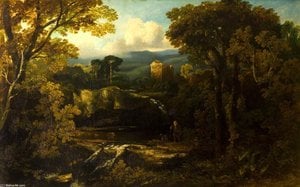
Mountain Scenery
Reproduction Size

Horatio McCulloch, born in Glasgow in 1805, stands as Scotland’s most celebrated landscape painter—a figure who eloquently captured the nation's wild beauty during a period of profound change. His journey began with formal training under John Knox, a respected Glasgow landscape artist, laying the groundwork for his future artistic endeavors. Early on, necessity led him and Daniel Macnee to pursue decorative painting, but McCulloch’s talents soon expanded. A brief stint coloring illustrations for Prideaux John Selby's *British Birds* while working with engraver William Home Lizars in Edinburgh honed his observational skills and introduced him to the demands of commercial art. Returning to Glasgow, he further refined his abilities through theatrical scene painting and diligent study directly from nature—a practice that would remain central to his artistic process throughout his life. These formative experiences shaped a painter deeply attuned to both detail and atmosphere, poised to translate the Scottish landscape onto canvas with remarkable sensitivity.
McCulloch’s artistic development was profoundly influenced by literary figures like Sir Walter Scott and fellow artist John Thomson. He moved beyond mere topographical representation, gradually forging a unique style that blended keen observation with romantic interpretation. His paintings became renowned for their depictions of the Scottish Highlands—not simply as geographical locations, but as spaces imbued with grandeur, poetic truthfulness, and an almost spiritual quality. He masterfully emphasized scale, conveying the dramatic beauty and untamed power of the wilderness. This wasn’t merely about painting what he saw; it was about evoking a feeling, a sense of awe in the face of nature's majesty. His canvases often feature expansive skies, rugged mountains, and shimmering lochs, all rendered with a meticulous attention to light and shadow that creates an immersive experience for the viewer. He wasn’t simply recording landscapes; he was interpreting them through the lens of Romantic sensibility, imbuing them with emotional resonance.
McCulloch's career gained momentum with his first exhibition at the Royal Scottish Academy in 1829—the beginning of a long and prolific period of exhibiting his work. His talent was quickly recognized, culminating in his election as a full Academician in 1838, solidifying his position within Scotland’s artistic community. This recognition opened doors to commissions from prominent figures such as Lord Provost James Lumsden, establishing his reputation among influential patrons and ensuring financial stability. His paintings resonated with collectors who appreciated his ability to capture the essence of the Scottish landscape, leading to growing demand for his work. He became a sought-after artist, not just within Scotland but also gaining recognition further afield. This success allowed him to dedicate himself fully to his art, continually refining his technique and exploring new facets of the Highland scenery that captivated him.
Horatio McCulloch’s legacy extends far beyond his artistic skill; he is considered a pivotal figure in Scottish art history. He bridged the transition between traditional and modern approaches to landscape painting, influencing generations of artists who followed. His work played a crucial role in shaping the iconography of the Scottish Highlands during a period marked by significant social and economic upheaval—including the Highland Clearances. While his paintings often romanticized the region’s beauty, they also inadvertently contributed to a broader cultural shift that defined the Highlands as a distinct wilderness separate from the increasingly urbanized Lowlands. He captured an idealized vision of Scotland's past, one that resonated deeply with Victorian audiences and continues to evoke powerful emotions today. McCulloch didn’t just paint landscapes; he helped create a national identity—a romanticized image of Scotland that endures in the collective imagination. His ability to capture the spirit of the land ensures his place as a master of Scottish art, whose works continue to inspire awe and wonder.

1805 - 1867 , United Kingdom

Elevate luxury interiors with exquisite mountain oil painting reproductions. From Romanticism to the Hudson River School, WahooArt offers bespoke, hand-painted masterpieces and large-scale murals tailored for hotel designers and elite collectors worldwide.

 Preview
 Send
Send Share
Share
 Details
 Guide
Guide

 Download
 Similars
 X-Ray
X-Ray Diaporama
 Stats
Stats
 Read More









 Glass option is only available in size under 110 CM