Get a print-ready file that goes far beyond the web preview. Every digital image we sell comes from a high-resolution master in our stock database — usually 5,000 to 15,000 pixels wide — so you can print large, crop tightly, or reproduce fine detail with confidence.
No file leaves our studio untouched. A digital expert checks the colors against the original painting and corrects them if needed, then improves clarity and detail with professional retouching tools — always staying faithful to the artist's brushwork and style. The result is an image that looks like the painting, not like a filtered scan.
You approve before you're done: our expert sends the image by e-mail within 72 hours for your review. Not satisfied? Ask for improvements or corrections, or request a refund if the quality falls short.
This is the quality relied on by publishers, design studios, galleries and print shops.
Download a high-resolution file for personal display, printing, and creative projects. ( Switch to Print Buy Hand Made Painting)
When you choose WahooArt.com, you're not just getting an image - you're receiving a professionally enhanced digital artwork, crafted with precision and backed by a satisfaction guarantee. Here's everything that comes with your order, automatically:
Your high-resolution digital image file will be emailed to you within 72 hours of ordering - ready for immediate use.
Your artwork is professionally optimized using advanced AI tools and manual editing, ensuring maximum detail, clarity, and color accuracy.
Accidentally deleted or lost your file? No worries - we'll resend it to you anytime, free of charge.
Enjoy your artwork instantly with zero customs, duties, or delivery fees - digital downloads are always tax-free.
We ensure your digital image reflects the original colors as closely as possible using professional tools and color management.
If you're not satisfied with your digital image, we'll revise it or refund 100% within 100 days - no questions asked.
Not satisfied? Get a full refund within 100 days of receiving your digital file - no questions asked.
Buy 3 images, save 10% - Buy 5, save 15% - Buy 10+, save 20%. Great for creative projects, galleries, and agencies.
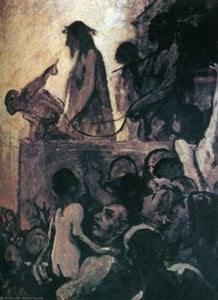
In the crowded, dimly lit confines of a mid-19th-century railway carriage, Honoré Daumier captures more than just a moment in transit; he captures the very essence of human endurance. The Third-class Carriage serves as a profound window into the burgeoning urban reality of France during the Second Empire. As the industrial revolution reshaped the landscape of Europe, Daumier turned his gaze away from the gilded salons of the aristocracy and toward the weary faces of the common people. The painting invites us to step into a space defined by proximity and shared struggle, where the boundaries between strangers dissolve in the cramped, rhythmic motion of the train.
The composition is a masterclass in realism, utilizing a tight, almost claustrophobic perspective that forces the viewer to sit alongside the passengers. There is no escape from the density of the scene; we are pressed against the heavy textures of worn clothing and the weathered surfaces of the carriage walls. Daumier’s ability to evoke the atmosphere of a moving vessel is palpable, as if one can almost feel the vibration of the tracks beneath the wooden benches. This sense of enclosure does not merely depict a setting; it symbolizes the social limitations and the heavy, inescapable weight of class distinctions that defined the era.
Technically, Daumier employs a palette dominated by somber earth tones—deep browns, muted ochres, and shadowy blues—which lends the work an incredible sense of gravity and permanence. His use of chiaroscuro is particularly striking; light does not flood this carriage but rather seeps in, catching the edge of a forehead, the curve of a shoulder, or the texture of a bundle of belongings. This selective illumination directs our eyes through the crowd, highlighting the individual stories hidden within the collective mass. The brushwork, while grounded in realism, possesses an expressive, almost sculptural quality that gives the figures a monumental presence despite their humble status.
For the discerning collector or interior designer, this piece offers a sophisticated emotional depth that transcends mere decoration. It is a work of profound empathy. Each figure—the elderly woman, the young mother, the stoic laborer—carries an expression of quiet resignation and quiet strength. There is no melodrama here, only the dignified reality of daily life. Incorporating a high-quality reproduction of this masterpiece into a space brings with it a sense of historical weight and intellectual curiosity, making it an ideal centerpiece for a room designed to inspire reflection and conversation.
Beyond its visual beauty, The Third-class Carriage remains a powerful piece of social commentary. Daumier, a master of satire and a keen observer of political absurdity, uses this scene to honor the fortitude of the working class. He finds beauty in the unvarnished truth, transforming a mundane journey into an epic of human resilience. The painting does not look away from poverty or fatigue; instead, it elevates these experiences through art, granting the subjects a level of importance usually reserved for kings and deities.
To own a reproduction of this work is to possess a fragment of history—a piece that speaks to the enduring human spirit amidst the tides of change. Whether placed in a contemporary gallery setting or a classic study, Daumier’s vision continues to resonate, reminding us that even in the most crowded and difficult of journeys, there is a profound, quiet dignity to be found.
"The Third-class Carriage" by Honoré Daumier is in the public domain - its copyright has expired. Copyright duration runs from the artist's death, which occurred in 1879.
"The Third-class Carriage" by Honoré Daumier is placed in the Social Realism movement, within the 19th-Century era of its creator.
"The Third-class Carriage" dates from 1860. The date places the work within Honoré Daumier's career and its era.


1808 - 1879 , France
 Preview
 Send
Send Share
Share
 Details
 Guide
Guide

 Download
 Similars
 X-Ray
X-Ray Diaporama
 Q&A
Q&A Stats
Stats


 Read More