Artist Biography
A Life Etched in Satire: The World of Honoré Daumier
Born in Marseille in 1808, Honoré-Victorin Daumier’s journey was one deeply intertwined with the tumultuous currents of 19th-century France. His early life, marked by his father's poetic aspirations and subsequent relocation to Paris in 1814, immersed him in a city brimming with artistic energy. Though initially destined for a legal career, young Daumier’s inclination leaned irrevocably towards art. He apprenticed under Alexandre Lenoir, absorbing classical influences alongside an appreciation for the dramatic chiaroscuro of Rubens, and further honed his skills at the Académie Suisse. This foundational training would prove crucial in shaping his distinctive style—a potent blend of realism and expressive draftsmanship. However, it wasn’t merely artistic technique that defined Daumier; it was a profound sensitivity to the social injustices and political absurdities surrounding him.
The Sharpened Pen: Caricature and Social Commentary
Daumier's career truly ignited in the wake of the 1830 Revolution, an event that irrevocably altered the course of French history and simultaneously provided fertile ground for his burgeoning satirical talent. He quickly established himself as a master lithographer, initially contributing anonymously to various publications before gaining prominence through his work with *Le Charivari*, a fiercely independent comic journal founded by Charles Philipon. It was here that Daumier’s genius truly blossomed. His caricatures weren't simply humorous depictions; they were scathing indictments of the bourgeoisie, the legal system, and the political establishment. He fearlessly lampooned King Louis-Philippe, earning himself a six-month imprisonment in 1832 for a particularly biting caricature. This experience, far from silencing him, only solidified his commitment to exposing hypocrisy and challenging authority through art. His lithographs became visual manifestos, capturing the spirit of dissent and offering a critical commentary on the societal ills of his time. The sheer volume of his output during this period is astonishing—thousands of lithographs that served as both popular entertainment and potent political statements.
Beyond Caricature: Painting and Sculptural Visions
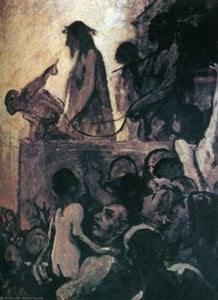
While Daumier is most celebrated for his lithography, to confine him solely to the realm of caricature would be a grave disservice. He was also a dedicated painter and sculptor, though recognition for these works came later in life. His paintings, often depicting scenes of everyday Parisian life—the third-class carriage, the laundresses, the lawyers—are imbued with a profound sense of realism and empathy. They are not idealized portrayals but rather unflinching depictions of hardship and struggle. He masterfully employed loose brushwork and dramatic lighting to convey emotion and atmosphere, foreshadowing some of the techniques later embraced by the Impressionists. His sculptural work, largely created in clay (many pieces remaining unbaked during his lifetime), reveals a similar commitment to capturing the human form with honesty and emotional depth. These sculptures, rediscovered after his death, demonstrate a remarkable talent for modeling and an ability to convey psychological complexity through physical gesture.
A Lasting Legacy: Influence and Historical Significance
Honoré Daumier’s impact on art history is undeniable. He bridged the gap between Romanticism and Realism, paving the way for future generations of artists who sought to depict the world as it truly was—warts and all. His unflinching social commentary influenced artists like Gustave Courbet and Édouard Manet, while his innovative use of lithography revolutionized printmaking. His work continues to resonate today, reminding us of the power of art to challenge authority, expose injustice, and bear witness to the human condition. The Musée d'Orsay in Paris houses a significant collection of his paintings and sculptures, offering visitors a glimpse into the world he so vividly portrayed. His lithographs are widely accessible through collections like those found on WahooArt, ensuring that his satirical genius continues to provoke thought and inspire dialogue. Daumier wasn’t merely an artist; he was a chronicler of his time—a visual poet who used his talent to give voice to the voiceless and hold power accountable. His legacy endures as a testament to the enduring relevance of art as a force for social change.


 Send
Send Share
Share
 Details
 Guide
Guide

 Download
 Similars
 Diaporama
 Q&A
Q&A
 Stats
Stats


 Read More
 Switch to Print





































 Glass option is only available in size under 110 CM