x


 1933
1933 62.0 x 52.0 cm
 Royal Academy of Music
Hand-painted oil on canvas in your size and frame, made to order by our artists. ( Buy Print Buy Image)
Pick from our preset sizes that match the artwork's original proportions.

You may enter your own dimensions to fit a specific frame or space. If your selected size does not match the original image's proportions, we will either crop the artwork or extend the painting with additional hand-painted elements. A digital mockup will be sent for your approval before production begins.
Please note that the on-screen preview does not reflect the actual cropping or extension. Only the mockup will accurately show the final composition.
While custom sizes are available, we recommend selecting a dimension from the predefined list to preserve the original proportions.
Worldwide Delivery () in 3/4 weeks instead of standard 5 weeks. (28 August). No compromise on quality.


Trees
Reproduction Size

Henry Joseph Wood, a name perhaps less familiar to the general public than many of his contemporaries, stands as a pivotal figure in bridging the gap between the burgeoning world of orchestral music and the rise of Impressionist painting. Born in London in 1869, Wood’s life was inextricably linked to both musical innovation and artistic vision, shaping not only the soundscape of British culture but also influencing the aesthetic sensibilities of a generation of artists.
Initially trained as an organist, Wood's early career focused on the sacred music of Bach and Mendelssohn. However, his true passion lay in popularizing orchestral music – a relatively niche pursuit at the time – through innovative concert series. Recognizing that audiences were often intimidated by the formality and perceived complexity of classical performance, he pioneered the “Promenade Concerts” at the Queen’s Hall in 1895. These concerts weren't simply recitals; they were carefully curated experiences designed to introduce a wider range of listeners – from seasoned music lovers to those entirely new to orchestral sound – to the glories of the repertoire. Wood meticulously selected pieces, often incorporating popular tunes and familiar melodies alongside works by composers like Wagner, Brahms, and Dvořák, creating an accessible and engaging listening experience.
Crucially, Wood’s success wasn't solely based on programming; he was a skilled promoter and organizer. He understood the power of visual presentation, collaborating with stage designers to create immersive environments that enhanced the musical performance. This approach mirrored his later artistic pursuits – specifically, his foray into painting. Wood began exhibiting his work in the late 1890s, embracing the tenets of Impressionism, a movement characterized by its focus on capturing fleeting moments and subjective impressions rather than precise representation. His paintings, often depicting coastal scenes, landscapes, and portraits, are imbued with a similar spirit to his musical endeavors – an emphasis on atmosphere, light, and emotion.
Wood's artistic style is immediately recognizable for its shimmering surfaces and evocative use of color. He was deeply influenced by the Impressionist masters, particularly Monet and Pissarro, but he developed a distinctive approach rooted in his understanding of light and sound. Like capturing a fleeting musical moment, Wood sought to distill the essence of a scene – not through detailed realism, but through carefully layered brushstrokes and subtle shifts in hue. His paintings are often described as “atmospheric,” conveying a sense of mood and feeling rather than precise visual accuracy.
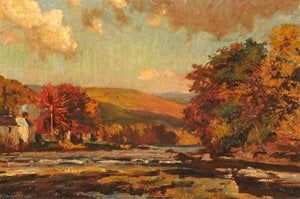
A prime example is "The Sandy Shallows at Parkstone near Bournemouth" (1907), a captivating depiction of the Dorset coastline. The painting isn’t a literal rendering of the beach; instead, it's an exploration of light and shadow, texture and color. Thick impasto – a technique involving applying paint in thick layers – creates a tactile surface that seems to shimmer with reflected sunlight. The colors are muted yet vibrant, evoking the hazy atmosphere of a coastal morning. The composition is deceptively simple, drawing the viewer into the scene’s tranquil beauty.
Wood's impact on British musical culture is undeniable. He transformed the Promenade Concerts from a niche event into a national institution, establishing them as a cornerstone of orchestral music programming. His championing of contemporary composers like Tchaikovsky – he was instrumental in the premiere of his Sixth Symphony in London – broadened the repertoire available to British audiences and helped to solidify England’s position as a center for musical innovation.
Interestingly, Wood's artistic sensibilities were not entirely isolated from his musical pursuits. He frequently sought inspiration from nature, mirroring the Impressionist painters’ fascination with capturing fleeting moments of beauty. His paintings often reflect the same sense of tranquility and contemplation found in his music. Furthermore, he collaborated with artists like Joseph Henry Sharp, a prominent member of the Taos Society of Artists, exchanging ideas and insights about capturing the essence of their respective subjects – musical sound and visual landscapes.
Henry Joseph Wood died in 1944, leaving behind a legacy that extends far beyond his contributions to orchestral music. His pioneering work in popularizing classical music paved the way for future generations of conductors and music educators. His artistic style, characterized by its atmospheric quality and evocative use of color, continues to resonate with viewers today. Wood’s life serves as a testament to the power of cross-disciplinary inspiration – a reminder that art forms can enrich and inform one another in profound ways.

1869 - 1944


Stay updated with the latest art news, exclusive offers, and decoration ideas.
Tell us about your project and our art experts will provide you with 3 personalized art suggestions.
Let Us Curate 3 Options Just for You - Free!

 Preview
 Send
Send Share
Share
 Details

 Download
 Similars
 X-Ray
X-Ray Diaporama
 Read More




































 Glass option is only available in size under 110 CM