

 Impressionism
 1933
1933 35.0 x 25.0 cm
 Barnet Local Studies - Archives
Museum-quality giclée or canvas print with fast production and flexible finish options. ( Buy Hand Made Painting Switch to Digital Image)
Pick from our preset sizes that match the artwork's original proportions.

You may enter your own dimensions to fit a specific frame or space. If your selected size does not match the original image's proportions, we will either crop the artwork or extend the image with a mirrored or solid-fill edge. A digital mockup will be sent for your approval before production begins.
Please note that the on-screen preview does not reflect the actual cropping or extension. Only the mockup will accurately show the final composition.
While custom sizes are available, we recommend selecting a dimension from the predefined list to preserve the original proportions.
Worldwide Delivery () in 2 weeks instead of standard 4/5 weeks. (15 September)


Cattle by a Pond
Reproduction Size

In the heart of the Victorian era, a period defined by rapid industrialization and shifting social landscapes, Henry Childe Pocock (1854–1934) emerged as a steadfast guardian of the English countryside. A painter of profound sensitivity, Pocock dedicated much of his life to chronicling the serene, untouched beauty of Mill Hill, Hertfordshire. His work serves as more than mere documentation; it is an emotional journey into a pastoral ideal, where the rolling hills and sun-drenched meadows of rural England are rendered with a reverence that borders on the spiritual. Born in London, Pocock’s artistic soul was shaped by the rigorous traditions of British fine art, yet his vision remained uniquely tethered to the quiet, rhythmic life of the landscapes he called home.
The foundation of Pocock’s mastery can be traced back to his formative years at the Slade School of Fine Art. Under the tutelage of the celebrated Pre-Raphaelite master Frederence Leighton, Pocock imbibed a philosophy of meticulous observation and idealized representation. This training instilled in him an unwavering commitment to capturing the natural world with both accuracy and emotional resonance. Influenced by the critical eye of John Ruskin and the vibrant realism of William Holman Hunt, Pocock learned to see the landscape not just as scenery, but as a complex tapestry of light, texture, and atmosphere. This academic rigor allowed him to bridge the gap between classical precision and a more fluid, impressionistic approach that would characterize his later, most evocative works.
Pocock’s technical prowess was defined by a remarkable ability to manipulate oil paints to achieve a sense of luminous depth. He often employed the painstaking method of layering thin glazes over the canvas, a technique that allowed light to penetrate the upper layers and reflect back, creating a glowing, translucent effect on the surface of his landscapes. This mastery of tonal subtlety enabled him to capture the fleeting nuances of English weather—the soft haze of a summer morning, the heavy moisture of a damp meadow, or the sharp clarity of a coastal breeze. His compositions frequently utilized horizontal formats, which emphasized the breadth of the horizon and invited the viewer to step into an expansive, open world.
Beyond his technical skill, Pocock’s work is noted for its ability to evoke specific moods through texture and color:
The significance of Henry Childe Pocock lies in his role as a chronicler of a vanishing way of life. As the world around him grew increasingly urbanized, his canvases remained sanctuaries of stillness. Whether depicting the lively summer energy of The Sheepwash or the quiet, reflective moment of Cattle by a Pond, his work captures a harmony between animals and their environment that feels both eternal and fragile. His paintings are not merely landscapes; they are portraits of a specific English identity, rooted in the soil and the seasons.
Today, Pocock’s legacy continues to resonate through his ability to transport the viewer to a more tranquil era. His works, held in esteemed collections such as the Barnet Local Studies Archives, stand as enduring testaments to the beauty of the English pastoral tradition. Through his eyes, we are reminded that even in the midst of change, there is a profound, lasting grace to be found in the quiet corners of the world.

1854 - 1934
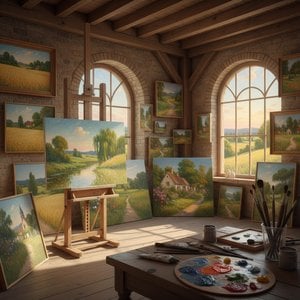
Discover the profound tranquility of rural art through an expert exploration of Impressionist landscapes. From pastoral scenes to textured oil masterpieces, learn how timeless nature-inspired artworks bring enduring elegance and serenity to sophisticated collectors.

Explore the ethereal beauty of Impressionist landscapes. Discover how masters like Monet captured fleeting light through color and texture, and learn to curate these timeless, luminous masterpieces for your home collection.

Explore the profound beauty of village scene art. From Impressionist light to pastoral realism, discover how timeless landscapes capture nostalgia through expert artistry and historical depth. Perfect for collectors seeking evocative, museum-quality landscape inspirations.

 Preview
 Send
Send Share
Share
 Details

 Download
 Similars
 X-Ray
X-Ray Diaporama
 Stats
Stats Read More




































 Glass option is only available in size under 110 CM


