Museum-quality giclée or canvas print with fast production and flexible finish options. ( Buy Hand Made Painting Switch to Digital Image)
Pick from our preset sizes that match the artwork's original proportions.

Type the width and the height you need, to fit your frame or your wall. A print can only be cut, never made bigger than the picture, so a size with a different shape loses a part of the image. We send you a digital mockup to approve before we print anything. The picture shown on this page does not show the real cut — only the mockup does.
Worldwide Delivery () in 2 weeks instead of standard 4/5 weeks. (8 November)
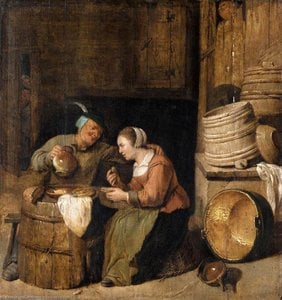
A Kitchen
Reproduction Size
When "A Kitchen" was created in 1643, Hendrick Maertensz Sorgh - born in 1610 - was 33 years old.
"A Kitchen" by Hendrick Maertensz Sorgh is a portrait composition measuring 52 x 44 cm in the original.
"A Kitchen" by Hendrick Maertensz Sorgh can be previewed on your own wall with the artwork's AR Preview page, using augmented reality on a compatible device.

In the golden light of the seventeenth-century Netherlands, few artists captured the quiet, rhythmic pulse of everyday life as intimately as Hendrik Maertensz Sorgh. Born in Rotterdam around 1610, Sorgh emerged during a period of unparalleled artistic flourishing, a time when the Dutch Golden Age was redefining the boundaries of genre painting. His journey into the heart of the Baroque tradition began with rigorous training under two formidable masters: the Antwerp virtuoso David Teniers the Younger and the Rotterdam painter Willem Pieterszoon Buytwech. This dual lineage gifted him a unique stylistic vocabulary, blending the theatrical grandeur of the Flemish school with a grounded, meticulous realism that would become his hallmark.
Sorgh’s artistry was never merely about documentation; it was an exploration of atmosphere and the profound beauty found in the mundane. He possessed a singular ability to transform a simple kitchen or a bustling market into a stage for human emotion. His works often feature chiaroscuro, that dramatic interplay of light and shadow, which lends a sculptural depth to his subjects. Whether he was rendering the glint of light on a pewter plate in a still life or the weary expression of a peasant in a tavern, Sorgh used light to guide the viewer’s eye through complex narratives of domesticity and survival.
The true soul of Sorgh’s oeuvre lies in his genre paintings, where he invites us into the private corners of 17 and 18th-century life. His interiors are far more than mere settings; they are rich with symbolic resonance. In masterpieces such as “The Lute Player,” created in 1661, we see a profound harmony of elements. The presence of the lute evokes the fleeting nature of music and joy, while carefully placed oranges serve as emblems of abundance and prosperity. Even the inclusion of animals, such as watchful dogs, adds a layer of warmth and companionship to the composition, grounding the scene in a sense of lived reality.
Beyond the cozy domestic sphere, Sorgh demonstrated remarkable versatility, proving his command over diverse subject matters that expanded the reach of his talent. His repertoire included:
Sorgh’s life was deeply intertwined with the very fabric of the Dutch art world. His marriage in 1633 to Adriaantje Hollaer created a connection to some of the most significant figures of the age. In a fascinating historical footnote, Sorgh’s sister served as the model for one of Rembrandt's most famous portraits of his wife—a subtle yet powerful testament to the interconnectedness of the Amsterdam and Rotterdam artistic circles. This web of familial and professional relationships placed Sorgh at the center of a cultural renaissance.
His ascent within the professional community was equally notable. In 1659, he achieved the prestigious position of leader within the Rotterdam Guild of St. Luke, an honor that reflected his high standing among his peers and his commitment to the standards of his craft. As he navigated the complexities of patronage and the evolving tastes of the Dutch Republic, Sorgh remained steadfast in his devotion to capturing the authentic essence of the human experience. Today, his works remain vital windows into a lost world, reminding us that there is profound dignity and artistry to be found in the simplest of moments.

1610 - 1670 , Netherlands
 Preview
 Send
Send Share
Share
 Details
 Guide
Guide

 Download
 Similars
 X-Ray
X-Ray Diaporama
 Q&A
Q&A
 Stats
Stats
 Read More






































 Glass option is only available in size under 110 CM