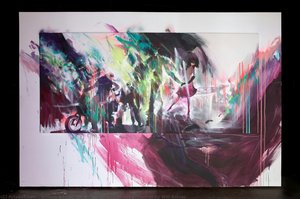
310.0 x 140.0 cm
 Bonnefanten Museum
Museum-quality giclée or canvas print with fast production and flexible finish options. ( Buy Hand Made Painting Switch to Digital Image)
Pick from our preset sizes that match the artwork's original proportions.

You may enter your own dimensions to fit a specific frame or space. If your selected size does not match the original image's proportions, we will either crop the artwork or extend the image with a mirrored or solid-fill edge. A digital mockup will be sent for your approval before production begins.
Please note that the on-screen preview does not reflect the actual cropping or extension. Only the mockup will accurately show the final composition.
While custom sizes are available, we recommend selecting a dimension from the predefined list to preserve the original proportions.
Worldwide Delivery () in 2 weeks instead of standard 4/5 weeks. (25 September)


Thingly Character VIII
Reproduction Size

In the quiet, profound spaces between ritual and reality, the work of Helen Verhoeven resides. Born in Leiden, Netherlands, in 1974, Verhoeven has emerged as a formidable voice in contemporary painting and sculpture, crafting a visual language that is as much about the weight of human existence as it is about the grandeur of scale. Based in Berlin, her practice is defined by a relentless pursuit of the profound, utilizing monumental canvases to confront the rawest facets of the human condition. Her art does not merely invite observation; it demands an encounter, pulling the viewer into staged, cinematic worlds where figures are caught in the throbin pulse of rapture, despair, lust, and estrangement.
Verhoeven’s artistic identity is a rich tapestry woven from diverse cultural and academic threads. Having moved to the United States in 1986, her formative years were shaped by a dual perspective that bridges European tradition with American experimentalism. Her rigorous training at the San Francisco Art Institute and the New York Academy of Art provided her with a masterful command of anatomical precision and classical technique, while her time at the prestigious Rijksakademie van Beeldende Kunsten in Amsterdam allowed her to push these foundations toward more conceptual and boundary-breaking territories. This synthesis of technical excellence and philosophical inquiry allows her to create works that feel both timelessly classical and strikingly modern.
At the heart of Verhoeven’s oeuvre is an obsession with the collective rituals that define our species. She often depicts ceremonial gatherings—scenes that feel like frozen moments from a grand, unfolding drama. These compositions are frequently populated by contorted figures whose physical postures mirror their internal psychological states. Through her use of bold color palettes and dramatic lighting, she transforms the canvas into a stage where the boundaries between the observer and the observed begin to blur. In works such as her Thingly Character series, she explores the philosophical nuances of existence, drawing inspiration from Martin Heidegger’s meditations on the nature of art and the relationship between objects and their representations.
The technical execution of her work is nothing short of breathtaking. Verhoeven utilizes scale to overwhelm the senses, creating environments that feel like immersive installations. In certain pieces, she employs a monochromatic or limited palette—blacks, whites, and greys—to heighten a sense of cinematic tension, making the scenery feel like an imaginative collage of fragmented interiors. This technique forces the viewer’s gaze into constant motion, as if one were walking through a gallery of living statues. Her ability to render the "silence that is pregnant or almost threatening" creates a palpable atmosphere, where every figure and every shadow contributes to a larger, often unsettling, narrative of human connection and isolation.
The trajectory of Verhoeven’s career has been marked by significant institutional recognition and high-profile commissions. Her ability to translate complex societal themes into visual masterpieces was notably demonstrated when she was commissioned to create a painting for the new courthouse of the Dutch Supreme Court in The Hague, which opened in 2015. This work, a monumental testament to justice and reflection, solidified her status as an artist capable of addressing the highest levels of societal responsibility. Her excellence has been further validated by several prestigious accolades, including:
Beyond her individual achievements, Verhoeven contributes to the future of the medium through her role as a professor at the Dresden Academy of Fine Arts. In this capacity, she nurtures the next generation of painters, passing on the technical rigor and conceptual depth that define her own practice. As both a painter and a sculptor, her work continues to bridge the gap between the tangible object and the ephemeral emotion, ensuring her place as a significant figure in the landscape of contemporary figurative art.

1974 - , Netherlands

 Preview
 Send
Send Share
Share
 Details
 Guide
Guide

 Download
 Similars
 X-Ray
X-Ray Diaporama
 Stats
Stats Read More




































 Glass option is only available in size under 110 CM