x


Hand-painted oil on canvas in your size and frame, made to order by our artists. ( Buy Print Buy Image)
Pick from our preset sizes that match the artwork's original proportions.

You may enter your own dimensions to fit a specific frame or space. If your selected size does not match the original image's proportions, we will either crop the artwork or extend the painting with additional hand-painted elements. A digital mockup will be sent for your approval before production begins.
Please note that the on-screen preview does not reflect the actual cropping or extension. Only the mockup will accurately show the final composition.
While custom sizes are available, we recommend selecting a dimension from the predefined list to preserve the original proportions.
Worldwide Delivery () in 3/4 weeks instead of standard 5 weeks. (25 August). No compromise on quality.


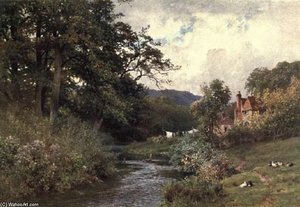
Highland Scene
Reproduction Size

Harry S. Sutton Palmer (1854-1933) emerges from the late 19th and early 20th centuries as a quietly significant figure in British watercolour painting. While he never achieved the widespread fame of his contemporaries, Palmer’s meticulous observation, masterful use of light, and evocative depictions of rural England have secured him a devoted following amongst collectors and art enthusiasts. Born in Plymouth, Devon, to a family with artistic leanings, Palmer's journey began not with grand ambitions but with a disciplined study of still life – a foundation that ultimately informed his later success in capturing the fleeting beauty of the natural world.
Palmer’s formal training at the Royal College of Art proved formative. He quickly demonstrated an aptitude for draughtsmanship and a keen eye for detail, winning a gold medal that signaled his potential. However, it was his subsequent move to London and his embrace of landscape painting that truly defined his artistic career. Unlike many of his contemporaries who sought dramatic or theatrical subjects, Palmer focused on the quiet dignity of rural England – the rolling hills of Surrey, the serene valleys of the Lake District, and the picturesque landscapes of Devon. His work is characterized by a remarkable sense of tranquility and an almost photographic realism, achieved through painstaking observation and a subtle understanding of colour theory.
Palmer’s artistic development was closely linked to his illustration work for A & C Black, a leading publisher of travel books and illustrated guides. These commissions provided him with invaluable experience in rendering detailed landscapes and capturing the essence of specific locations. His illustrations for titles such as “The Rivers and Streams of England” and “Bonnie Scotland” showcased his ability to convey atmosphere and mood through watercolour – a medium he handled with exceptional skill. The precision required for these illustrations undoubtedly honed his observational abilities, further refining his technique.
Palmer’s mastery lay not just in his subject matter but also in his technical approach. He was a staunch advocate of watercolour as a medium capable of achieving remarkable detail and luminosity. Unlike some artists who favored looser, more expressive brushstrokes, Palmer employed a controlled and deliberate technique – layering thin washes to build up colour gradually, creating subtle gradations of tone, and meticulously rendering every leaf, blade of grass, and ripple in the water. His work is often described as “atmospheric,” reflecting his ability to capture not just the visual appearance of a landscape but also its feeling and mood.
His use of light was particularly noteworthy. Palmer possessed an intuitive understanding of how light interacts with different surfaces – the shimmering reflections on water, the dappled shade beneath trees, the golden glow of sunset. He skillfully employed techniques such as glazing and scumbling to create a sense of depth and atmosphere, imbuing his paintings with a vibrant energy. He was known for his ability to depict the subtle shifts in colour and tone that occur throughout the day, capturing the ephemeral beauty of the natural world.
Several of Palmer’s works are now held in prestigious collections, including the Victoria and Albert Museum, Leek Art Gallery, and Wardown Park Museum. “Waverley Abbey Near Farnham” exemplifies his ability to capture a complex scene with remarkable clarity and detail, while “The Wye Valley” showcases his mastery of atmospheric perspective. His watercolour paintings are frequently found in private collections as well.
Palmer’s work was regularly exhibited at leading venues such as the Royal Academy, Fine Art Society, Leicester Galleries, and Dowdeswell galleries in London, and also in New York City. He was elected a member of both the Royal Society of British Artists (RBA) and the Royal Institute of Painters in Water Colours (RI), recognizing his contribution to the art world.
Harry S. Sutton Palmer’s legacy lies not in grand pronouncements or revolutionary techniques, but in his quiet dedication to capturing the beauty of everyday England. He represents a significant strand within the broader narrative of Victorian landscape painting – an era characterized by both romantic idealism and meticulous realism. His work reflects the growing interest in nature and the countryside during this period, as well as the increasing popularity of watercolour as a medium for artistic expression.
Palmer’s influence extends beyond his individual paintings. He helped to establish watercolour as a respected art form and demonstrated its potential for capturing both visual detail and atmospheric effect. His meticulous approach and unwavering commitment to observation continue to inspire artists today, cementing his place as a pioneering figure in British watercolour painting.

1854 - 1933 , United Kingdom


Stay updated with the latest art news, exclusive offers, and decoration ideas.
Tell us about your project and our art experts will provide you with 3 personalized art suggestions.
Let Us Curate 3 Options Just for You - Free!

 Preview
 Send
Send Share
Share
 Details

 Download
 Similars
 X-Ray
X-Ray Diaporama
 Read More




































 Glass option is only available in size under 110 CM