

 1919
1919 154.0 x 172.0 cm
 Grundy Art Gallery
Purchase a high-resolution, enhanced digital image, far superior to the online preview.
Each file is meticulously prepared by our in-house specialists using advanced tools and expert manual retouching. We ensure every image has exceptional clarity, precise color accuracy, and fine detail.
The final file is delivered via email within 72 hours, optimized for immediate use in professional, editorial, and print environments. This is the same quality trusted by top-tier design studios, publishers, and galleries.
Download a high-resolution file for personal display, printing, and creative projects. ( Switch to Print Buy Hand Made Painting)
When you choose WahooArt.com, you're not just getting an image - you're receiving a professionally enhanced digital artwork, crafted with precision and backed by a satisfaction guarantee. Here's everything that comes with your order, automatically:

Your high-resolution digital image file will be emailed to you within 72 hours of ordering - ready for immediate use.

Your artwork is professionally optimized using advanced AI tools and manual editing, ensuring maximum detail, clarity, and color accuracy.

Accidentally deleted or lost your file? No worries - we'll resend it to you anytime, free of charge.

Enjoy your artwork instantly with zero customs, duties, or delivery fees - digital downloads are always tax-free.

We ensure your digital image reflects the original colors as closely as possible using professional tools and color management.

If you're not satisfied with your digital image, we'll revise it or refund 100% within 100 days - no questions asked.

Not satisfied? Get a full refund within 100 days of receiving your digital file - no questions asked.

Buy 3 images, save 10% - Buy 5, save 15% - Buy 10+, save 20%. Great for creative projects, galleries, and agencies.

Born in Florence, Italy, in 1856 to American parents – Dr. Fitzwilliam Sargent, an eye surgeon, and Mary Newbold Singer – John Singer Sargent’s life was one of constant movement and artistic evolution. His childhood was steeped in European culture, a far cry from the conventional upbringing of many American artists at the time. He spent his formative years touring Italy, France, Switzerland, and Germany, absorbing the art and atmosphere of these vibrant locales. This early exposure to diverse artistic traditions would profoundly shape his distinctive style, blending influences ranging from Velázquez’s masterful realism to the burgeoning Impressionism of the late 19th century.
Sargent's formal training began in Florence at the Accademia delle Belle Arti, but he quickly recognized that Paris offered a more stimulating environment for an aspiring artist. In 1874, he moved to the French capital and enrolled in the atelier of Carolus-Duran, a prominent portraitist known for his emphasis on direct painting—applying paint directly onto the canvas with a loaded brush—and for his connections to the avant-garde. Duran’s influence was crucial; Sargent learned to capture fleeting moments and convey a sense of immediacy through his brushwork, techniques that would become hallmarks of his work. His early submissions to the Paris Salon garnered attention, establishing him as a rising star in the Parisian art scene, though not without controversy – notably with *Madame X*, a portrait that scandalized society due to its unconventional depiction of a fashionable woman.
Sargent quickly established himself as one of the most sought-after portrait painters of his generation, particularly in England. He possessed a remarkable ability to capture not just physical likeness but also the personality and social standing of his subjects. He was commissioned by wealthy industrialists, aristocrats, and celebrities – figures like Roosevelt, Rockefeller, and Lady Randolph Churchill – reflecting the prosperity and glamour of Edwardian society. His portraits were characterized by their elegance, sophistication, and a subtle sense of drama, often capturing fleeting expressions and intimate moments.
However, Sargent’s artistic journey wasn't solely defined by commissioned works. He also produced a significant body of informal sketches and landscapes that revealed a more experimental and personal side to his art. These studies showcased his technical virtuosity and his fascination with light, color, and the beauty of the natural world. He traveled extensively – from Venice and Corfu to Montana and Maine – documenting these experiences through a prolific output of watercolors and oils, often working *en plein air* (outdoors) to capture the immediacy of the scene.
Sargent’s career was not without its complexities. His early success, fueled by his technical brilliance and adherence to established conventions, initially masked a growing dissatisfaction with the constraints of formal portraiture. As he matured as an artist, he began to explore more unconventional subjects – including nude studies—challenging societal norms and expressing a degree of personal freedom that was often overlooked in his earlier work. The rediscovery of these male nudes in the late 20th century sparked renewed interest in Sargent’s life and art, revealing a complex individual grappling with issues of sexuality, gender identity, and social change.
Despite initial criticism for perceived superficiality, art historians now recognize Sargent as a pivotal figure in British art history. His influence extended beyond portraiture, impacting the development of mural painting – notably his ambitious murals at the Boston Public Library – and inspiring generations of artists with his masterful technique and innovative approach to capturing light, color, and human emotion. His legacy continues to be debated and reinterpreted, solidifying his position as a truly remarkable and enduring artist.
John Singer Sargent achieved widespread recognition during his lifetime as one of the most accomplished portrait painters of his era. His work was exhibited at major venues including the Royal Academy and the Grosvenor Gallery in London, and Knoedler’s in New York. He became a member of the prestigious Royal Academy in 1894 and received numerous commissions from prominent figures, solidifying his position as a leading artist within Edwardian society. Sargent's career coincided with a period of significant social and cultural change, marked by industrialization, urbanization, and increasing globalization. His art reflects these shifts, capturing both the opulence and the anxieties of a rapidly changing world.
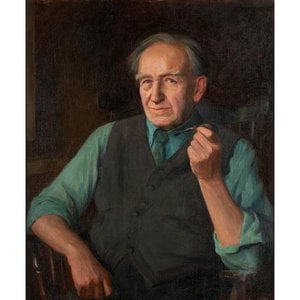
1856 - 1935 , United Kingdom

 Preview
 Send
Send Share
Share
 Details
 Guide
Guide

 Download
 Similars
 X-Ray
X-Ray Diaporama
 Stats
Stats Read More


