FREE ART CONSULTATION

x
Buy Painting Buy PaintingBuy Image Buy Image SendSend
DetailsDetails Add to favorites Add to favorites DownloadDownload SimilarsSimilars X-RayX-Ray DiaporamaDiaporama

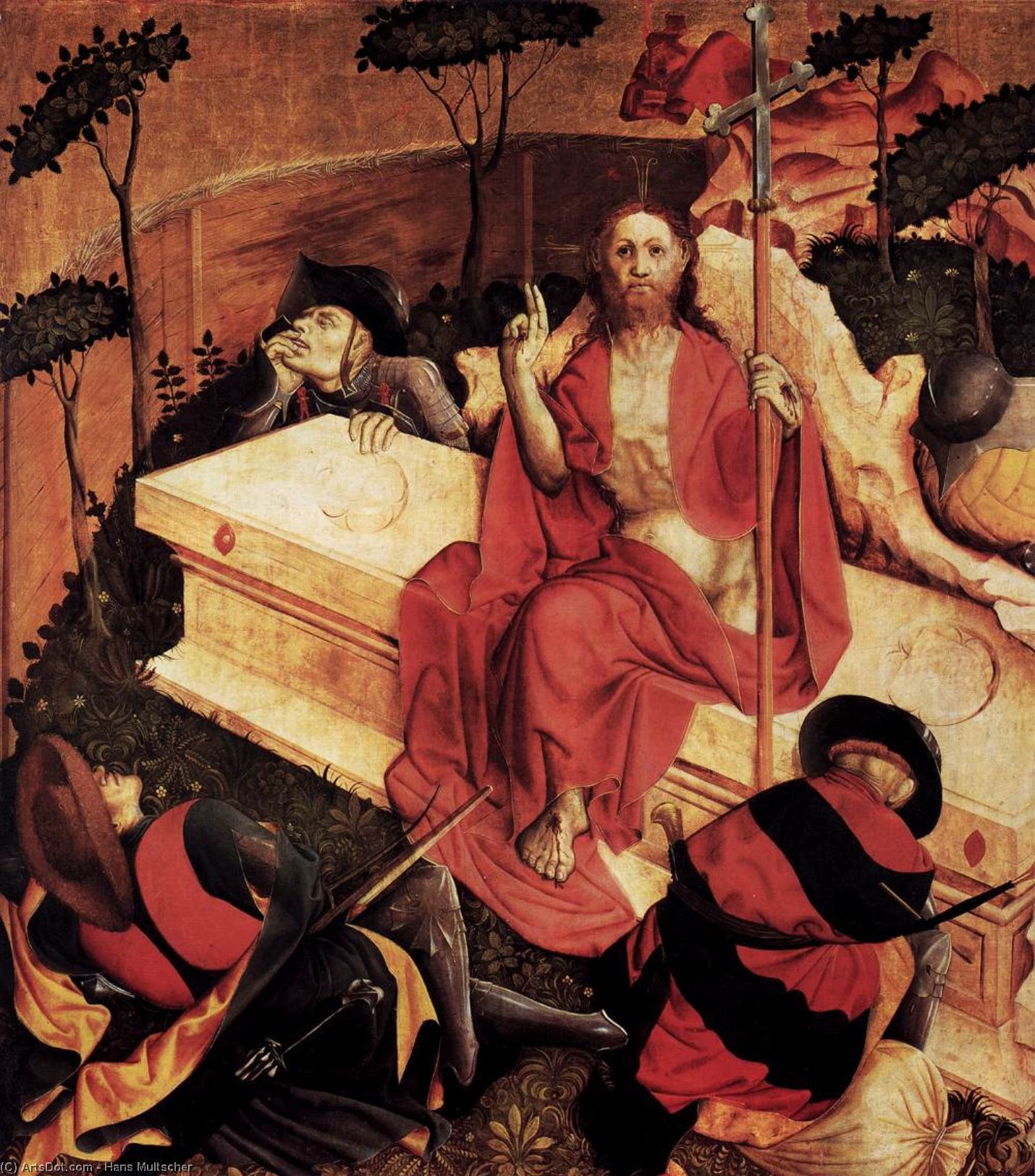
Resurrection

Discover Hans Multscher’s ‘Resurrection’ (1437) – a stunning medieval painting of Christ's deposition. Rich colors, detailed figures & pyramidal composition. Explore this masterpiece!

Discover Hans Multscher (c.1400-1467), a German sculptor & painter bridging Gothic and Renaissance art. Explore his realistic style, religious themes, and influential workshop!

Giclée / Art Print

Museum-quality giclée or canvas print with fast production and flexible finish options.

P118B $10
P118H $10
P118W $10
P438Z $10
P508JH $12
P508YH $12
P805H $10
P805Z $10
P919BZ $10
P919G $10
P919XJ $10
P959ZH $10
P968JZ $12
W106C $8
W218G $10
W218JH $8
W218Y $10
W307PJ $10
W316G $10
W316PJ $8
W316Y $10
W398PJ $8
W4111J $10
W500HY $15
W500JH $15
W692G $12
W849H $8
W940BG $15
W953PJ $8

Standard
custom
CM
INCH

Pick from our preset sizes that match the artwork's original proportions.

width
height

You may enter your own dimensions to fit a specific frame or space. If your selected size does not match the original image's proportions, we will either crop the artwork or extend the image with a mirrored or solid-fill edge. A digital mockup will be sent for your approval before production begins.
Please note that the on-screen preview does not reflect the actual cropping or extension. Only the mockup will accurately show the final composition.
While custom sizes are available, we recommend selecting a dimension from the predefined list to preserve the original proportions.

Worldwide Delivery () in 2 weeks instead of standard 4/5 weeks. (3 July)

why_choose_icon
Free Worldwide Express Shipping
why_choose_icon
High-Quality Linen Canvas
why_choose_icon
Full Shipping Insurance
why_choose_icon
Customs Tax Refund Guarantee
why_choose_icon
True Color Matching Guarantee
why_choose_icon
60-Day Return Policy (Defects Only)
why_choose_icon
100% Money-Back Guarantee
why_choose_icon
Bulk Discount Offer

Total Price

-

reproduction

Resurrection

Giclée / Art Print

Reproduction Size

-

Total Price

-

Quick Facts

  • Title: Resurrection
  • Influences:
    • Northern France
    • Netherlands
  • Medium: Oil on wood panel
  • Movement: Late Medieval/Early Renaissance
  • Dimensions: 148 x 140 cm
  • Notable elements: Pyramidal composition, gold leaf accents
  • Artist: Hans Multscher

Art Quiz

There is only one correct answer for each question.

Question 1:
What is the primary subject depicted in Hans Multscher’s ‘Resurrection’?
Question 2:
According to the description, what artistic style is most evident in ‘Resurrection’?
Question 3:
What material was primarily used for the painting ‘Resurrection’?
Question 4:
The description mentions a pyramidal composition in the artwork. What does this compositional element primarily emphasize?
Question 5:
What symbolic element is represented by the presence of John the Evangelist in the painting?

Collectible Description

A Window Into Medieval Grief: Hans Multscher’s “Resurrection”

Hans Multscher's "Resurrection," painted in 1437, is more than just a depiction of Christ’s deposition; it’s a profound meditation on loss, faith, and the transition between earthly existence and the promise of salvation. Executed in the rich, detailed style characteristic of late medieval German art, this panel from the lost Wurzacher Altar offers a remarkably intimate glimpse into the artistic sensibilities of a pivotal figure bridging the Gothic and Renaissance eras. The painting immediately commands attention with its dramatic composition – a pyramidal structure anchored by Christ’s body, carefully arranged to draw the viewer's eye through layers of mourners and architectural elements. The use of linear perspective, though stylized for the time, establishes a convincing sense of depth, while geometric shapes—rectangles defining the coffin, rounded forms representing the human bodies—create a balanced yet emotionally charged scene.

Multscher’s technical mastery is evident in every brushstroke. The meticulous layering of paint achieves remarkable volume and realism, particularly in the drapery and flesh tones – a testament to his skill as both a sculptor and painter. The application of gold leaf accents not only adds visual richness but also subtly elevates the scene, hinting at the divine nature of the subject matter. Notice the careful modeling of light and shadow; it’s not merely decorative, but actively shapes the forms, lending them a tangible presence within the enclosed space. The color palette is deliberately restrained – predominantly reds dominating Christ's body and robes, contrasted with cooler blues and greens in the background landscape – creating a powerful visual dichotomy between suffering and hope.

The Symbolism of Sorrow and Witness

“Resurrection” is deeply laden with symbolic meaning. The scene itself, the deposition of Christ after his crucifixion, speaks volumes about grief and acceptance. Christ’s body, laid upon Mary's lap, embodies both physical suffering and spiritual transcendence. John the Evangelist, positioned as a witness to this pivotal moment, holds aloft his writing tablet – a potent symbol of record-keeping and the preservation of faith. The presence of the other mourners underscores the communal nature of grief, reflecting the shared sorrow felt by the entire community. The soldiers lying asleep represent humanity’s inability to fully comprehend or prevent such profound events, highlighting the mystery at the heart of Christian belief.

Beyond these immediate symbols, the painting engages with broader theological themes. The red cloth draped over Christ's body is a deliberate reference to his blood – a symbol of sacrifice and redemption. The unbroken seals on the sarcophagus suggest that even in death, Christ’s sacrifice remains secure and powerful. The scene powerfully conveys the transition from earthly mortality to eternal life, offering a visual representation of faith’s enduring promise.

A Bridge Between Eras: Multscher's Artistic Legacy

Hans Multscher stands as a crucial figure in German art history, skillfully navigating the stylistic shifts between the late Gothic and burgeoning Renaissance. His travels to northern France and the Netherlands exposed him to the realism and meticulous detail of Early Netherlandish painting – influences that profoundly shaped his own distinctive style. “Resurrection” exemplifies this synthesis; it retains the emotional intensity and symbolic richness of medieval art while incorporating elements of Renaissance perspective and naturalism.

Born in Reichenhofen, Bavaria, around 1400, Multscher’s career was marked by a dedication to both sculpture and painting, as evidenced by his work on the Wurzacher Altar. His workshop produced numerous religious panels, each imbued with his characteristic skill and artistic vision. Today, reproductions of “Resurrection” offer art lovers a chance to experience the profound beauty and emotional depth of this remarkable masterpiece – a testament to Multscher’s enduring legacy as a pioneer of German realism.

Bringing "Resurrection" into Your Space

WahooArt offers meticulously crafted, hand-painted reproductions of Hans Multscher's “Resurrection,” allowing you to bring this iconic work of art into your home or office. Our artists replicate the painting’s rich colors, intricate details, and dramatic composition with unparalleled accuracy, ensuring that your reproduction captures the essence of Multscher’s original vision. Whether you are a collector of medieval art, an admirer of German realism, or simply seeking to add a touch of timeless beauty to your surroundings, our “Resurrection” reproductions provide a stunning and authentic representation of this powerful masterpiece.

Explore the full details and dimensions of this exceptional artwork on our website: https://www.wga.hu/html_m/m/multsche/wurzach/4resurr.html


Artist Biography

A Pioneer of German Realism: The Life and Art of Hans Multscher

Born around 1400 in the small Bavarian town of Reichenhofen, now part of Leutkirch im Allgäu, Hans Multscher emerged as a pivotal figure bridging the stylistic transition from the late Gothic period to the burgeoning Renaissance in Germany. While precise details surrounding his early life remain scarce, it’s clear that Multscher possessed an inquisitive spirit and a keen eye for artistic innovation. He didn't simply absorb prevailing trends; he actively sought out new influences, embarking on journeys that would profoundly shape his unique aesthetic vision. These travels likely took him to the artistic centers of northern France and the Netherlands, exposing him to the burgeoning realism and meticulous detail characteristic of Early Netherlandish painting – a style that would become a defining feature of his own work. In 1427, Multscher established himself as a free citizen of Ulm, a thriving commercial hub on the Danube River, marking a turning point in his career. There he married Adelheid Kitzin and, alongside his brother Heinrich, founded a workshop that quickly gained prominence for its innovative sculptures and paintings.

The Workshop and Artistic Development

The Multscher workshop was not merely a place of production; it was a crucible of artistic experimentation. Hans oversaw a substantial team – records indicate as many as sixteen assistants at times – fostering an environment where traditional Gothic forms were gradually infused with the naturalism he had absorbed during his travels. This blend is particularly evident in his sculptural work, which moved away from the elongated figures and stylized drapery typical of the late Gothic period towards more anatomically accurate representations and a greater sense of emotional depth. His paintings, though fewer in number, demonstrate an equally compelling shift. The *Wurzacher Altar*, begun in 1437, stands as a testament to this evolving style. This ambitious project, originally intended for the church of St. James in Wurzach, showcases Multscher’s mastery of oil painting – a relatively new medium at the time – and his ability to render textures, light, and shadow with remarkable precision. The altar's panels depict scenes from the life of Christ and the Virgin Mary, each imbued with a sense of palpable humanity that set it apart from earlier devotional art. It’s important to note that Multscher wasn’t solely focused on religious subjects; his commissions also included secular works, such as the group of emperors adorning the eastern window of Ulm's city hall, demonstrating his versatility and appeal to a broad clientele.

Key Works and Lasting Legacy

Beyond the *Wurzacher Altar*, several other works cemented Multscher’s reputation as one of Germany’s most important artists. The sculpture of *Holy Mary Magdalen*, now housed in Frankfurt's Liebieghaus, is a particularly poignant example of his ability to convey profound emotion through sculpted form. Her sorrowful expression and the delicate rendering of her hair and clothing reveal a deep understanding of human psychology. Another notable work is the *Man of Sorrows* – copies of which can be found at Ulm Minster – a powerful depiction of Christ’s suffering that reflects the devotional fervor of the era. These pieces, along with his contributions to the Ulm city hall, demonstrate Multscher's skill in both sculpture and painting, as well as his ability to adapt his style to different contexts and patrons. His influence extended far beyond his own lifetime; the workshop he established continued to thrive after his death in 1467, disseminating his artistic principles throughout Swabia and beyond.

A Bridge Between Eras

Hans Multscher’s significance lies not only in the beauty and technical skill of his art but also in his role as a catalyst for change. He was among the first German artists to fully embrace the realism and naturalism that were transforming art in northern Europe, paving the way for subsequent generations of Renaissance masters. His work represents a crucial moment in the development of German art, marking a departure from the stylized conventions of the Gothic period towards a more humanistic and observational approach. While he didn’t entirely abandon traditional forms – elements of Gothic ornamentation can still be detected in his work – he skillfully integrated them with new techniques and aesthetic sensibilities, creating a unique artistic language that resonated deeply with his contemporaries and continues to captivate audiences today. He stands as a testament to the power of artistic exchange and the enduring legacy of those who dare to challenge convention.

Exploring Multscher’s World Today

Fortunately, numerous examples of Hans Multscher's artistry survive, allowing us to appreciate his genius firsthand. The Gemäldegalerie Alte Meister in Dresden houses an impressive collection of European paintings from the 15th to 18th centuries, offering a broader context for understanding Multscher’s place within art history. For those interested in exploring high-quality reproductions of his work, platforms like WahooArt and WahooArt offer meticulously hand-painted copies that capture the nuances of his original masterpieces. Furthermore, resources such as Wikipedia and the Web Gallery of Art provide valuable biographical information and detailed analyses of his artistic style. By engaging with these resources, we can continue to celebrate the life and legacy of Hans Multscher – a true pioneer of German realism whose art continues to inspire and move us centuries later.
Hans Multscher

Hans Multscher

1400 - 1467 , Germany

Quick Facts

  • Artistic Movement Or Style: Late Gothic/Renaissance
  • Artists Who Influenced This Artist:
    • Northern France styles
    • Netherlands styles
  • Date Of Birth: c. 1400
  • Date Of Death: 1467
  • Full Name: Hans Multscher
  • Nationality: German
  • Notable Artworks:
    • Holy Mary Magdalen
    • Man of Sorrows
    • Group of Emperors
    • Wurzach Altar
  • Place Of Birth: Reichenbach, Germany
Explore artworks organized by themes, styles, and characteristics.