The artwork displayed on this page is protected by copyright law, which means we cannot legally create or sell an identical reproduction. This protection is enforced under international agreements such as the Berne Convention and by national laws, including those outlined by the U.S. Copyright Law - Title 17.
This method fully complies with copyright regulations because it does not involve copying or duplicating the protected artwork. Instead, it is a creative reinterpretation - a new painting that is influenced by the original but not identical to it.
Museum-quality giclée or canvas print with fast production and flexible finish options. ( Buy Hand Made Painting Switch to Digital Image)





























Pick from our preset sizes that match the artwork's original proportions.

Type the width and the height you need, to fit your frame or your wall. A print can only be cut, never made bigger than the picture, so a size with a different shape loses a part of the image. We send you a digital mockup to approve before we print anything. The picture shown on this page does not show the real cut — only the mockup does.
Worldwide Delivery () in 2 weeks instead of standard 4/5 weeks. (22 October)
The Dance
Reproduction Size
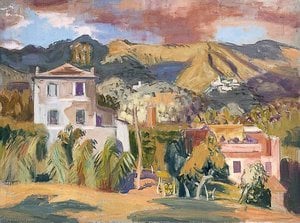
In the vibrant tapestry of mid-century expressionism, Hans Feibusch’s "The Dance" emerges as a breathtaking celebration of human connection and rhythmic vitality. Created in 1950, this masterpiece captures a moment of pure, unadulterated ecstasy, where a group of at least twelve figures becomes entwined in a communal ritual of movement. The scene unfolds within a lush, verdant field, where the boundaries between the dancers and the natural world seem to blur. As eyes wander across the canvas, one discovers the delicate presence of birds amidst the foliage, subtle reminders of the harmony that exists when humanity moves in cadence with the earth. It is not merely a depiction of a social gathering; it is an evocative portrayal of life’s inherent pulse, rendered with a palette that radiates warmth and energy.
The technique employed by Feibusch invites the viewer into a world of tactile emotion. Through a masterful use of color and light, the artist breathes life into the landscape, using the backdrop of deep, textured trees to provide a sense of profound depth and sanctuary. The interplay of light across the dancers' forms suggests a flickering, cinematic quality, as if the viewer has stumbled upon a fleeting, magical moment in time. For the discerning collector or interior designer, this piece offers a dynamic focal point that commands attention through its luminosity. The brushwork, while controlled, possesses an organic fluidity that mirrors the swirling motions of the dancers themselves, making the canvas feel less like a static image and more like a living, breathing entity.
To understand the profound emotional impact of "The Dance," one must consider the life of its creator. Hans Feibusch, a visionary who navigated the shadows of 20th-century upheaval, brought a unique resilience to his art. Having experienced the displacement caused by the rise of Nazi Germany, Feibusch’s later works often seek to reclaim beauty and communal spirit. In this painting, we see the triumph of light over darkness. The joy depicted is not superficial; it is a hard-won celebration of existence. This layer of historical context adds an invaluable dimension for those seeking art with soul—a piece that does more than decorate a room, but rather enriches the atmosphere with themes of peace, resilience, and the enduring power of the human spirit.
Integrating a high-quality reproduction of this work into a curated space allows for a sophisticated dialogue between modern elegance and classical emotion. Whether placed in a sun-drenched living area or a contemplative study, "The Dance" serves as an eternal invitation to find joy in the present moment. It is a work that resonates with anyone who appreciates the intersection of fine art history and emotive storytelling, making it an exquisite choice for those looking to invest in a piece that inspires movement, warmth, and a sense of profound well-being.
"The Dance" is attributed to Hans Feibusch.
The color harmony of "The Dance" is recorded as strong color unity.
The diaporama of "The Dance" can be watched on the artwork's Diaporama page.


1898 - 1998

Discover the profound emotional depth of Color Field Painting. Explore how masters use pure color and expansive scale to evoke the sublime, offering expert insights for discerning collectors seeking to integrate chromatic abstraction into sophisticated modern interiors.

 Preview
 Send
Send Share
Share
 Details
 Guide
Guide

 Download
 Similars
 X-Ray
X-Ray Diaporama
 Stats
Stats


 Read More









 Glass option is only available in size under 110 CM