Museum-quality giclée or canvas print with fast production and flexible finish options. ( Buy Hand Made Painting Switch to Digital Image)





























Pick from our preset sizes that match the artwork's original proportions.

You may enter your own dimensions to fit a specific frame or space. If your selected size does not match the original image's proportions, we will either crop the artwork or extend the image with a mirrored or solid-fill edge. A digital mockup will be sent for your approval before production begins.
Please note that the on-screen preview does not reflect the actual cropping or extension. Only the mockup will accurately show the final composition.
While custom sizes are available, we recommend selecting a dimension from the predefined list to preserve the original proportions.
Worldwide Delivery () in 2 weeks instead of standard 4/5 weeks. (26 September)


Prometheus in Chains
Reproduction Size
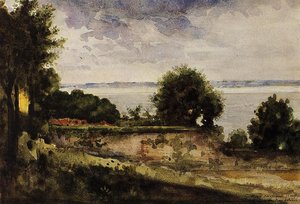
In the ethereal realm of Symbolist art, few works capture the profound tension between agony and defiance as poignantly as Gustave Moreau’s "Prometheus in Chains." Completed in 1880, this watercolor masterpiece serves as a haunting window into the human psyche, inviting viewers to move beyond the literal and enter a world of mythic introspection. The painting depicts the Titan Prometheus, punished by Zeus for his selfless act of gifting fire to humanity, bound to a desolate rock beneath an expansive, somber sky. Moreau does not merely illustrate a Greek tragedy; he orchestrates a visual poem about the endurance of the spirit against the crushing weight of tyranny.
The composition is masterfully balanced to evoke a sense of dramatic isolation. As Prometheus sits in a posture that is simultaneously vulnerable and unyielding, his hands bound behind him, the viewer is drawn into his existential struggle. The presence of two other figures—standing like silent witnesses on the periphery—adds a layer of theatrical tension, suggesting a cosmic scale to his suffering. This arrangement creates a profound emotional resonance, making the piece an ideal focal point for those looking to introduce depth and intellectual gravity into a curated space.
Technically, Moreau utilizes the watercolor medium to achieve a dreamlike luminosity that oil paints often struggle to replicate. Through delicate, translucent washes, he builds layers of color that seem to glow from within, creating an atmosphere of hazy, melancholic beauty. The palette is a sophisticated study in muted tones; deep blues, earthy ochre, and somber greens dominate the landscape, reinforcing the painting’s heavy, sorrowful mood. This soft-focus technique allows for a sense of ambiguity, where shapes bleed into one another, mirroring the fluid boundaries between reality and the subconscious.
Every brushstroke contributes to the artwork's intricate texture. While certain areas possess an amorphous, ethereal quality characteristic of Symbolism, Moreau juxtaposes this with precise detailing that draws the eye to the textures of the rock and the subtle anatomy of the bound figure. For collectors and interior designers, this interplay of soft light and sharp detail offers a versatile aesthetic appeal, capable of complementing both classical settings and modern, minimalist environments where texture and mood are paramount.
Beyond its visual splendor, "Prometheus in Chains" is rich with symbolic motifs that invite endless contemplation. The inclusion of birds within the landscape serves as a powerful metaphor for the duality of existence. A bird perched near the Titan represents a fragile flicker of hope—a small, living pulse of light against the bleakness of his imprisonment. Conversely, a more distant bird suggests the cold, divine indifference of the heavens. These avian elements are quintessential to Moreau’s vision, acting as spiritual anchors that connect the earthly struggle to the celestial realm.
To possess a reproduction of this work is to bring a piece of history into the home—a piece that speaks of resistance, sacrifice, and the indomitable will. It is an artwork for the thinker and the dreamer, offering a sophisticated narrative that transcends mere decoration. Whether placed in a quiet study or as a centerpiece in a grand salon, Moreau’s vision of Prometheus remains a timeless testament to the beauty found within the struggle, making it a profound choice for any discerning art lover.


1826 - 1898 , France

Discover the exquisite era of Victorian Naturalism. Explore how master artists blended scientific precision with breathtaking realism to capture the soul of nature through botanical oil paintings and legendary landscapes.

Explore the breathtaking world of the Pre-Raphaelite Brotherhood. Discover how this movement redefined Victorian art through vivid detail, mythological depth, and romanticism. An expert guide for classic art enthusiasts seeking to rediscover these timeless masterpieces.

Discover the ethereal beauty of watercolor through an art-historical lens. Master the delicate balance of light, fluidity, and pigment to capture the luminous essence of nature, inspired by the legendary techniques of the Old Masters and Impressionist greats.

Discover the ethereal beauty of premium watercolor reproductions and bespoke commissions at WahooArt. From museum-quality landscapes to custom AI-enhanced portraits, our master artists deliver unparalleled craftsmanship and white-glove service for discerning collectors worldwide.

Embark on a sophisticated journey through the eternal allure of mythological art. Discover how master painters breathe life into ancient legends, from Greek deities to Baroque masterpieces, and learn to curate these timeless narratives within your own exquisite art collection.

 Preview
 Send
Send Share
Share
 Details
 Guide
Guide

 Download
 Similars
 X-Ray
X-Ray Diaporama
 Stats
Stats

 Read More







 Glass option is only available in size under 110 CM