
Get a print-ready file that goes far beyond the web preview. Every digital image we sell comes from a high-resolution master in our stock database — usually 5,000 to 15,000 pixels wide — so you can print large, crop tightly, or reproduce fine detail with confidence.
No file leaves our studio untouched. A digital expert checks the colors against the original painting and corrects them if needed, then improves clarity and detail with professional retouching tools — always staying faithful to the artist's brushwork and style. The result is an image that looks like the painting, not like a filtered scan.
You approve before you're done: our expert sends the image by e-mail within 72 hours for your review. Not satisfied? Ask for improvements or corrections, or request a refund if the quality falls short.
This is the quality relied on by publishers, design studios, galleries and print shops.
Download a high-resolution file for personal display, printing, and creative projects. ( Switch to Print Buy Hand Made Painting)
When you choose WahooArt.com, you're not just getting an image - you're receiving a professionally enhanced digital artwork, crafted with precision and backed by a satisfaction guarantee. Here's everything that comes with your order, automatically:
Your high-resolution digital image file will be emailed to you within 72 hours of ordering - ready for immediate use.
Your artwork is professionally optimized using advanced AI tools and manual editing, ensuring maximum detail, clarity, and color accuracy.
Accidentally deleted or lost your file? No worries - we'll resend it to you anytime, free of charge.
Enjoy your artwork instantly with zero customs, duties, or delivery fees - digital downloads are always tax-free.
We ensure your digital image reflects the original colors as closely as possible using professional tools and color management.
If you're not satisfied with your digital image, we'll revise it or refund 100% within 100 days - no questions asked.
Not satisfied? Get a full refund within 100 days of receiving your digital file - no questions asked.
Buy 3 images, save 10% - Buy 5, save 15% - Buy 10+, save 20%. Great for creative projects, galleries, and agencies.
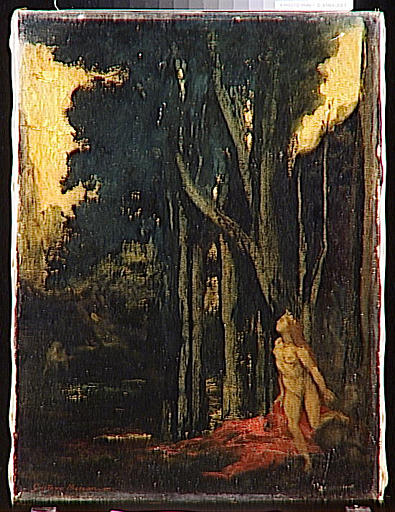
To encounter Gustave Moreau’s Pasiphaé is to step beyond the veil of the tangible world and enter a realm where the boundaries between dream and reality dissolve. This monumental canvas, painted during the height of the Symbolist movement between 1890 and 1895, serves as much more than a mere retelling of Greek mythology; it is an immersive psychological landscape. The painting captures the profound tension of the Phoenician queen of Crete, whose legendary encounter with Zeus's bull birthed a legacy of transgression and monstrous beauty. Moreau does not rely on explicit, jarring storytelling, but instead invites the viewer into a state of quiet, unsettling contemplation, where every shadow and glimmer of light whispers of forbidden longing.
The composition is masterfully orchestrated to evoke an atmosphere of oppressive enchantment. A dense, dreamlike forest dominates the scene, with towering trees whose intertwining branches create a claustrophobic yet majestic canopy. This labyrinthine setting mirrors Pasiphae’s own tormented inner state, trapping her within a visual metaphor for her inescapable fate. As the eye wanders through the muted, atmospheric depths, one might catch glimpses of distant figures that add layers of complexity to this mythic stage, suggesting a world teeming with unseen, archetypal forces.
Moreau’s technical prowess is on full display through his meticulous use of tempera on canvas, a medium he favored for its ability to achieve an almost supernatural luminosity. He employs a palette rich in golds and deep reds, which glow against more somber, earthy tones, creating a dramatic chiaroscuro effect that breathes life into the mythological figures. His style is characterized by a unique blend of fine, intricate detail and a deliberate flattening of perspective, a hallmark of Symbolist aesthetics that prioritizes emotional resonance over photographic accuracy.
The artist’s brushwork creates a texture that feels both ancient and ethereal. By eschewing the fleeting light of the Impressionists in favor of a more permanent, jewel-like finish, Moreau achieves a sense of timelessness. This technique allows the painting to function as a window into the subconscious, where the physical world is secondary to the spiritual and emotional truths being conveyed. For the collector or designer, this piece offers a profound depth of texture and color that can serve as a commanding focal point in any curated space.
Beyond its visual splendor, Pasiphaé is deeply rooted in the intellectual currents of the late 19th century. Moreau was profoundly moved by Nietzschean philosophy, particularly the concept of Eternal Recurrence—the idea that life and myth repeat in endless, archetypal cycles. In this work, the bull stands as a potent symbol of primal instinct and irrationality, while Pasiphae represents the vulnerability of the human soul when confronted with overwhelming, elemental forces. The painting captures that precise, breathless moment of transition between human agency and divine or animalistic destiny.
For those seeking to bring art into their homes that transcends mere decoration, this reproduction offers an opportunity to possess a piece of profound intellectual and emotional weight. It is an artwork that demands engagement, rewarding the viewer with new discoveries upon every glance. Whether placed in a quiet study or a grand gallery, Moreau’s vision of mythic desire provides a sophisticated, evocative atmosphere, inviting all who behold it to explore the beautiful, haunting mysteries of the human psyche.
Statistics about "Pasiphaé" by Gustave Moreau are on the artwork's Stats page: monthly visits of the artwork, visits of the artist's works, and country and language breakdowns of recent visitors.
"Pasiphaé" by Gustave Moreau is placed in the Symbolist Painting movement, within the 19th-Century era of its creator.
"Pasiphaé" by Gustave Moreau is recorded with a muted saturation and a monochromatic intensity.


1826 - 1898 , France

 Preview
 Send
Send Share
Share
 Details
 Guide
Guide

 Download
 Similars
 X-Ray
X-Ray Diaporama
 Stats
Stats

 Read More


