Museum-quality giclée or canvas print with fast production and flexible finish options. ( Buy Hand Made Painting Switch to Digital Image)





























Pick from our preset sizes that match the artwork's original proportions.

You may enter your own dimensions to fit a specific frame or space. If your selected size does not match the original image's proportions, we will either crop the artwork or extend the image with a mirrored or solid-fill edge. A digital mockup will be sent for your approval before production begins.
Please note that the on-screen preview does not reflect the actual cropping or extension. Only the mockup will accurately show the final composition.
While custom sizes are available, we recommend selecting a dimension from the predefined list to preserve the original proportions.
Worldwide Delivery () in 2 weeks instead of standard 4/5 weeks. (22 September)


The Hammock
Reproduction Size
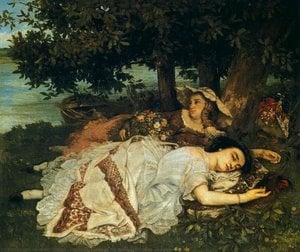
Gustave Courbet’s “The Hammock,” painted circa 1869-70, stands as a cornerstone of Realism—a movement that deliberately rejected the romanticized fantasies and idealized depictions favored by its predecessors. More than just a depiction of a simple outdoor scene, this canvas embodies Courbet's radical ambition to portray life as it truly is: unvarnished, honest, and devoid of embellishment.
Painted during a period of significant social upheaval in France—marked by industrialization, urbanization, and growing anxieties about societal change—Courbet's work directly confronted the artistic establishment. The École des Beaux-Arts, dominated by conservative tastes, favored idealized portraits and mythological subjects. Courbet deliberately rejected these conventions, arguing that art should reflect the realities of ordinary people’s lives.
Despite its apparent simplicity, “The Hammock” is replete with symbolic elements. The birds circling overhead represent freedom and aspiration—a visual counterpoint to the woman’s stillness. Courbet's unwavering attention to detail—the dappled sunlight filtering through the leaves, the subtle variations in color—underscores his belief that observation is paramount to artistic expression.
"The Hammock" continues to resonate with viewers today because it captures something profoundly human: the desire for respite from the pressures of daily life. Courbet’s unflinching realism—coupled with his masterful technique—transformed painting into a vehicle for conveying emotional truthfulness. It stands as a testament to the enduring power of observation and the importance of portraying life authentically, cementing Courbet's place as one of the most influential artists of the Realist movement.


1819 - 1877 , France
Delve into the world of Gustav Klimt with our top 25 masterpieces! Explore his iconic paintings – 'The Kiss,' 'Portrait of Adele,' and more. Discover museum-quality reproductions & curated decor ideas. Explore the full collection online at WahooArt.com.

Explore 10 defining Realism masterpieces – Courbet, Millet & more. Discover the stories behind these iconic paintings and their impact on art history. Find museum-quality reproductions for your home at !

Explore the revolutionary art of Gustave Courbet, pioneer of Realism. Discover his iconic paintings, social commentary, and lasting impact on 19th-century French art history. Expert analysis & insights.

Explore the captivating landscapes of Gustave Loiseau, a key Post-Impressionist painter. Discover his unique 'en treillis' technique and artistic legacy with our comprehensive guide.

Journey through 10 Romantic landscape masterpieces by Friedrich, Turner & Cole. Explore emotional art, sublime nature scenes & iconic 19th-century paintings. Find museum-quality reproductions for your home at WahooArt.com – discover the full collection online!

 Preview
 Send
Send Share
Share
 Details
 Guide
Guide

 Download
 Similars
 X-Ray
X-Ray Diaporama
 Stats
Stats
 Read More







 Glass option is only available in size under 110 CM