

Museum-quality giclée or canvas print with fast production and flexible finish options. ( Buy Hand Made Painting Switch to Digital Image)





























Pick from our preset sizes that match the artwork's original proportions.

Type the width and the height you need, to fit your frame or your wall. A print can only be cut, never made bigger than the picture, so a size with a different shape loses a part of the image. We send you a digital mockup to approve before we print anything. The picture shown on this page does not show the real cut — only the mockup does.
Worldwide Delivery () in 2 weeks instead of standard 4/5 weeks. (16 November)
Philosophy(study)
Reproduction Size
Gustav Klimt's "Philosophy," a preparatory study for the monumental ceiling painting of the same name in Vienna’s University, is far more than just a sketch; it’s a concentrated microcosm of the artist’s evolving Symbolist vision and a profound meditation on knowledge, mortality, and the human condition. This black-and-white image offers a tantalizing glimpse into Klimt's creative process – a chaotic yet meticulously rendered exploration of figures adrift in a swirling vortex of thought. The study itself is imbued with an immediate sense of urgency and intellectual intensity, hinting at the grander work it would eventually become.
The composition immediately commands attention. A central, almost ethereal figure dominates the upper portion, radiating a subtle halo – a potent symbol suggesting wisdom or perhaps even divine inspiration. Surrounding this core are a diverse array of individuals: some reclining in languid poses, others standing with contemplative gazes, and still others engaged in what appears to be animated discussion. The inclusion of two bicycles is an unexpected detail, injecting a note of modernity and challenging the viewer to consider how Klimt was grappling with the changing landscape of his era. These aren’t simply decorative elements; they could represent the tension between tradition and progress, or perhaps the fleeting nature of experience in a rapidly modernizing world.
Klimt's masterful use of charcoal and pencil is immediately apparent. The lines are not clean or precise; instead, they possess a raw energy, a sense of urgency captured through expressive gestural strokes. Varying line weights create a dynamic interplay of light and shadow, lending depth and volume to the figures while simultaneously contributing to the overall feeling of movement and disorientation. The texture is deliberately rough – a deliberate rejection of academic smoothness—reflecting the preliminary nature of the study but also hinting at Klimt’s desire to break free from traditional artistic constraints. The diffused lighting suggests a studio setting, emphasizing the intimacy of this creative exploration.
The flattened perspective, devoid of a clear vanishing point, further enhances the sense of unease and psychological depth. Rather than offering a realistic representation of space, Klimt prioritizes emotional impact. Overlapping forms create a complex visual tapestry, drawing the eye through the composition and inviting contemplation. The ambiguity of the scene encourages viewers to project their own interpretations onto the figures and their interactions – a hallmark of Symbolist art.
“Philosophy” is inextricably linked to Klimt’s involvement with the Vienna Secession, an avant-garde movement that challenged the conservative artistic establishment. The original ceiling painting, commissioned for the University of Vienna in 1900, was met with considerable controversy due to its unconventional imagery and perceived challenge to established academic thought. The study itself reflects this tension – a visual manifestation of Klimt’s willingness to push boundaries and engage with complex philosophical ideas.
Further research reveals that Klimt's work on the University ceiling paintings was deeply influenced by Schopenhauer’s philosophy, particularly his pessimistic view of human existence. The figures in “Philosophy” can be interpreted as representing different stages of life – from youthful exuberance to decay and oblivion – mirroring this philosophical framework. The inclusion of the sphinx-like figure at the center further reinforces this connection, suggesting a quest for ultimate knowledge or understanding amidst the chaos of the world. It’s a powerful statement about the limitations of human reason and the enduring mysteries of existence.
WahooArt is proud to offer meticulously hand-painted reproductions of Gustav Klimt’s “Philosophy,” capturing the artist’s unique style and emotional intensity. Each reproduction is created by skilled artists using archival-quality materials, ensuring that the colors and details faithfully reflect the original study. Whether you're an art enthusiast, a collector seeking a statement piece, or simply someone drawn to Klimt’s evocative imagery, our reproductions provide a beautiful and authentic way to experience this iconic work of art.
The recommended pairing for "Philosophy(study)" by Gustav Klimt: a large print in a living room.
"Philosophy(study)" by Gustav Klimt has an iconic popularity level. This classification reflects how widely the work is recognized.
In terms of perceived brightness, "Philosophy(study)" by Gustav Klimt is brilliant.

In the small town of Baumgarten, near Vienna, Gustav Klimt was born into a world where the shimmer of metal was a constant presence. His father, Ernst Klimt, spent his days as a gold engraver, a craft that required a steady hand and an eye for the finest details. This early intimacy with precious metals and the precision of engraving would eventually find its way into the very soul of his later compositions. Yet, life was not always a matter of luster and ease. The family faced frequent financial hardships, which forced them to move often through the streets of Vienna. These transitions and the struggle to find stability shaped a young man who understood both the weight of poverty and the allure of ornament.
By the age of fourteen, his talent had become too evident to ignore. In 1876, he entered the Vienna Kunstgewerbeschule, seeking to turn his innate ability into a formal discipline. He did not begin his path by painting the human form in all its complexity, but rather by mastering the structured world of architectural painting. Under the guidance of Ferdinand Laufberger, he learned to decorate the grand spaces of buildings, focusing on the decorative needs of the era. This rigorous training provided the technical foundation upon which he would later build his more personal and experimental visions.
By the late 1890s, a restless energy began to stir beneath the surface of Klimt’s formal training. The heavy, historical academicism that had long governed the Viennese art establishment felt increasingly stifling to him. He sought a space where innovation could exist outside these rigid dictates of tradition, a place where the artist might finally breathe. This desire for creative freedom led him to become a founding member of the Vienna Secession, a movement born from a need to embrace new currents like Art Nouveau, Symbolism, and Japonism. In 1897, he was chosen as the first president of this defiant group, helping to steer a new direction for the city's artistic soul.
This rebellion was not merely a matter of style, but a rejection of the old ways of seeing. Klimt turned away from the predictable, grand narratives of the past, favoring instead organic lines and a profound symbolic depth. He sought to dissolve the boundaries between fine painting and ornamental design, drawing heavily from the flattened perspectives and patterned aesthetics found in Japanese art. This shift allowed him to explore the complexities of human intimacy and mortality with a frankness that often unsettled the conservative public. His work began to move toward a more personal, decorative language that prioritized the psychological weight of the subject over mere physical likeness.
As his reputation grew, Klimt found himself working within a collaborative spirit, forming a partnership with his brother Ernst and Franz von Matsch. This trio of artists operated with a shared purpose, securing significant commissions to decorate the grand spaces of Vienna. They spent much of their early professional years focused on large-scale decorative murals and ceilings, tasks that required a disciplined hand and an eye for ornamentation. Their work in these public spaces brought them into the direct orbit of the imperial court. It was for his contributions to the murals of the Burgtheater that Emperor Franz Joseph I bestowed upon him the Gold Cross of Merit, a high honor that signaled his acceptance into the upper echelons of Austrian society.
However, the very public nature of these grand projects eventually brought friction. The tension between his evolving, more provocative vision and the expectations of the state became a heavy burden. Following the controversy surrounding his ceiling paintings for the University of Vienna, Klimt made a decisive change in his professional life. He chose to withdraw from further public commissions, turning his back on the rigid dictates of state-sponsored art. Instead, he sought the support of private patronage. This shift allowed him to move away from the constraints of academic tradition and focus on a more personal, intimate style that would define his most celebrated years.
Around 1900, a transformation took hold of his brush, ushering in a period that would define his legacy. He moved away from the heavy, academic shadows of his youth to embrace a luminous, decorative language. This was a time when his canvases began to radiate their own light, as if the paint itself held a celestial glow. He achieved this through the meticulous application of gold leaf, a technique that lent his figures a shimmering, otherworldly presence. This obsession with light and surface was not born of a vacuum; he drew deep inspiration from the ancient mosaics of Ravenna and the intricate, sacred patterns found in medieval manuscripts. He sought to capture a sense of the eternal through these precious, reflective materials.
His vision was further shaped by the quiet elegance of Japanese art. He adopted the flattened perspectives and the rhythmic, patterned aesthetics of ukiyo-e prints, weaving these elements into his compositions. This fusion allowed him to blur the lines between the physical world and a more symbolic, ornamental realm. The figures in his paintings often seemed to emerge from a sea of geometric shapes and organic swirls, caught in a dance of texture and color. He did not merely depict a subject; he enveloped it in a complex, mosaic-like environment that challenged the viewer's sense of depth and space.
The artist’s brush found its most profound expression when he allowed gold to become a living part of his subjects. In the years between 1907 and 1908, he produced The Kiss, a work where a couple is enveloped in a shimmering, patterned aura. The figures seem to emerge from a floral meadow, their forms entwined in an intimate embrace that defies the simple boundaries of the canvas. This period of intense ornamentation was not merely a decorative choice but a way to capture the psychological weight of human connection. He achieved a similar, though more somber, effect in The Three Ages of Woman, painted in 1905. Here, he used contrasting auras—one of blue, fluid patterns for the younger figures and another of warm, earthy tones for the elderly woman—to trace the inevitable cycle of life and the physical reality of aging.
His ability to blend the human form with complex, mosaic-like textures reached a peak in his portraiture. The Portrait of Adele Bloch-Bauer I remains a central part of his legacy, capturing a sense of presence through intricate, shimmering surfaces. He often looked toward the flattened perspectives of Japanese art to inform these compositions, creating a sense of depth through pattern rather than traditional shadow. This fascination with organic, swirling lines is perhaps most evident in The Tree of Life, which he completed in 1909. The work uses spirals and gold to suggest a sense of continuous growth and movement, a theme that echoed his interest in the mysteries of the soul.
As the years progressed, the heavy, shimmering ornamentation that had once defined his presence began to recede. A new, more restrained aesthetic emerged, trading the dense gold leaf of his earlier triumphs for a style marked by angularity and expressive simplification. This shift suggested a man looking toward a more direct, perhaps more stark, way of seeing the world. His brushstrokes grew more rapid and free, moving away from the meticulous precision of his youth toward a more fluid, almost urgent, application of color.
This period of stylistic evolution coincided with a time of profound personal and global hardship. The world was gripped by the Spanish Flu pandemic, a shadow that cast a heavy toll upon many lives, including his own. Even as he grappled with the physical exhaustion of the era, his creative spirit continued to seek new forms. In 1918, he completed The Jurisprudence, a work that reflected a complex, almost anxious exploration of judgment and fate. It was a painting that moved away from the decorative toward something more somber and psychologically weighted.
The end came swiftly in the early months of 1918. After suffering a stroke and facing the onset of pneumonia, he passed away on February 6, 1918. He left behind a studio filled with works in transition, including portraits that captured a sense of quiet introspection and a fascination with the delicate details of feminine mystique. His final years were a period of constant movement, a restless search for a new visual language that even death could not fully silence.
The ripples of his creative rebellion reached far beyond the borders of Austria, helping to define the Art Nouveau style across Europe. By breaking away from the heavy, historical academicism of the past, he opened a door for a new visual language that embraced organic lines and symbolic depth. This shift fundamentally altered the trajectory of Austrian modernism, moving the focus from rigid tradition toward a more personal and psychological exploration of the human experience. His influence was felt most keenly by those who followed in his footsteps, such as his younger peer Egon Schiele, who drew from the expressive possibilities Klimt had carved out.
Even long after his passing, the value of his vision remained immense. His paintings have brought some of the highest prices recorded at auction, reflecting a lasting fascination with his unique ability to marry decorative pattern with profound emotion. The way he used gold and texture to map the unseen landscapes of the soul ensured that his name would remain central to the history of modern art. His presence is still felt in the way artists approach the tension between the physical and the spiritual.
To witness the physical presence of his vision, one must travel to the heart of Vienna, where the Austrian Gallery Belvedere preserves much of his luminous output. Within those walls, the gold leaf seems to retain a warmth that defies the passage of time. Nearby, the Leopold Museum also holds significant pieces, offering a different perspective on his evolution. These collections allow a viewer to trace the shift from his early academic training to the decorative intensity that defined his most celebrated years.
The reach of his influence extends far beyond the borders of Austria. In Rome, the Galleria Nazionale d'Arte Moderna houses works that speak to his profound psychological depth. Meanwhile, the National Gallery in Prague provides a space to encounter his later, more restrained aesthetic. These various repositories ensure that his exploration of the human form and the complexities of life remains accessible to those who seek it.

1862 - 1918 , Austria

Journey through the Albertina’s legacy with our curated guide to 25 iconic masterpieces. From Dürer's precision to Habsburg grandeur, explore the stories behind these timeless works and find museum-quality art reproductions for your space. Discover all masterpieces on WahooArt.com.

Immerse yourself in the golden splendor of Gustav Klimt. Explore 25 iconic Art Nouveau masterpieces, from The Kiss to his legendary portraits. Discover the stories behind these timeless works and find museum-quality art reproductions on WahooArt.com.
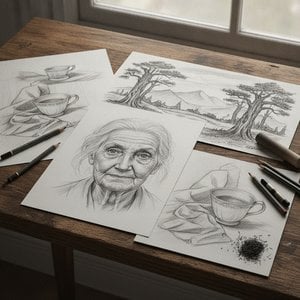
Explore the profound elegance of pencil and charcoal sketching. Discover how masters use line, shadow, and chiaroscuro to capture light and texture, bridging the gap between preparatory studies and timeless fine art masterpieces.
 Preview

 Send
 Share
 Details
 Guide


 Download
 Similars
 X-Ray
 Diaporama
 Q&A

 Stats


 Read More









 Glass option is only available in size under 110 CM


