

Museum-quality giclée or canvas print with fast production and flexible finish options. ( Buy Hand Made Painting Switch to Digital Image)





























Pick from our preset sizes that match the artwork's original proportions.

You may enter your own dimensions to fit a specific frame or space. If your selected size does not match the original image's proportions, we will either crop the artwork or extend the image with a mirrored or solid-fill edge. A digital mockup will be sent for your approval before production begins.
Please note that the on-screen preview does not reflect the actual cropping or extension. Only the mockup will accurately show the final composition.
While custom sizes are available, we recommend selecting a dimension from the predefined list to preserve the original proportions.
Worldwide Delivery () in 2 weeks instead of standard 4/5 weeks. (9 September)


Kühe im Stall
Reproduction Size
Gustav Klimt, a titan of Austrian Symbolism, is perhaps best known for his dazzling portraits and opulent use of gold leaf. However, ‘Kühe im Stall’ (Cows in the Barn) reveals a fascinating departure in his artistic journey – a move towards more grounded, pastoral subjects while retaining his signature expressive style. Painted later in his career, this oil painting offers a glimpse into Klimt's evolving interests and demonstrates his mastery beyond the realm of eroticism and portraiture.
‘Kühe im Stall’ depicts a tranquil barn interior populated by several cows, clustered together in a pen. The scene is bathed in subdued light, likely emanating from an unseen window, creating a sense of intimacy and enclosure. Klimt doesn't present a meticulously detailed representation; instead, he focuses on capturing the *essence* of rural life – the warmth of the animals, the texture of their coats, and the quiet stillness of the barn. The composition is dominated by horizontal lines—the wooden structure of the pen, the ground, and the bodies of the cows themselves—which contribute to a feeling of stability and peaceful containment.
While Klimt famously employed decorative patterns and gold leaf in many of his works, ‘Kühe im Stall’ showcases a more restrained palette and a looser brushstroke. The painting is executed in oil, allowing for rich color blending and textural depth. Klimt's characteristic style shines through in the expressive handling of paint; it isn’t about photographic accuracy but rather an emotional response to the scene. The visible brushwork imbues the canvas with a sense of movement and life, suggesting the gentle shifting of the animals within their enclosure.
Born in 1862, Gustav Klimt was a pivotal figure in the Vienna Secession movement, which rebelled against the conservative artistic establishment. Initially focused on historical and mythological subjects, his work gradually embraced more personal and symbolic themes, often exploring female sensuality. ‘Kühe im Stall’ represents a shift towards simpler, more naturalistic motifs. This change may reflect Klimt's desire to explore different facets of life or perhaps a response to the changing artistic landscape of the early 20th century.
The symbolism within ‘Kühe im Stall’ is subtle yet resonant. Cows, traditionally symbols of nourishment, abundance, and maternal care, evoke themes of rural life, labor, and connection to the land. The barn itself represents shelter, security, and a retreat from the outside world. The painting's muted colors and soft lighting contribute to a mood of quiet contemplation and peaceful serenity. It’s an artwork that invites viewers to slow down and appreciate the simple beauty of everyday life.
‘Kühe im Stall’ is more than just a depiction of cows in a barn; it's a testament to Klimt’s artistic genius and his ability to find beauty and meaning in the ordinary. It stands as a captivating example of his later work, offering a unique perspective on one of art history’s most celebrated masters.


1862 - 1918 , Austria
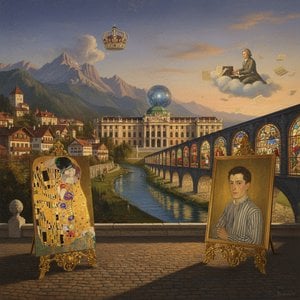
Embark on a sophisticated journey through Austrian art history. Explore the golden brilliance of Gustav Klimt and the elegance of the Vienna Secession through an expert lens, celebrating the enduring soul of Central European masterpieces.

Discover the profound allure of oil on canvas. Explore the mastery of impasto textures, the science of pigment longevity, and expert guides to selecting museum-quality reproductions that elevate your collection with timeless elegance and tactile depth.

Explore the profound impact of the Vienna Secession movement. Discover how visionaries like Gustav Klimt revolutionized modern art through symbolism, gold leaf, and bold ornamentation in this deep dive into the aesthetic revolution that redefined the visual landscape of Europe.

 Preview
 Send
Send Share
Share
 Details

 Download
 Similars
 X-Ray
X-Ray Diaporama
 Stats
Stats
 Read More







 Glass option is only available in size under 110 CM


