

 Oil On CanvasWallArtMannerism
 1591Early Modern
 73.0 x 56.0 cm
Museum-quality giclée or canvas print with fast production and flexible finish options. ( Buy Hand Made Painting Switch to Digital Image)





























Pick from our preset sizes that match the artwork's original proportions.

You may enter your own dimensions to fit a specific frame or space. If your selected size does not match the original image's proportions, we will either crop the artwork or extend the image with a mirrored or solid-fill edge. A digital mockup will be sent for your approval before production begins.
Please note that the on-screen preview does not reflect the actual cropping or extension. Only the mockup will accurately show the final composition.
While custom sizes are available, we recommend selecting a dimension from the predefined list to preserve the original proportions.
Worldwide Delivery () in 2 weeks instead of standard 4/5 weeks. (24 September)


Floral Still LIfe
Reproduction Size
Created in 1591 by Italian Mannerist master Giuseppe Arcimboldo, this captivating work transcends traditional portraiture, presenting a human likeness entirely constructed from an astonishing array of flowers. More than just a visually striking image, it’s a profound meditation on the relationship between humanity and nature, beauty and decay, artifice and reality.
Arcimboldo was renowned for his imaginative and unconventional compositions, and this piece exemplifies his unique style. Departing from the High Renaissance emphasis on idealized form, Mannerism embraced complexity, exaggeration, and a playful distortion of reality. Executed with meticulous detail in oil paint – likely on canvas or wood panel – the artwork showcases Arcimboldo’s exceptional observational skills and technical prowess. Each petal, stem, and leaf is rendered with precision, creating a rich tapestry of texture and color that coalesces into a recognizable human form.
Arcimboldo served as court painter to three generations of Habsburg emperors – Ferdinand I, Maximilian II, and Rudolf II. His work was deeply embedded within the intellectual climate of the time, reflecting an interest in natural history, allegory, and hidden meanings. These “composite portraits” were not merely decorative; they often carried symbolic weight, conveying messages about the emperor’s power, wisdom, or connection to the natural world. While specific interpretations vary, the floral construction can be seen as representing abundance, fertility, and the ephemeral nature of life itself.
The choice of flowers is significant. Beyond their aesthetic appeal, blossoms traditionally symbolize a range of emotions and concepts – love, beauty, fragility, renewal, and even mortality. The slightly melancholic expression hinted at within the floral face adds another layer of complexity, prompting viewers to contemplate the fleeting nature of existence. Arcimboldo’s work invites us to consider how we perceive identity and representation, challenging conventional notions of portraiture.
This artwork evokes a sense of wonder and intrigue. Its unusual composition sparks conversation and encourages close examination, revealing new details with each viewing. The rich color palette – dominated by reds, oranges, yellows, pinks, and purples against a dark background – lends warmth and vibrancy to any space. A reproduction of this iconic work would serve as a captivating focal point in a living room, study, or dining area, adding a touch of historical sophistication and artistic flair. It’s an investment not just in art, but in a conversation starter that celebrates the ingenuity and enduring legacy of Giuseppe Arcimboldo.


1527 - 1593 , Italy
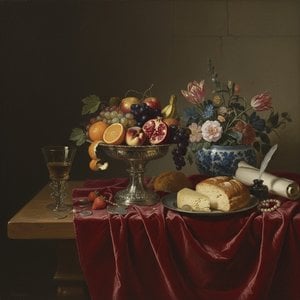
Embark on a sophisticated journey through the history of still life art. From Dutch Golden Age masterpieces to Baroque opulence, explore the profound symbolism and timeless beauty of the world's most exquisite table compositions.

 Preview
 Send
Send Share
Share
 Details
 Guide
Guide

 Download
 Similars
 X-Ray
X-Ray Diaporama
 Stats
Stats Read More







 Glass option is only available in size under 110 CM


