x


 PaintingWallArtHigh Renaissance
 Renaissance
 325.0 x 224.0 cm
 The Louvre
Museum-quality giclée or canvas print with fast production and flexible finish options. ( Buy Hand Made Painting Buy Image)





























Pick from our preset sizes that match the artwork's original proportions.

You may enter your own dimensions to fit a specific frame or space. If your selected size does not match the original image's proportions, we will either crop the artwork or extend the image with a mirrored or solid-fill edge. A digital mockup will be sent for your approval before production begins.
Please note that the on-screen preview does not reflect the actual cropping or extension. Only the mockup will accurately show the final composition.
While custom sizes are available, we recommend selecting a dimension from the predefined list to preserve the original proportions.
Worldwide Delivery () in 2 weeks instead of standard 4/5 weeks. (6 September)


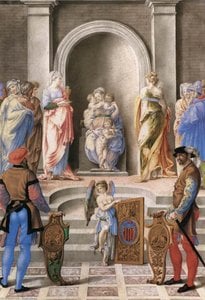
Elymas Struck Blind by St Paul before the Proconsul Sergius Paulus
Reproduction Size
In the grand tapestry of the Italian High Renaissance, few moments possess the visceral tension found in Giulio Clovio’s Elymas Struck Blind by St Paul before the Proconsul Sergius Paulus. This masterpiece serves as a breathtaking window into a moment of profound spiritual upheaval, where the earthly and the divine collide with startling clarity. The scene captures the precise instant of a miracle: the sorcerer Elymas is overcome by sudden darkness, his sight stolen by the righteous authority of Saint Paul. Clovio does not merely illustrate a biblical passage; he orchestrates a drama of light and shadow, positioning the viewer directly within the crowded, breathless atmosphere of Paphos. The composition is alive with movement, as figures react to the divine intervention—some recoiling in awe, others leaning in with suspicion or curiosity—creating a rhythmic energy that pulls the eye across the canvas.
The emotional weight of the piece lies in its ability to convey both terror and transcendence. As St Paul performs his divine act, there is an unmistakable sense of gravity; the air seems thick with the weight of judgment. For the modern collector or lover of classical art, this painting offers more than just a historical narrative; it provides a profound meditation on the power of faith and the vulnerability of human perception. The dramatic interplay between the central figures and the surrounding onlookers creates a psychological depth that makes the scene feel perpetually present, as if the miracle is unfolding for the very first time before our eyes.
Giulio Clovio, often celebrated as the "Michelangelo of the miniature," brought a level of sophistication to this larger-scale work that bridged the delicate precision of manuscript illumination with the monumental grandeur of High Renaissance painting. His technique is characterized by an extraordinary command of detail, where every fold of heavy drapery and every expressive gesture is rendered with meticulous care. Clovical influence is evident in the way he handles light; it does not merely illuminate the scene but acts as a narrative tool, highlighting the divine authority of Paul while casting the shadows of confusion over those caught in the wake of the miracle.
Interestingly, Clovio’s approach to this composition was a brilliant act of artistic dialogue. Drawing inspiration from the monumental tapestry cartoons of Raphael, Clovio chose to deliberately invert the composition. This was not a mere stylistic whim but a calculated move to enhance the immediacy and impact of the biblical story. By reconfiguring the spatial relationships between the Proconsul, the Saint, and the sorcerer, he achieved a sense of arresting intimacy. For interior designers seeking to anchor a room with a piece of significant historical weight, this painting offers a sophisticated balance of complex detail and powerful, singular focus, making it an ideal centerpiece for a gallery-style collection or a stately study.
To behold this work is to understand the zenith of Clovio’s career. Born in Croatia but flourishing under the patronage of Italian cardinals, Clovio infused his works with a unique blend of Gothic intricacy and Renaissance humanism. In Elymas Struck Blind, we see the culmination of this journey—a painting that uses the physical medium of pigment and light to explore the metaphysical concept of spiritual sight. The symbolism is layered; the blinding of Elymas represents the stripping away of worldly deception to reveal a higher truth, a theme that resonates deeply across centuries.
Owning or displaying a high-quality reproduction of this work allows one to bring this era of intense devotion and artistic innovation into a contemporary space. It serves as a conversation starter, an object of contemplation, and a tribute to the enduring power of the Renaissance spirit. Whether placed in a sunlit salon or a quiet library, Clovio’s dramatic depiction continues to command attention, reminding us of the moments in history when the veil between the seen and the unseen was momentarily torn asunder.

Giulio Clovio, born Juraj Julije Klović in 1498 amidst the rolling hills of Grižane, Croatia, stands as a pivotal figure bridging the late Gothic tradition of manuscript illumination with the burgeoning High Renaissance. Though his origins lay within the Kingdom of Croatia, it was in Italy that Clovio’s artistic genius truly blossomed, earning him renown as arguably the greatest illuminator of his era and the last significant master in a lineage stretching back centuries. His story is one of remarkable talent, astute patronage, and an unwavering dedication to transforming the miniature into a breathtakingly sophisticated art form.
The early years of Clovio’s life remain shrouded in some mystery. It's believed he may have received initial artistic training within monastic circles near Rijeka, but by the age of eighteen, his ambition led him to Italy. Entering the household of Cardinal Marino Grimani proved a turning point; here, under the cardinal’s guidance, Clovio honed his skills as a painter and began to develop the meticulous technique that would define his career. He absorbed influences from leading artists of the time—Giulio Romano and Girolamo dai Libri both played roles in shaping his style—but quickly forged his own path, demonstrating an exceptional aptitude for translating the grandeur of Renaissance painting onto a miniature scale.
Clovio’s artistry wasn't merely about replicating existing styles; it was about synthesizing them. He masterfully blended the delicate precision of Northern European illumination with the dynamic compositions and vibrant color palettes characteristic of Italian Renaissance masters like Raphael, Michelangelo, and Titian. This fusion is particularly evident in his illuminated manuscripts, where figures possess a sculptural quality, landscapes recede into atmospheric perspective, and every detail—from the folds of drapery to the glint of jewelry—is rendered with astonishing accuracy.
His work for Cardinal Domenico Grimani, including the exquisitely detailed commentary on St. Paul’s Epistle to the Romans (now housed in the Sir John Soane's Museum), showcased his burgeoning talent and secured his reputation. The miniatures within this manuscript are not simply illustrations; they are miniature paintings in their own right, brimming with narrative power and emotional depth. The conversion of Saint Paul is depicted with a dramatic intensity rarely seen in illuminated manuscripts.
Clovio’s career was inextricably linked to the powerful patrons who recognized his exceptional abilities. Following his time with the Grimani family, he served at the Hungarian court of King Louis II, creating works like “The Judgment of Paris” and “Lucretia.” The king's untimely death at the Battle of Mohács propelled Clovio back to Rome, where he continued to attract influential supporters.
His association with Cardinal Alessandro Farnese proved particularly fruitful. It was for Farnese that Clovio created his magnum opus: the Farnese Hours, a lavishly illuminated book of hours completed in 1546 after nine years of painstaking work. This masterpiece, now residing in the Morgan Library in New York, contains twenty-eight miniatures depicting scenes from both the Old and New Testaments, culminating in a spectacular double-page spread representing the Corpus Christi procession in Rome. The Farnese Hours is not only a testament to Clovio’s technical skill but also a reflection of his deep understanding of Renaissance iconography and theological themes.
Clovio's influence extended beyond the realm of manuscript illumination. He was a respected figure in artistic circles, befriending artists like Pieter Bruegel the Elder—who even contributed a miniature to one of Clovio’s works—and El Greco, who painted several portraits of the master illuminator, placing him alongside Michelangelo, Raphael and Titian as his influences. These portraits serve as powerful visual statements about Clovio's standing within the artistic community.
Though he worked primarily in miniature, Clovio’s impact on Renaissance art was significant. He elevated the status of illumination from a craft to a fine art, demonstrating its potential for expressive power and technical virtuosity. His ability to capture the spirit of the High Renaissance within the confines of a small-scale format ensured his place as one of the most celebrated artists of his time—a Croatian luminary whose legacy continues to illuminate the world of art today.

1498 - 1578 , Croatia

Embark on a journey through time with our deep dive into the exquisite beauty of illuminated manuscripts. Discover the sacred artistry, precious materials, and enduring legacy of medieval illumination in this cultural exploration for history lovers.


Stay updated with the latest art news, exclusive offers, and decoration ideas.
Tell us about your project and our art experts will provide you with 3 personalized art suggestions.
Let Us Curate 3 Options Just for You - Free!

 Preview
 Send
Send Share
Share
 Details

 Download
 Similars
 X-Ray
X-Ray Diaporama
 Read More







 Glass option is only available in size under 110 CM