x


Museum-quality giclée or canvas print with fast production and flexible finish options. ( Buy Hand Made Painting Buy Image)





























Pick from our preset sizes that match the artwork's original proportions.

You may enter your own dimensions to fit a specific frame or space. If your selected size does not match the original image's proportions, we will either crop the artwork or extend the image with a mirrored or solid-fill edge. A digital mockup will be sent for your approval before production begins.
Please note that the on-screen preview does not reflect the actual cropping or extension. Only the mockup will accurately show the final composition.
While custom sizes are available, we recommend selecting a dimension from the predefined list to preserve the original proportions.
Worldwide Delivery () in 2 weeks instead of standard 4/5 weeks. (5 September)


Still life
Reproduction Size
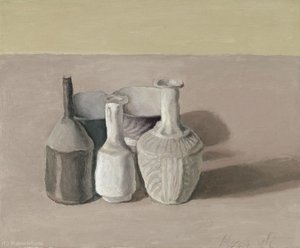
Giorgio Morandi (1890 – 1964) stands as one of the most enduring figures in Italian art, renowned for his deceptively simple yet profoundly resonant still life paintings. Unlike Impressionists or Expressionists who sought to capture fleeting moments of sensation, Morandi pursued a radically different path—one rooted in observation and contemplation, aiming to distill the essence of existence into carefully considered compositions.
Morandi’s artistic vision emerged from a rejection of prevailing trends. Influenced by Cézanne and Cubism, he eschewed dramatic color palettes and dynamic perspectives, opting instead for muted earth tones—beige, brown, gray—that dominate his canvases. This deliberate restraint wasn't merely stylistic; it reflected Morandi’s philosophical stance – a belief that beauty resided in the subtle nuances of everyday life, untouched by grand narratives or emotional outbursts.
His technique was characterized by meticulous layering of thin glazes—a painstaking process that resulted in surfaces imbued with remarkable texture. Morandi’s brushstrokes weren't intended to convey movement or vibrancy but rather to capture the materiality of objects themselves, emphasizing their solidity and permanence. The artist painstakingly recreated the appearance of glass bottles and jars, meticulously rendering their contours and subtle variations in color—a testament to his dedication to capturing visual reality with unwavering precision.
The recurring motif of glass bottles and jars is central to Morandi’s oeuvre. These seemingly unremarkable objects served as conduits for exploring deeper themes – solitude, memory, and the passage of time. As Marilena Pasquali eloquently observed, “Morandi’s bottles are not merely containers; they are vessels of stillness, emblems of a contemplative gaze.” The repetition of these images allowed Morandi to delve into variations of tonal harmony and subtle textural shifts—transforming what might appear as mere replication into an exercise in artistic exploration.
Morandi’s influence extends far beyond the realm of painting. His approach to art – prioritizing observation, restraint, and a profound appreciation for materiality – continues to inspire artists today. He achieved a remarkable feat: transforming commonplace objects into vehicles for conveying complex emotions and philosophical ideas. Giorgio Morandi's enduring legacy lies not in grand gestures or flamboyant displays but in the quiet power of his canvases—a testament to the transformative potential of simplicity and unwavering dedication to artistic truth.


1890 - 1964 , Italy

Explore the profound evolution of Cubist still life, from Cézanne's structural foundations to the fragmented brilliance of Braque and Léger. Discover how geometric abstraction redefined reality through a sophisticated lens of form, color, and modern artistic mastery.


Stay updated with the latest art news, exclusive offers, and decoration ideas.
Tell us about your project and our art experts will provide you with 3 personalized art suggestions.
Let Us Curate 3 Options Just for You - Free!

 Preview
 Send
Send Share
Share
 Details

 Download
 Similars
 X-Ray
X-Ray Diaporama

 Read More







 Glass option is only available in size under 110 CM