
Preview AR preview Buy Hand Made Painting Switch to Digital Image Send
Details Guide Add to favorites Download Similars X-Ray Diaporama Stats

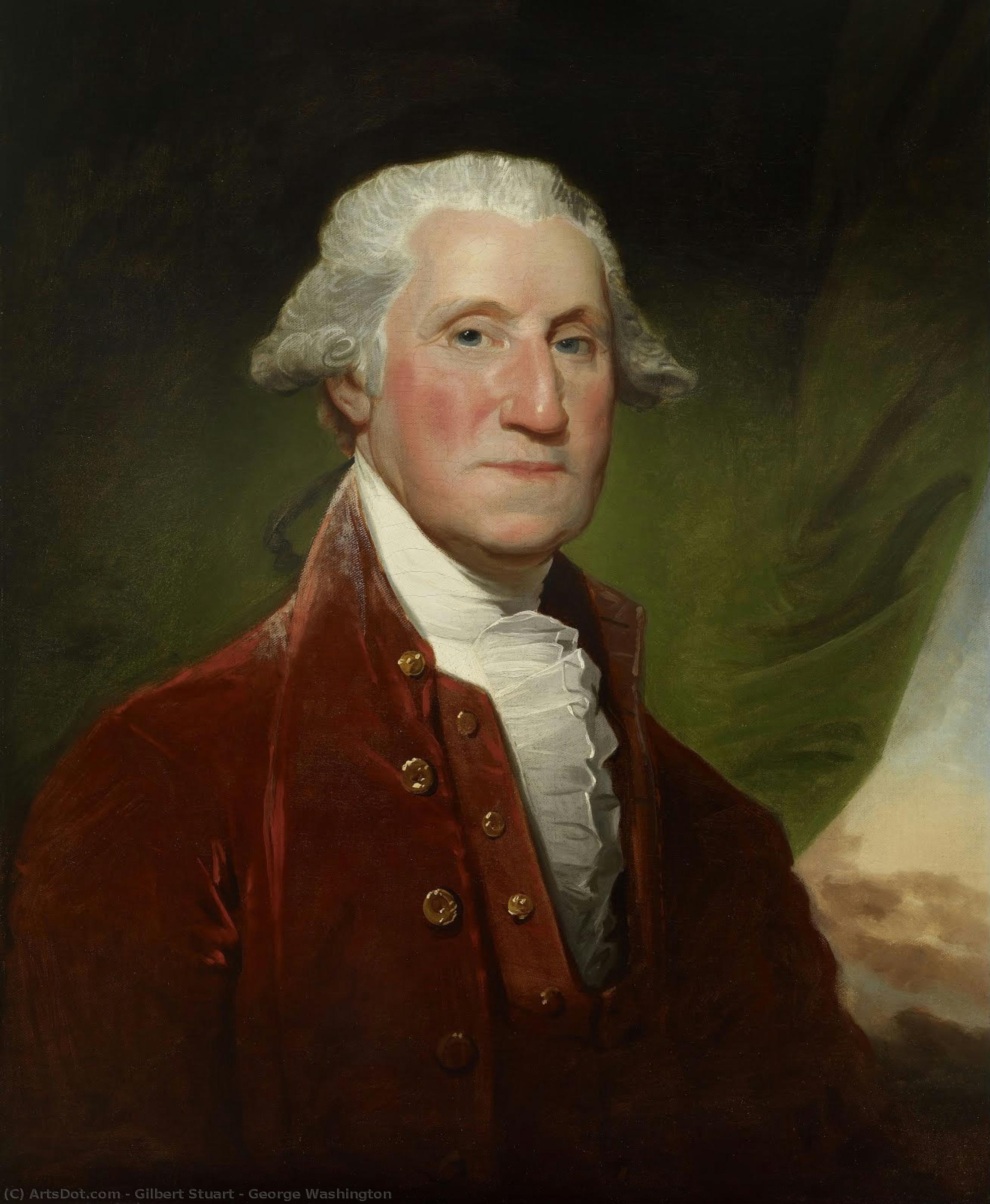
George Washington

Experience Gilbert Stuart's iconic 1796 portrait of George Washington – ‘The Vaughan Type.’ Admire the neoclassical detail and historical significance of this masterpiece, a key piece of American art.

Gilbert Stuart (1755-1828): America's foremost portraitist! Explore his Neoclassical style, iconic Washington image on the dollar bill & legacy in American art.

Giclée / Art Print

Museum-quality giclée or canvas print with fast production and flexible finish options. ( Buy Hand Made Painting Switch to Digital Image)

Corner sample of the P118B picture frame: moulded polystyrene, 5 cm wide and 3 cm thick
P118B $10
Corner sample of the P118H picture frame: moulded polystyrene, 5 cm wide and 3 cm thick
P118H $10
Corner sample of the P118W picture frame: moulded polystyrene, 5 cm wide and 3 cm thick
P118W $10
Corner sample of the P438Z picture frame: moulded polystyrene, 5.5 cm wide and 3.5 cm thick
P438Z $10
Corner sample of the P508JH picture frame: moulded polystyrene, 7 cm wide and 3.5 cm thick
P508JH $12
Corner sample of the P508YH picture frame: moulded polystyrene, 7 cm wide and 3.5 cm thick
P508YH $12
Corner sample of the P805H picture frame: moulded polystyrene, 5 cm wide and 3.5 cm thick
P805H $10
Corner sample of the P805Z picture frame: moulded polystyrene, 5 cm wide and 3.5 cm thick
P805Z $10
Corner sample of the P919BZ picture frame: moulded polystyrene, 7 cm wide and 3.5 cm thick
P919BZ $10
Corner sample of the P919G picture frame: moulded polystyrene, 7 cm wide and 3.5 cm thick
P919G $10
Corner sample of the P919XJ picture frame: moulded polystyrene, 7 cm wide and 3.5 cm thick
P919XJ $10
Corner sample of the P959ZH picture frame: moulded polystyrene, 5 cm wide and 3 cm thick
P959ZH $10
Corner sample of the P968JZ picture frame: moulded polystyrene, 6 cm wide and 4 cm thick
P968JZ $12
Corner sample of the W106C picture frame: solid wood, 5 cm wide and 3 cm thick
W106C $8
Corner sample of the W218G picture frame: solid wood, 5 cm wide and 3 cm thick
W218G $10
Corner sample of the W218JH picture frame: solid wood, 5 cm wide and 3 cm thick
W218JH $8
Corner sample of the W218Y picture frame: solid wood, 5 cm wide and 3 cm thick
W218Y $10
Corner sample of the W307PJ picture frame: solid wood, 6 cm wide and 3 cm thick
W307PJ $10
Corner sample of the W316G picture frame: solid wood, 6 cm wide and 3 cm thick
W316G $10
Corner sample of the W316PJ picture frame: solid wood, 6 cm wide and 3 cm thick
W316PJ $8
Corner sample of the W316Y picture frame: solid wood, 6 cm wide and 3 cm thick
W316Y $10
Corner sample of the W398PJ picture frame: solid wood, 5 cm wide and 3 cm thick
W398PJ $8
Corner sample of the W4111J picture frame: solid wood, 6.5 cm wide and 3.5 cm thick
W4111J $10
Corner sample of the W500HY picture frame: solid wood, 7 cm wide and 5 cm thick
W500HY $15
Corner sample of the W500JH picture frame: solid wood, 7 cm wide and 5 cm thick
W500JH $15
Corner sample of the W692G picture frame: solid wood, 8 cm wide and 4 cm thick
W692G $12
Corner sample of the W849H picture frame: solid wood, 5 cm wide and 3 cm thick
W849H $8
Corner sample of the W940BG picture frame: solid wood, 7.5 cm wide and 4.5 cm thick
W940BG $15
Corner sample of the W953PJ picture frame: solid wood, 6 cm wide and 3.5 cm thick
W953PJ $8

Standard
custom
CM
INCH

Pick from our preset sizes that match the artwork's original proportions.

width
height

You may enter your own dimensions to fit a specific frame or space. If your selected size does not match the original image's proportions, we will either crop the artwork or extend the image with a mirrored or solid-fill edge. A digital mockup will be sent for your approval before production begins.
Please note that the on-screen preview does not reflect the actual cropping or extension. Only the mockup will accurately show the final composition.
While custom sizes are available, we recommend selecting a dimension from the predefined list to preserve the original proportions.

Worldwide Delivery () in 2 weeks instead of standard 4/5 weeks. (13 October)

Free Worldwide Express Shipping
High-Quality Linen Canvas
Full Shipping Insurance
Customs Tax Refund Guarantee
True Color Matching Guarantee
100-Day Return Policy (Defects Only)
100% Money-Back Guarantee
Bulk Discount Offer

Total Price

$ 69

George Washington

Giclée / Art Print

Reproduction Size

-

Total Price

$ 69

Quick Facts

  • Artistic style: Portraiture
  • Medium: Oil on canvas
  • Influences:
    • Romney
    • Hoppner
  • Location: Frick Collection, NYC
  • Title: George Washington
  • Subject or theme: Presidential portrait

The Weight of Authority: Gilbert Stuart’s “George Washington”

Gilbert Stuart's "George Washington," painted in 1796, isn’t merely a portrait; it’s a carefully constructed embodiment of the nascent American republic. This remarkable work, now housed within the Frick Collection in New York City, transcends the simple act of representation and delves into the very essence of leadership, virtue, and the weighty responsibility of guiding a new nation. Stuart, a master of his craft, skillfully captures Washington’s dignified presence, imbuing him with an aura of both strength and quiet contemplation – qualities desperately needed in the years following the Revolutionary War.

The painting itself is a testament to Stuart's Neoclassical training, evident in its balanced composition and restrained palette. The muted tones of brown, gray, and green create a sense of gravitas, drawing the viewer’s eye directly to Washington’s face – a study in subtle expressions that convey both resolve and humility. The artist meticulously rendered every detail, from the texture of the fabric of his coat to the delicate lines etched by time around his eyes, revealing an almost obsessive attention to realism. Yet, it's not a literal depiction; Stuart employs chiaroscuro—the dramatic contrast between light and shadow—to sculpt Washington’s form and emphasize his importance within the scene.

A Portrait of a Nation Forged in Virtue

The historical context surrounding “George Washington” is crucial to understanding its significance. Painted just a few years after the end of the Revolutionary War, the portrait coincided with a fervent desire to establish a stable and virtuous government. Stuart’s decision to portray Washington in a formal, three-quarter pose – a departure from earlier, more informal depictions – immediately elevates him to the status of an ideal statesman. The red coat, a symbol of military honor, subtly references his role as commander-in-chief, while the white collar and cravat speak to his adherence to social decorum and respect for tradition.

Interestingly, this particular version – often referred to as the “Vaughan type” – differs slightly from other known portraits of Washington. The subtle shift in the color of the coat is a key distinguishing feature, suggesting that Stuart may have been experimenting with his technique or responding to specific requests from John Vaughan, one of the painting’s patrons. The background, a simple yet evocative landscape, reinforces the idea of Washington as a man deeply connected to the land and its future.

Symbolism Woven into the Canvas

Beyond the obvious symbolism of military rank and civic virtue, “George Washington” is rich with subtle visual cues. The careful arrangement of his hands – one resting on a book, a symbol of knowledge and wisdom, and the other holding a quill pen, representing his role as a writer and communicator – speaks to his commitment to education and informed governance. The slight furrow in his brow suggests a thoughtful consideration of the challenges facing the new nation, while his steady gaze conveys an unwavering determination to uphold its ideals.

Furthermore, the painting’s scale—measuring 74 x 61 cm—contributes to its impact. It's large enough to command attention and invite prolonged contemplation, reflecting the monumental task of building a new nation. The portrait wasn’t simply intended as a likeness; it was designed to inspire confidence and instill a sense of shared purpose within the American populace.

A Timeless Legacy for Art & Design

Gilbert Stuart's “George Washington” remains an enduring masterpiece, admired for its technical brilliance, historical significance, and profound emotional resonance. It’s a painting that speaks to the ideals upon which America was founded – liberty, justice, and self-governance – and continues to captivate viewers centuries later. Today, high-quality reproductions of this iconic portrait offer art enthusiasts and interior designers alike an opportunity to bring a touch of American history and enduring artistic excellence into their homes or offices. The painting’s dignified presence and subtle complexities make it a truly timeless addition to any collection.

Questions & Answers

What color harmony does "George Washington" by Gilbert Stuart display?

The color harmony of "George Washington" is recorded as softly mixed palette.

What technique was used for "George Washington", and when was it created?

"George Washington" was made in 1796, in acrylic on canvas.

At what size is "George Washington" suggested for a living room?

In a living room, "George Washington" is suggested at a large print size.

What technique and style characterize "George Washington" by Gilbert Stuart?

"George Washington" by Gilbert Stuart combines the acrylic on canvas technique with the Neoclassical Portraiture style. Technique and movement describe the making and the style of the work.

Can I use augmented reality to see "George Washington" by Gilbert Stuart in my room?

"George Washington" by Gilbert Stuart can be previewed on your own wall with the artwork's AR Preview page, using augmented reality on a compatible device.

How strong is the contrast in "George Washington" by Gilbert Stuart?

The contrast level of "George Washington" by Gilbert Stuart is gentle.

How do the colors of "George Washington" by Gilbert Stuart relate to its emotion?

The earthy palette of "George Washington" by Gilbert Stuart goes together with its reflective emotional tone. Color is one of the ways a work conveys feeling.

How can "George Washington" by Gilbert Stuart be used in home decor?

Use (statement) and space (living room) are the two recommendations recorded for "George Washington" by Gilbert Stuart.


Artist Biography

Gilbert Stuart: A Life in Portraiture

  • Born: December 3, 1755, Saunderstown, Rhode Island
  • Died: July 9, 1828, Boston, Massachusetts
  • Nationality: American
  • Movement: Neoclassicism
  • Known for: Portraiture, particularly portraits of prominent figures in early American history.

Early Life and Training

  • Gilbert Stuart was born into a family with Scottish roots; his father, also named Gilbert, was an inventor who established the first snuff mill in Rhode Island.
  • His artistic talent emerged at a young age, demonstrating skill even as a child.
  • At 14, he painted "Dr. Hunter's Spaniels," showcasing early promise.
  • He traveled to Scotland around 1771 to study under Cosmo Alexander, but returned after Alexander’s death in 1775.
  • Further training occurred in London with Benjamin West, a prominent American painter residing in England, from 1775 to 1780. This period was crucial for developing his artistic style and gaining recognition within the Royal Academy.

Artistic Career and Major Works

  • Stuart's career faced challenges during the American Revolution, prompting him to relocate to England in 1775.
  • He achieved early success with "The Skater" (1782), a portrait that established his reputation.
  • His most famous work is the unfinished portrait of George Washington, known as the Athenaeum Portrait (begun in 1796). This image has become iconic, appearing on U.S. currency and postage stamps. Stuart produced numerous copies of this portrait for patrons across America and Europe.
  • He painted portraits of several other prominent figures including John Adams, Thomas Jefferson, James Madison, and many members of the Federalist elite.
  • Stuart’s style was characterized by a Neoclassical approach, emphasizing realism and capturing the likeness and character of his subjects. He often employed a dramatic use of light and shadow to enhance the portraits' impact.

Influences and Development

  • Cosmo Alexander provided early training in technique and composition.
  • Benjamin West’s influence was significant, shaping Stuart’s understanding of portraiture and artistic principles.
  • The Neoclassical movement, with its emphasis on classical forms and ideals, heavily influenced his style.
  • Stuart's own observations and interactions with his subjects contributed to the psychological depth and realism in his portraits. He aimed to capture not just a likeness but also the character and personality of those he painted.

Historical Significance and Legacy

  • Gilbert Stuart is considered one of America’s foremost portraitists, playing a vital role in documenting the early years of the United States.
  • The Athenaeum Portrait of George Washington has become an enduring symbol of American identity and leadership.
  • His portraits provide valuable historical insights into the lives and appearances of prominent figures from the late 18th and early 19th centuries.
  • Stuart’s work is represented in major museums across the United States and Europe, ensuring his legacy continues to be appreciated by generations.
  • He established a distinct American style of portraiture that blended European techniques with uniquely American sensibilities.
Gilbert Stuart

Gilbert Stuart

1755 - 1828 , United Kingdom

Quick Facts

  • Full Name: Gilbert Charles Stuart
  • Nationality: American
  • Date Of Birth: 1755
  • Date Of Death: 1828
  • Place Of Birth: Southampton, United Kingdom
  • Notable Artworks:
    • Dr. Hunter's Spaniels
    • The Skater
    • Athenaeum Portrait of Washington
  • Artistic Movement Or Style: Neoclassical
  • Artists Who Influenced This Artist:
    • Cosmo Alexander
    • Benjamin West
Explore artworks organized by themes, styles, and characteristics.


































